Arabic Letters: The Connecting Forms
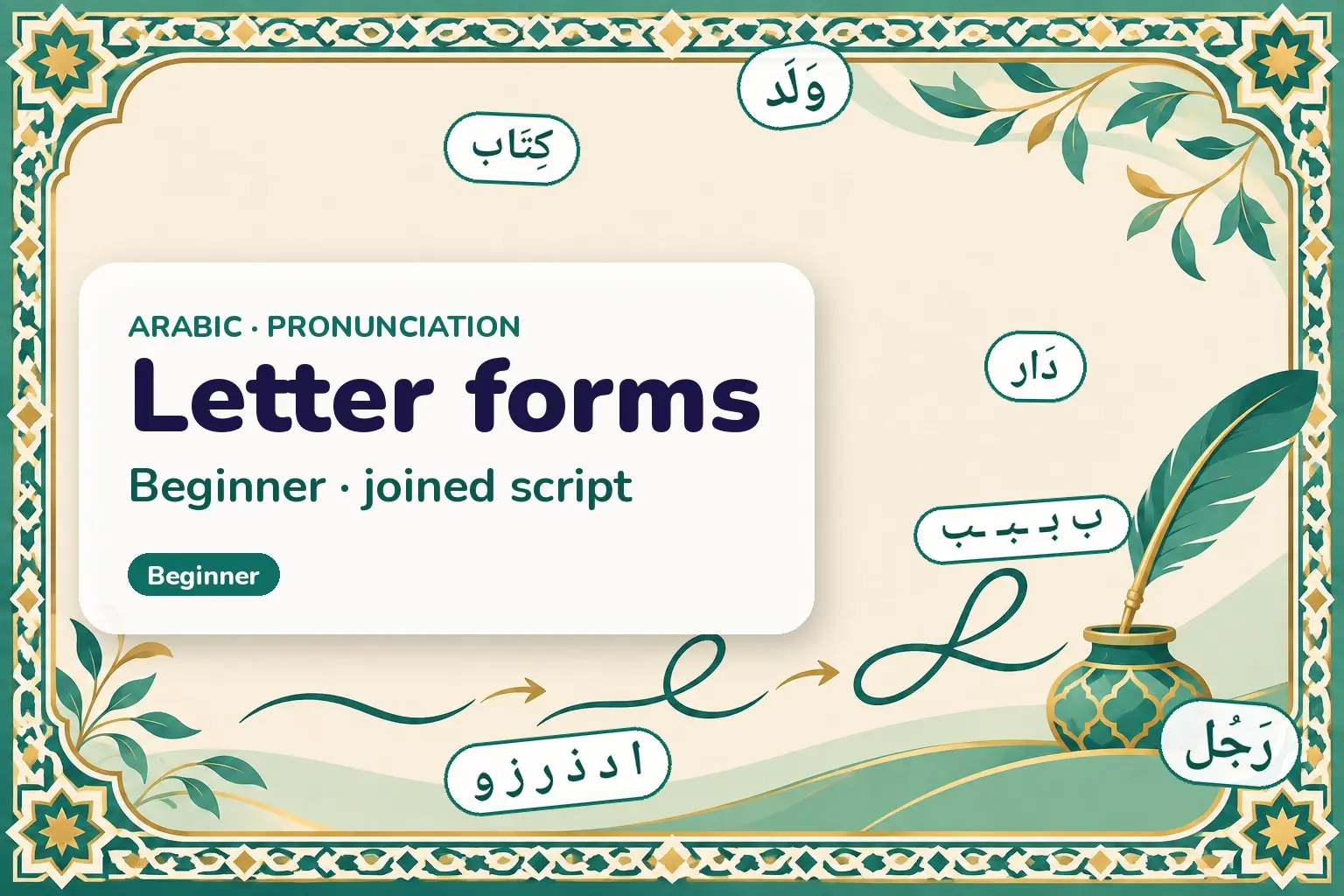
Most Arabic letters change shape by position in a word — isolated, initial, medial, or final — because the script is joined (cursive). Six letters, ا د ذ ر ز و, connect only on their right, leaving a small break.
Level: beginner. Arabic is written in a joined, cursive script, so letters link up into one connected shape — much like English handwriting. Because they join, most letters change shape depending on where they sit in the word. The good news: it is the same letter each time, with the same dots; only the connecting strokes change.
Why letters change shape
Arabic has no “print” style with separate blocks; every letter reaches out to join its neighbours. A single letter can therefore take up to four shapes:
- isolated — on its own, not joined to anything: ب (bāʾ).
- initial — at the start of a joined group, joining to the left: بـ (bāʾ initial).
- medial — in the middle, joined on both sides: ـبـ (bāʾ medial).
- final — at the end, joining only on the right: ـب (bāʾ final).
The core of the letter — the tooth of ب (bāʾ), the dots, the loop of م (mīm) — stays the same. What changes is the little tail or connector. Once you learn to see past the connectors, the letter is easy to recognise.
One letter, four positions
Each row shows the same letter in all four shapes. The dash shows where the letter joins.
| Letter | Isolated | Initial | Medial | Final | Reading |
|---|---|---|---|---|---|
| bāʾ | ب | بـ | ـبـ | ـب | bāʾ (b) |
| ʿayn | ع | عـ | ـعـ | ـع | ʿayn |
| hāʾ | ه | هـ | ـهـ | ـه | hāʾ |
| mīm | م | مـ | ـمـ | ـم | mīm |
| kāf | ك | كـ | ـكـ | ـك | kāf (k) |
Notice how ع (ʿayn) and ه (hāʾ) change the most between positions, while others change only a little.
The six non-connecting letters
Six letters are special: they join to the letter before them (on their right) but never to the letter after them. They are ا د ذ ر ز و (alif, dāl, dhāl, rāʾ, zāy, wāw). After one of these, the next letter has to start fresh, so the word shows a small gap.
Take دَار (dār, “house”): the د (dāl) does not join the ا (alif), and the ا (alif) does not join forward either, so the word looks like separate pieces. In وَلَد (walad, “boy”), the و (wāw) at the start refuses to join the letter after it. This is normal — it is not a mistake or a space.
Letters and words in action
- بbāʾ (b)the letter b, isolated
- بَيْتbaythouse — b joins forward to the next letter
- كَتَبَkatabahe wrote — k, t, b all join in a row
- مَكْتَبmaktaboffice — note the medial forms joined on both sides
- مُدَرِّسmudarristeacher — several letters joined together
- بِنْتbintgirl — b and n join, t takes a final form
- وَلَدwaladboy — و (wāw) will not join the next letter
- دَارdārhouse — د and ا both refuse to join forward
- رَجُلrajulman — ر (rāʾ) does not join to the left
- زَهْرَةzahraflower — ز (zāy) leaves a gap after it
- ذَهَبdhahabgold — ذ (dhāl) does not join forward
- قَمَرqamarmoon — q joins, then ر breaks
- سَلَامsalāmpeace — s and l join; ا does not join forward
- جَمِيلjamīlbeautiful — j, m, y, l joined in a chain
- شَمْسshamssun — sh, m, s each take their joined shapes
How to read the gaps
When you meet a new word, scan it right to left and look for the six right-only letters. Each one tells you “the chain breaks here, but the word continues”. With practice your eye stops treating those breaks as word boundaries, and reading speeds up.
Practice
Arabic letter forms practice
Try each one, then press Check. No sign-up, nothing is sent anywhere — it all runs in your browser.
3 Match each position to its description.
- isolated
- initial
- medial
- final
Show answer
- isolated → stands alone, not joined
- initial → joins to the left only
- medial → joined on both sides
- final → joins to the right only
Position controls which side the letter joins.
Hint: the opposite of a gap between words
Show answer
word — The six right-only letters leave a gap, but the word continues.
Where to go next
Now that you can see how letters join, train the sounds in the Arabic pronunciation overview, review how the whole system works in the Arabic script and abjad, then meet the definite article ال (al-). New here? Start at Start Learning Arabic Here.
Quiz
Arabic connecting forms quiz
10 questions · pick an answer and you'll see straight away if it's right.
-
Show answer
because the script is joined (cursive) — Letters join their neighbours, so their shape depends on position.
-
Show answer
isolated, initial, medial, final — Isolated, initial, medial and final.
-
Show answer
on both sides — A medial letter sits in the middle, joined on both sides.
-
Show answer
six — Six: ا د ذ ر ز و (alif, dāl, dhāl, rāʾ, zāy, wāw).
-
Show answer
ر (rāʾ) — ر (rāʾ) joins only on its right, never to the next letter.
-
Show answer
the word continues; wāw just doesn't join forward — The six right-only letters leave a gap but the word continues.
-
Show answer
the body and dots — The skeleton — body and dots — is the same; only connectors change.
-
Show answer
do not join forward (د (dāl) and ا (alif) are right-only) — Both د (dāl) and ا (alif) are non-connecting, so the word shows gaps.
-
Show answer
to the left only — An initial letter starts a group and joins to the left (the next letter).
-
Show answer
four shapes — Knowing all four shapes lets you recognise the letter anywhere in a word.
All Arabic pronunciation & writing topics
Vocabulary, pronunciation, phrases, practice and exam help, ordered by level. Pick a topic and go straight to it. New lessons go live every day, so topics marked Coming soon fill in over the next weeks.
Pronunciation & writing
Beginner 10 topics · 7 ready
- 01 Arabic Pronunciation Overview
- 02 The Arabic Script & Abjad
- 03 Arabic Letters: Connecting Forms You are here
- 04 Harakat: Short Vowels & Sukun
- 05 Arabic Long Vowels (alif, waw, ya)
- 06 Sun & Moon Letters
- 07 Ta Marbuta & Alif Maqsura
- 08 Arabic Handwriting & Numerals Coming soon
- 09 How to Type Arabic (Keyboard Guide) Coming soon
- 10 Arabic Transliteration Systems & Limits Coming soon
Elementary 2 topics · 2 ready
Intermediate 1 topics
- 13 Reading Arabic Without Vowels Coming soon