The Arabic Script & Abjad: How It Works
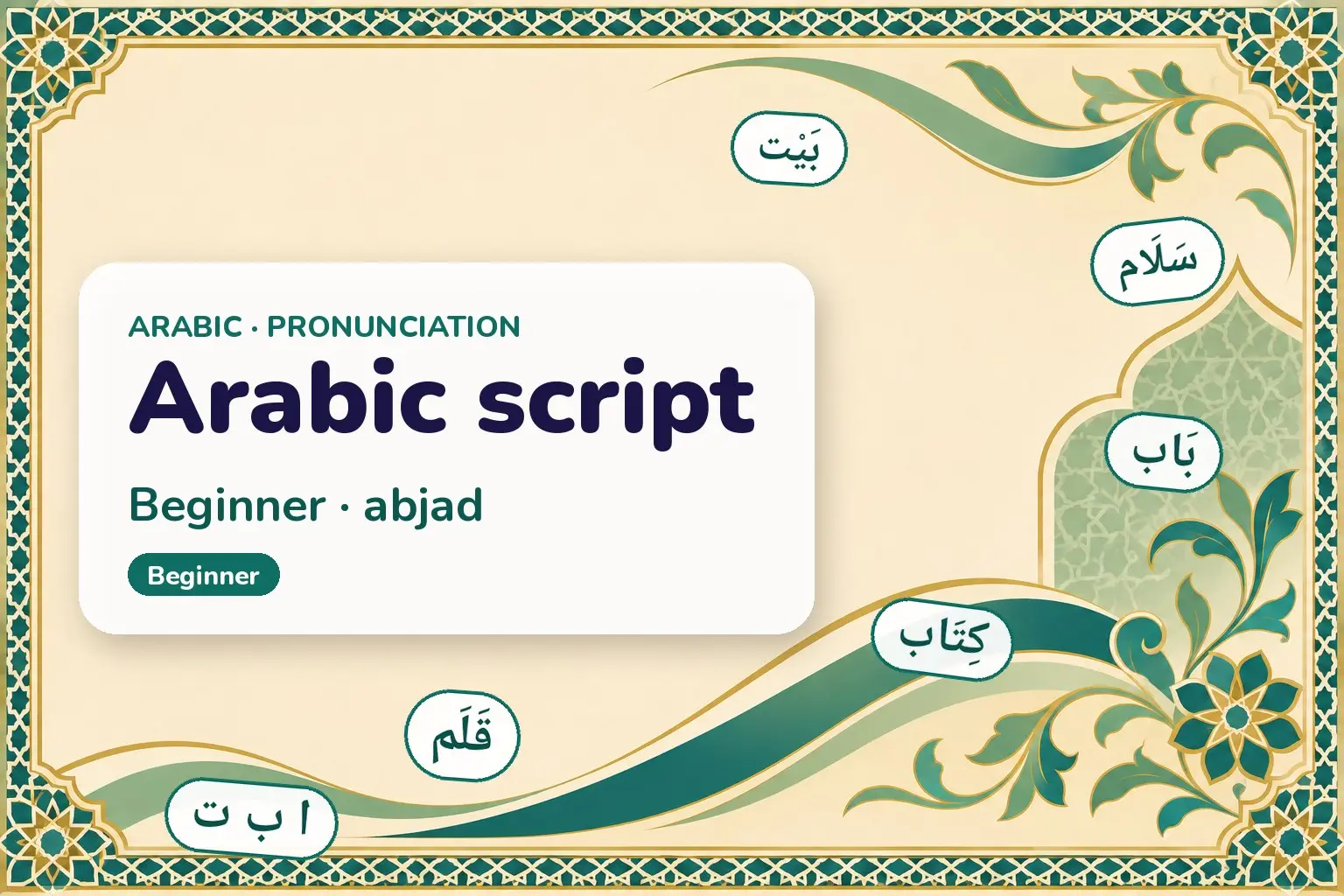
Arabic is written right to left in a joined, cursive script of 28 letters. It is an abjad: the letters stand mainly for consonants and long vowels, while short vowels are shown by optional marks called harakat and are usually left out in everyday text.
Level: beginner. Before any grammar, you need to read the letters. Arabic uses a 28-letter script written right to left, in joined, flowing shapes. It is an abjad, which means the letters mostly write the consonants, and the short vowels are added as small marks only when needed.
What an abjad is
An abjad is a writing system in which each letter stands mainly for a consonant (a sound like b, t, k). The short vowels — the a, i, u sounds between consonants — are not full letters. Compare that with the Latin alphabet you are reading now, where a, e, i, o, u are letters in their own right.
In practice, the three long vowels do get written, using the letters ا (alif, long ā), و (wāw, long ū) and ي (yāʾ, long ī). It is the short vowels that are usually left out. A reader fills them in from knowing the word — much as an English reader can still read “wrd” as “word”.
Reading right to left, in joined letters
Arabic runs right to left: you start at the right edge of the line and move left. Within a word, most letters join to the next one, like English handwriting, so a word is a connected shape rather than separate blocks.
Because letters join, a single letter has up to four shapes depending on where it sits: on its own (isolated), at the start of a word (initial), in the middle (medial) and at the end (final). The core identity of the letter is the same; only the connecting strokes change.
Six letters are exceptions that only connect on their right side — ا د ذ ر ز و (alif, dāl, dhāl, rāʾ, zāy, wāw). They link to the letter before them but never to the letter after, so they leave a small break in the word.
Short vowels: the harakat
The optional vowel marks are called harakat. The main ones sit above or below a consonant:
- fatḥa — a small stroke above, a short a: بَ (ba).
- kasra — a small stroke below, a short i: بِ (bi).
- ḍamma — a small loop above, a short u: بُ (bu).
- sukūn — a small circle above, meaning “no vowel here”: بْ (b).
- shadda — a mark meaning the consonant is doubled: بّ (bb).
There is also tanwīn, a doubling of the final short vowel that adds an -n sound and marks an indefinite noun: كِتَابٌ (kitābun, “a book”). You will see all of these in this course’s examples, which are fully vowelled to help you learn.
The script at a glance
| Feature | Arabic | What it means |
|---|---|---|
| direction | right to left | start at the right, read leftwards |
| letters | 28 | all consonants (plus long vowels) |
| joining | cursive | most letters connect; shapes change by position |
| long vowels | ا و ي (alif, wāw, yāʾ) | these are written as letters |
| short vowels | harakat marks | optional, usually left off |
Letters and words in action
- اalif (ā)first letter; also the long a vowel
- بbāʾ (b)the letter b
- تtāʾ (t)the letter t
- مmīm (m)the letter m
- كkāf (k)the letter k
- كِتَابkitābbook — three consonants k-t-b with vowels added
- بَابbābdoor — note the long ā (alif)
- بَيْتbaythouse
- قَلَمqalampen
- سَلَامsalāmpeace — a common greeting word
- شُكْرًاshukranthank you — the -an ending is tanwīn
- كَتَبَkatabahe wrote — same k-t-b, short a vowels
- كُتُبkutubbooks — same k-t-b, u vowels
- مَكْتَبmaktaboffice/desk — also from k-t-b
Practice
Arabic script practice
Try each one, then press Check. No sign-up, nothing is sent anywhere — it all runs in your browser.
3 Match each vowel mark to its sound.
- fatḥa
- kasra
- ḍamma
- sukūn
Show answer
- fatḥa → short a
- kasra → short i
- ḍamma → short u
- sukūn → no vowel
fatḥa a, kasra i, ḍamma u, sukūn means no vowel.
Hint: between 26 and 30
Show answer
28 — The Arabic script has 28 letters.
Where to go next
Now that you can see how the script works, train the sounds themselves in the Arabic pronunciation overview, then meet the article that attaches to nouns, The Arabic Definite Article ال (al-), and browse the Arabic grammar section. New here? Start at Start Learning Arabic Here.
Quiz
The Arabic script and abjad quiz
10 questions · pick an answer and you'll see straight away if it's right.
-
Show answer
28 — There are 28 letters.
-
Show answer
right to left — Right to left.
-
Show answer
consonants — Consonants (plus long vowels); short vowels are optional marks.
-
Show answer
harakat — Harakat: fatḥa, kasra, ḍamma, sukūn, shadda, tanwīn.
-
Show answer
ا و ي (alif, wāw, yāʾ) — ا و ي (alif, wāw, yāʾ) carry the long vowels ā, ū, ī.
-
Show answer
up to four — Isolated, initial, medial and final — up to four shapes.
-
Show answer
no, there is no upper/lowercase — Arabic makes no capital/small distinction.
-
Show answer
consonants (k, t, b) — Same consonants k-t-b; the short vowels differ.
-
Show answer
usually left out — Everyday text omits them; learners' books and the Quran show them.
-
Show answer
left to right — Numerals run left to right even within right-to-left text.
All Arabic pronunciation & writing topics
Vocabulary, pronunciation, phrases, practice and exam help, ordered by level. Pick a topic and go straight to it. New lessons go live every day, so topics marked Coming soon fill in over the next weeks.
Pronunciation & writing
Beginner 10 topics · 2 ready
- 01 Arabic Pronunciation Overview
- 02 The Arabic Script & Abjad You are here
- 03 Arabic Letters: Connecting Forms Coming soon
- 04 Harakat: Short Vowels & Sukun Coming soon
- 05 Arabic Long Vowels (alif, waw, ya) Coming soon
- 06 Sun & Moon Letters Coming soon
- 07 Ta Marbuta & Alif Maqsura Coming soon
- 08 Arabic Handwriting & Numerals Coming soon
- 09 How to Type Arabic (Keyboard Guide) Coming soon
- 10 Arabic Transliteration Systems & Limits Coming soon
Elementary 2 topics
- 11 Arabic Emphatic & Throat Letters Coming soon
- 12 Hamza & Its Seats Coming soon
Intermediate 1 topics
- 13 Reading Arabic Without Vowels Coming soon