Arabic Handwriting & Numerals
Arabic joins most letters in cursive, so each letter has up to four shapes. Six letters — ا د ذ ر ز و (alif, dāl, dhāl, rāʾ, zāy, wāw) — never join forward. The numerals are written left to right inside the number.
Level: Beginner. Arabic letters are not printed one by one like Latin letters: most of them hold hands with their neighbours and change outline to do it. Two things make handwriting manageable — the four positional shapes of a letter, and the small group of letters that refuse to hold hands forward. The numerals are the easy part: ten shapes, running in the direction you already expect.
One letter, up to four shapes
Arabic runs right to left, so the first letter of a word sits on the right edge and the word grows leftwards. Most letters are cursive: they link to the letter before them (on their right) and to the letter after them (on their left). A letter has a different outline depending on what it is touching:
- Isolated — the letter stands alone, or follows one of the six non-connectors.
- Initial — it opens a word and links forward.
- Medial — it is held by both neighbours.
- Final — it closes a word and links backward only.
Only the skeleton changes. The dots above and below stay put, and they are the real identity of the letter: ب (bāʾ) has one dot below, ت (tāʾ) two above, ث (thāʾ) three above, ن (nūn) one above, ي (yāʾ) two below. In fast handwriting the bodies of these letters look almost alike; the dots do the talking.
The forms at a glance
| Letter | Name | Reading | Isolated | Initial | Medial | Final |
|---|---|---|---|---|---|---|
| ب | باء | bāʾ | ب | بـ | ـبـ | ـب |
| ت | تاء | tāʾ | ت | تـ | ـتـ | ـت |
| ن | نون | nūn | ن | نـ | ـنـ | ـن |
| ك | كاف | kāf | ك | كـ | ـكـ | ـك |
| م | ميم | mīm | م | مـ | ـمـ | ـم |
| ه | هاء | hāʾ | ه | هـ | ـهـ | ـه |
The small stroke ـ (kashida, also called tatweel) is not a letter. It is a stretcher: typists drop it in to even out a line, as in رَحْمَـٰن (raḥmān). Never insert it inside a word on an exam or a form — write the letters and let the joins do the work.
The six letters that never join forward
Six letters have only two shapes each, isolated and final. They connect to the letter before them and then stop:
| Letter | Name | Reading | Joins backward | Joins forward |
|---|---|---|---|---|
| ا | ألف | alif | yes | no |
| د | دال | dāl | yes | no |
| ذ | ذال | dhāl | yes | no |
| ر | راء | rāʾ | yes | no |
| ز | زاي | zāy | yes | no |
| و | واو | wāw | yes | no |
Two more shapes behave the same way for their own reasons. ة (tāʾ marbūṭa) only ever appears at the end of a word, so it has no initial or medial form: مَدْرَسَة (madrasa, school). ء (hamza) does not join at all — it is written as a separate small sign and breaks the chain on both sides, as in شَيْء (shayʾ, thing).
The practical consequence: دَار (dār, house) is written as two joined pieces, د (dāl) then ا (alif) joined to ر (rāʾ). بَاب (bāb, door) is ب (bāʾ) joined to ا (alif), then a fresh ب (bāʾ). Count the breaks and the word almost writes itself.
The Eastern Arabic numerals
The digits used across most of the Arab east are these:
| Digit | Value | Name | Reading | Shape note |
|---|---|---|---|---|
| ٠ | 0 | صفر | ṣifr | a single dot |
| ١ | 1 | واحد | wāḥid | a vertical stroke |
| ٢ | 2 | اثنان | ithnān | like a mirrored 2 |
| ٣ | 3 | ثلاثة | thalātha | two teeth and a tail |
| ٤ | 4 | أربعة | arbaʿa | like a reversed 3 |
| ٥ | 5 | خمسة | khamsa | a circle — the shape Westerners read as 0 |
| ٦ | 6 | ستة | sitta | like a 7 |
| ٧ | 7 | سبعة | sabʿa | like a V |
| ٨ | 8 | ثمانية | thamāniya | like an inverted V |
| ٩ | 9 | تسعة | tisʿa | like a 9 |
Two traps come out of that table. ٥ (khamsa) is five, though it looks like a zero; ٦ (sitta) is six, though it looks like a seven. Read the digit as part of the number rather than as a shape, and the confusion stops.
The direction is friendlier than the shapes. Inside a number the digits run left to right, with the units on the right — the order you already use. What feels strange is only the mix: the words around the number move right to left, the number itself runs the other way, and a year written in Eastern digits sits inside an Arabic sentence as a left-to-right island.
Regional variation is real and worth recognising rather than resolving. In Morocco, Algeria and Tunisia everyday writing uses the Western digits 0–9; the Eastern forms above are the norm in Egypt, the Levant, Iraq and the Gulf. Persian and Urdu add their own variants of ٤ (arbaʿa), ٥ (khamsa) and ٦ (sitta), so a newspaper from Tehran may not match a form printed in Cairo.
Handwriting habits that keep it readable
- Stay on the baseline. Arabic letters sit on an imaginary line; ب (bāʾ), ت (tāʾ) and their family are teeth on that line, not floating shapes.
- Keep the dots decisive. One dot, two dots, three dots — placed directly above or below the letter body, not drifting into the next word.
- Pick a style and stay in it. Textbooks print naskh, the clear style with full curves. Everyday handwriting in much of the Arab world is ruqʿa, smaller and faster, with many letter bodies simplified. Learn to read both; write naskh first.
- Do not break a join by accident. A pen lift inside a join is what turns كِتَاب (kitāb) into something a reader has to guess at.
Example sentences
Each sentence was written for this lesson. Play the audio and watch where the joins break.
- بَابbābdoorب joins forward; ا never does
- دَارdārhouse, homeد stops the chain
- وَلَدwaladboyو never joins forward
- رَجُلrajulmanر stops the chain
- زَيْتzaytoilز never joins forward
- ذَهَبdhahabgoldذ never joins forward
- كِتَابkitābbookthree shapes in one word
- مَدْرَسَةmadrasaschoolة closes the word
- شَيْءshayʾthingء breaks the join both ways
- رَقْمُ الْبَيْتِ ٢٤.raqmu al-bayti arbaʿa wa-ʿishrūn.The house number is 24.
- السَّاعَةُ ٧:٣٠.as-sāʿatu sabʿa wa-thalāthūn.It is 7:30.
- عَامُ ٢٠٢٦.ʿāmu alfayn wa-sitta wa-ʿishrūn.the year 2026
- عِنْدِي ثَلَاثَةُ كُتُبٍ.ʿindī thalāthatu kutubin.I have three books.
- الْمَكْتَبُ فِي الطَّابِقِ الثَّالِثِ.al-maktabu fī aṭ-ṭābiqi ath-thālithi.The office is on the third floor.
- هَاتِفِي ٠٥٠ ١٢٣ ٤٥٦٧.hātifī ṣifr khamsa ṣifr, wāḥid ithnān thalātha, arbaʿa khamsa sitta sabʿa.My phone number is 050 123 4567.
- اكْتُبِ اسْمَكَ هُنَا.uktubi ismaka hunā.Write your name here.
Common mistakes
- ❌ joining a letter to ا (alif) as if it were a normal connector → ✅ lift the pen: بَاب (bāb) is written in two pieces.
- ❌ giving ر (rāʾ) an initial shape → ✅ ر (rāʾ) has isolated and final forms only, so رَجُل (rajul) begins with a stand-alone letter.
- ❌ reading ٥ (khamsa) as zero → ✅ it is five; the zero is the dot ٠ (ṣifr).
- ❌ writing a year in Eastern digits from the right → ✅ the digits run left to right inside the number.
- ❌ stretching a word with ـ (kashida) on an official form → ✅ write the letters normally; the stretcher is a typographic nicety.
Practice
Arabic handwriting and numerals practice
Try each one, then press Check. No sign-up, nothing is sent anywhere — it all runs in your browser.
Hint: the opposite of a circle
Show answer
dot — ٠ (ṣifr) is a dot; the circle is ٥ (khamsa, five).
4 Match each letter to its dots.
- ب (bāʾ)
- ت (tāʾ)
- ث (thāʾ)
- ي (yāʾ)
Show answer
- ب (bāʾ) → one below
- ت (tāʾ) → two above
- ث (thāʾ) → three above
- ي (yāʾ) → two below
Dot count and position separate ب (bāʾ), ت (tāʾ), ث (thāʾ) and ي (yāʾ) in handwriting.
5 Write the year 2026 in Eastern digits, left to right.
Show answer
٢ (ithnān) ٠ (ṣifr) ٢ (ithnān) ٦ (sitta) — Digits run left to right inside a number, so ٢٠٢٦ (alfayn wa-sitta wa-ʿishrūn) is 2026.
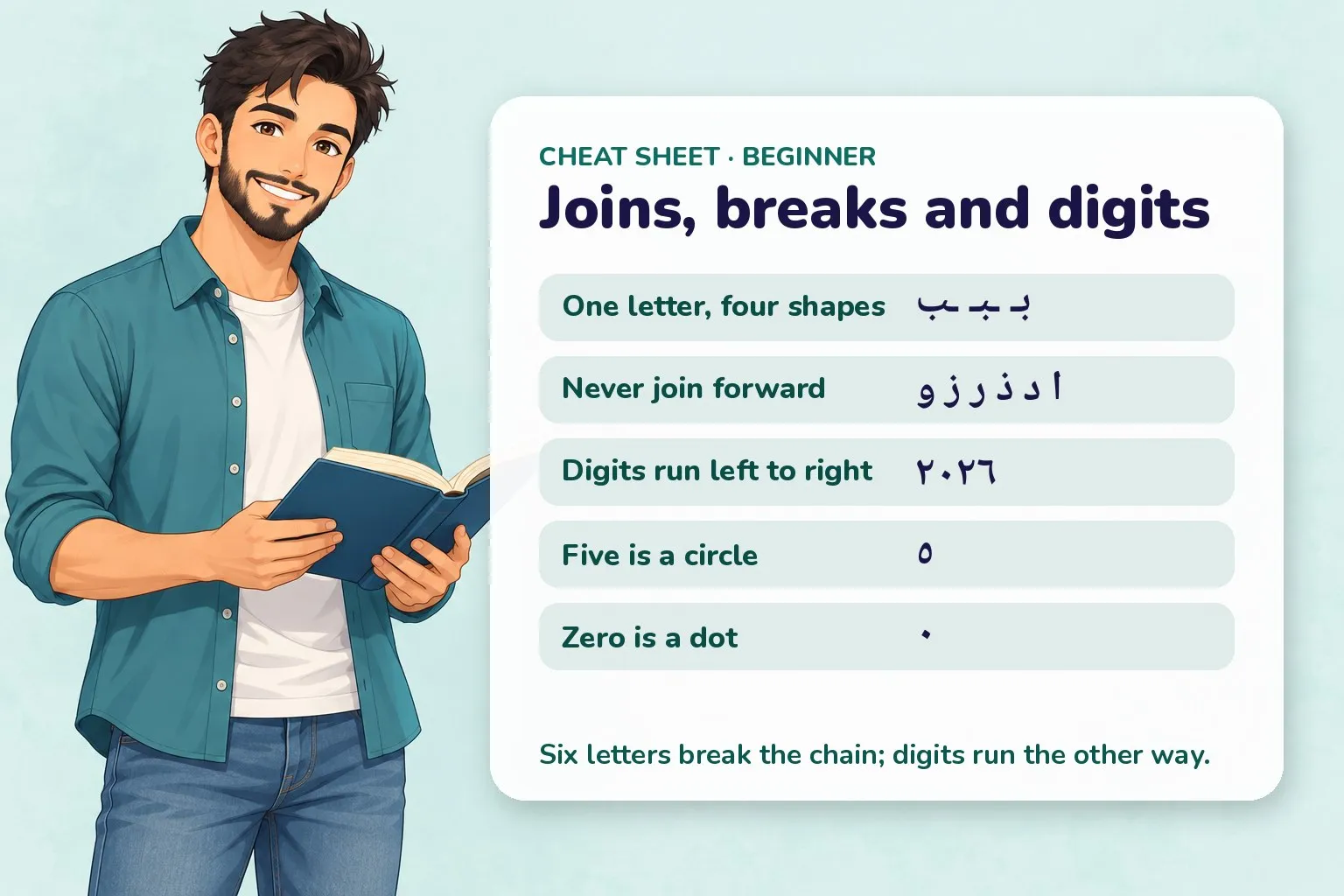
Quick recap before you practise.
Quiz
Arabic handwriting and numerals
10 questions · pick an answer and you'll see straight away if it's right.
-
Show answer
right to left — Arabic script runs right to left, so the first letter sits on the right.
-
Show answer
four — Isolated, initial, medial and final — up to four.
-
Show answer
و (wāw) — و (wāw) is one of the six non-connectors.
-
Show answer
six — ا د ذ ر ز و (alif, dāl, dhāl, rāʾ, zāy, wāw) — six letters.
-
Show answer
6 (sitta) — ٦ (sitta) is six, although its outline resembles a Western seven.
-
Show answer
left to right — The units sit on the right and place value grows to the left.
-
Show answer
isolated and final only — It only closes a word, so it has no initial or medial form: مَدْرَسَة (madrasa).
-
Show answer
stretching a join for layout — It is a typographic stretcher, not a letter or a vowel.
-
Show answer
the Maghreb — In Morocco, Algeria and Tunisia everyday writing uses Western digits.
-
Show answer
٥ (khamsa) — ٥ (khamsa) is the circle-shaped five.
Recap cheat-sheet
| Point | Rule | Example | Reading |
|---|---|---|---|
| Direction | right to left, cursive | بَاب | bāb (door) |
| Four shapes | isolated, initial, medial, final | بـ ـبـ ـب | bāʾ opening, held, closing |
| Non-connectors | alif, dāl, dhāl, rāʾ, zāy, wāw stop the chain | دَار | dār (house) |
| ة and ء | ة final only; ء never joins | مَدْرَسَة | madrasa (school) |
| Numerals | digits run left to right | ٢٠٢٦ | alfayn wa-sitta wa-ʿishrūn (2026) |
| Trap digits | five is a circle, six a seven-shape, zero a dot | ٥٠ | khamsūn (50) |
Next
- Shapes and names letter by letter: Arabic letters and their forms
- How the article changes in speech: Sun and moon letters
- Counting words and numbers: Arabic numbers 1–10
- New here? Start with Start Learning Arabic Here
All Arabic pronunciation & writing topics
Vocabulary, pronunciation, phrases, practice and exam help, ordered by level. Pick a topic and go straight to it. New lessons go live every day, so topics marked Coming soon fill in over the next weeks.
Pronunciation & writing
Beginner 10 topics · 8 ready
- 01 Arabic Pronunciation Overview
- 02 The Arabic Script & Abjad
- 03 Arabic Letters: Connecting Forms
- 04 Harakat: Short Vowels & Sukun
- 05 Arabic Long Vowels (alif, waw, ya)
- 06 Sun & Moon Letters
- 07 Ta Marbuta & Alif Maqsura
- 08 Arabic Handwriting & Numerals You are here
- 09 How to Type Arabic (Keyboard Guide) Coming soon
- 10 Arabic Transliteration Systems & Limits Coming soon