Building a Daily Japanese Habit
A daily Japanese habit sticks when it is small and automatic. Attach a few minutes of kana, kanji or a grammar point to something you already do each day, keep the goal tiny enough that you never skip it, track your streak, and start again after a miss.
Level: N5. Motivation rises and falls, so you cannot build a language on it. Japanese rewards frequent contact more than most: two writing systems, ひらがな (hiragana) and カタカナ (katakana), plus 漢字 (kanji), all fade without regular review. A small daily habit keeps them warm. This page helps you make Japanese a tiny, automatic part of your day.
By the end of this page you can…
…set up a daily Japanese habit that is small enough to keep, tied to your existing routine, and tracked so you can see it grow.
Start small — really small
Most study plans fail because they are too big. A huge goal feels great on day one and impossible by day three. A tiny goal survives a tired day — and keeping it is what builds the habit.
- Aim for five minutes a day, not an hour.
- A tiny goal could be: review five kana, read five 単語 (tango, “vocabulary words”), or drill one grammar point.
- You can always do more. The only rule is that you never do less than the tiny goal.
Habit-stacking: attach Japanese to your day
Habit-stacking means linking a new habit to something you already do daily. The old action becomes the cue, so you do not have to rely on memory or motivation. The pattern is: After I [existing habit], I will [Japanese habit].
- 今日も五分勉強します。Kyō mo go-fun benkyō shimasu.I'll study for five minutes today too.the daily promise
- 単語を五つ覚えます。Tango o itsutsu oboemasu.I'll memorise five words.
- 毎朝ひらがなを読みます。Maiasa hiragana o yomimasu.Every morning I read hiragana.
- 寝る前に一つ復習します。Neru mae ni hitotsu fukushū shimasu.Before bed I review one thing.a reliable end-of-day anchor
- 今日はできませんでした。Kyō wa dekimasen deshita.I couldn't do it today.
- 明日またやります。Ashita mata yarimasu.I'll try again tomorrow.the recovery mindset
Pick one action that happens every single day — your morning コーヒー (kōhī, “coffee”), the train, brushing your teeth — and attach your Japanese to it. Keep the same cue for a few weeks until the link is automatic.
Track your streak
Tracking turns invisible effort into something you can see. Each day you keep your tiny goal, mark it. A row of marks becomes a chain you will not want to break.
- Use a wall calendar, a notebook, or a habit app — whatever you will actually look at.
- Mark the day only once the tiny goal is done.
- Watching the chain grow is its own small reward.
When you miss a day
You will miss a day — everyone does. One missed day does not undo your progress; what matters is the next day.
- Never miss twice. One skipped day is a blip; two in a row is the start of quitting.
- Do not try to “make up” with a giant session. Just do your normal tiny goal.
- Skip the guilt. Guilt ends more habits than missed days do.
A weekly rhythm that fits Japanese
Because Japanese spreads across script, vocabulary, grammar and listening, rotate your five minutes so nothing is neglected:
- Two or three days: kana or 漢字 (kanji) review with flashcards.
- Two days: one grammar point — for example the は (wa) topic particle or the です (desu) copula.
- One or two days: listen to a short clip and repeat it aloud.
Frequency beats intensity: the same 35 minutes split across a week sticks far better than one Sunday marathon.
Tools on this site
- Build your five daily cards with How to Use Flashcards for Japanese.
- Not sure where to begin? Take the placement self-test.
- Fix the errors that waste review time on the top Japanese mistakes page.
- Print a tracker with the printable language worksheets.
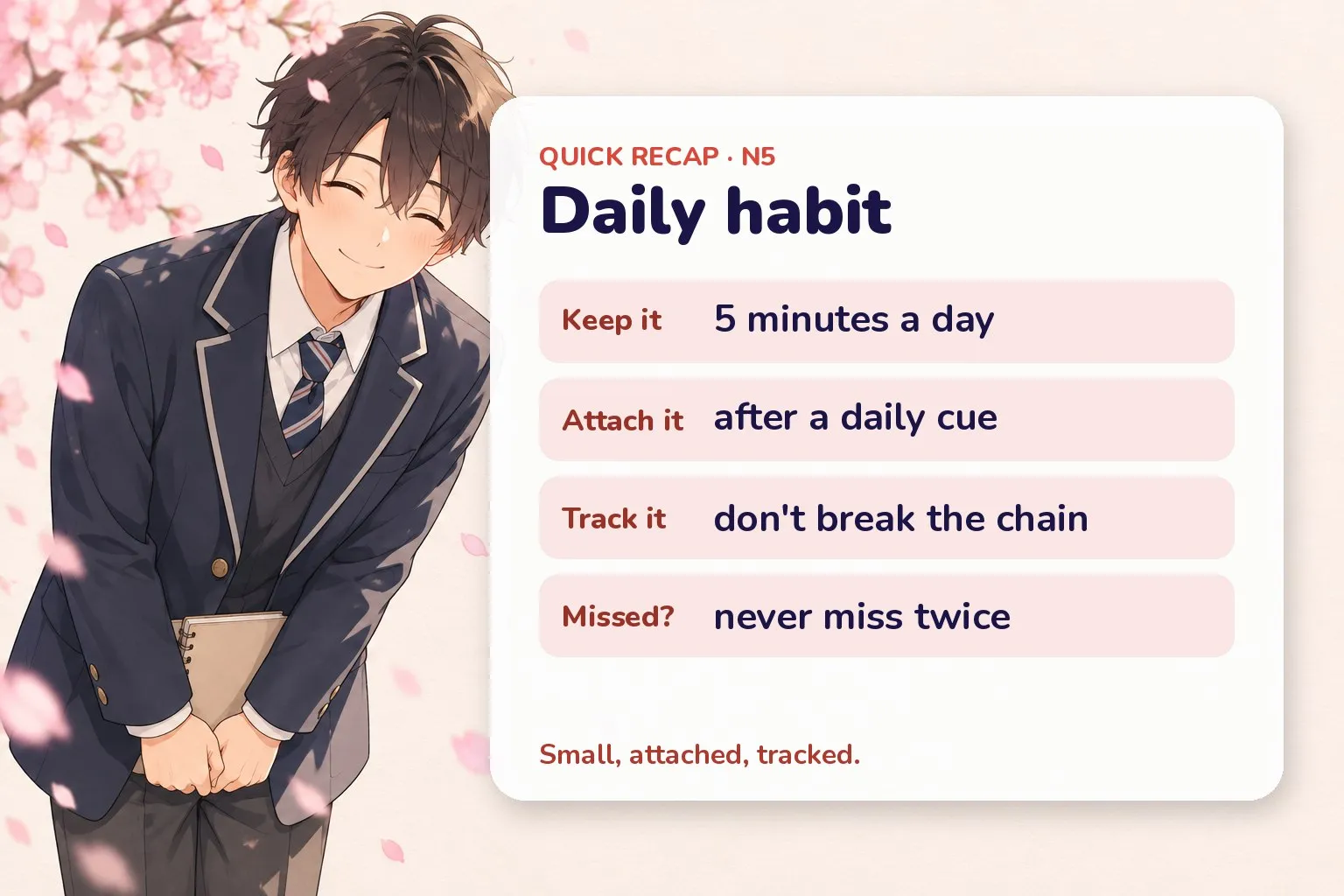
Quick recap before you practise.
Practice
Daily habit practice
Try each one, then press Check. No sign-up, nothing is sent anywhere — it all runs in your browser.
Hint: you build one habit on top of another
Show answer
stacking — Habit-stacking links the new habit to an existing daily cue.
4 Match each existing routine with a Japanese habit you could stack on it.
- after morning coffee
- after sitting on the train
- after brushing teeth
- after lunch
Show answer
- after morning coffee → review 5 kana
- after sitting on the train → listen to one clip
- after brushing teeth → drill one grammar point
- after lunch → read five words
Each daily action becomes the cue that triggers a small piece of Japanese.
Quiz
Daily Japanese habit quiz
7 questions · pick an answer and you'll see straight away if it's right.
-
Show answer
it does not depend on how you feel — Motivation comes and goes; a habit runs even on a bad day.
-
Show answer
five minutes or less — Make it too small to fail, then keep it every day.
-
Show answer
its kana and kanji fade without frequent review — The scripts and vocabulary need regular contact to stay fresh.
-
Show answer
attaching a new habit to one you already do daily — The existing daily action becomes the cue for your Japanese.
-
Show answer
to make your effort visible and keep going — A visible chain of successful days becomes its own reward.
-
Show answer
never miss twice in a row — One missed day is normal; two in a row is how a habit dies.
-
Show answer
rotate kana, grammar and listening — Rotating skills and spreading the time across the week both help retention.
Next
- Browse every topic in the Japanese start-here section
- Fill your five daily minutes with How to Use Flashcards for Japanese
- New here? Start with Start Learning Japanese Here
All Japanese study topics
Vocabulary, pronunciation, phrases, practice and exam help, ordered by level. Pick a topic and go straight to it. New lessons go live every day, so topics marked Coming soon fill in over the next weeks.
Study topics
Start here 5 topics · 5 ready
- 01 Start Learning Japanese Here
- 02 Japanese Level Self-Test (A1-C1 Guide)
- 03 How to Use Flashcards for Japanese
- 04 Top Mistakes Japanese Learners Make
- 05 Building a Daily Japanese Habit You are here
Lessons 54 topics
See the lessons page →- 06 Japanese: Greetings & Introductions Coming soon
- 07 Japanese: Numbers 0 to 100 Coming soon
- 08 Japanese: Introducing Yourself Coming soon
- 09 Japanese: Days, Months & Dates Coming soon
- 10 Japanese: Telling the Time Coming soon
- 11 Japanese: Giving Personal Information Coming soon
- 12 Japanese: Family Members Coming soon
- 13 Japanese: Describing People Coming soon
- 14 Japanese: Colours & Shapes Coming soon
- 15 Japanese: Food & Drink Basics Coming soon
- 16 Japanese: Ordering at a Cafe Coming soon
- 17 Japanese: Shopping & Prices Coming soon
- 18 Japanese: Clothing & Sizes Coming soon
- 19 Japanese: Asking for Directions Coming soon
- 20 Japanese: Using Public Transport Coming soon
- 21 Japanese: At the Hotel Coming soon
- 22 Japanese: Weather & Seasons Coming soon
- 23 Japanese: Hobbies & Free Time Coming soon
- 24 Japanese: Daily Routine Coming soon
- 25 Japanese: Housing & Rooms Coming soon
- 26 Japanese: Household Chores Coming soon
- 27 Japanese: At the Doctor Coming soon
- 28 Japanese: Parts of the Body Coming soon
- 29 Japanese: Emotions & Feelings Coming soon
- 30 Japanese: Making Appointments Coming soon
- 31 Japanese: Making Plans & Invitations Coming soon
- 32 Japanese: Phone & Messaging Coming soon
- 33 Japanese: Expressing Opinions Coming soon
- 34 Japanese: Talking About Past Experiences Coming soon
- 35 Japanese: Future Plans & Goals Coming soon
- 36 Japanese: School & Education Coming soon
- 37 Japanese: Jobs & Professions Coming soon
- 38 Japanese: At the Office Coming soon
- 39 Japanese: The Job Interview Coming soon
- 40 Japanese: Formal Writing & Emails Coming soon
- 41 Japanese: Money & Banking Coming soon
- 42 Japanese: Restaurant & Dining Out Coming soon
- 43 Japanese: Supermarket & Groceries Coming soon
- 44 Japanese: Travel & the Airport Coming soon
- 45 Japanese: Sightseeing & Tourism Coming soon
- 46 Japanese: Emergencies & Safety Coming soon
- 47 Japanese: Technology & the Internet Coming soon
- 48 Japanese: News & Current Affairs Coming soon
- 49 Japanese: Environment & Nature Coming soon
- 50 Japanese: Health & Lifestyle Coming soon
- 51 Japanese: Culture & Traditions Coming soon
- 52 Japanese: Describing Trends & Data Coming soon
- 53 Japanese: Debating & Argumentation Coming soon
- 54 Japanese: Idioms & Colloquialisms Coming soon
- 55 Japanese: Formal vs Informal Register Coming soon
- 56 Japanese: Storytelling & Narration Coming soon
- 57 Japanese: Complaints & Solving Problems Coming soon
- 58 Japanese: Giving a Short Presentation Coming soon
- 59 Japanese: Small Talk & Networking Coming soon
Vocabulary 43 topics
See the vocabulary page →- 60 100 Most Common Japanese Words Coming soon
- 61 Japanese Words 101-250 (Frequency) Coming soon
- 62 Japanese Words 251-500 (Frequency) Coming soon
- 63 Japanese Words 501-1000 (Frequency) Coming soon
- 64 Japanese Words 1001-1500 (Frequency) Coming soon
- 65 Japanese Words 1501-2000 (Frequency) Coming soon
- 66 Japanese Words 2001-3000 (Frequency) Coming soon
- 67 100 Essential Japanese Verbs Coming soon
- 68 Common Japanese Adjectives Coming soon
- 69 Everyday Japanese Adverbs Coming soon
- 70 Japanese Connectors & Linking Words Coming soon
- 71 Japanese Question Words & Phrases Coming soon
- 72 Japanese Time Expressions Coming soon
- 73 Japanese Food & Cooking Vocabulary Coming soon
- 74 Japanese Animals Vocabulary Coming soon
- 75 Japanese Body & Health Vocabulary Coming soon
- 76 Japanese Clothing Vocabulary Coming soon
- 77 Japanese House & Furniture Vocabulary Coming soon
- 78 Japanese Kitchen & Tableware Vocabulary Coming soon
- 79 Japanese Transport & Travel Vocabulary Coming soon
- 80 Japanese Places in Town Vocabulary Coming soon
- 81 Japanese Nature & Geography Vocabulary Coming soon
- 82 Japanese Weather Vocabulary Coming soon
- 83 Japanese Jobs & Professions Vocabulary Coming soon
- 84 Japanese Technology & Internet Vocabulary Coming soon
- 85 Japanese Money & Shopping Vocabulary Coming soon
- 86 Japanese Emotions & Feelings Vocabulary Coming soon
- 87 Japanese Sports & Exercise Vocabulary Coming soon
- 88 Japanese Education & School Vocabulary Coming soon
- 89 Japanese Business & Work Vocabulary Coming soon
- 90 Japanese Family & Relationships Vocabulary Coming soon
- 91 Japanese Colours Vocabulary Coming soon
- 92 Japanese Verbs of Motion Coming soon
- 93 Japanese Opinion & Attitude Vocabulary Coming soon
- 94 Japanese Academic Vocabulary Coming soon
- 95 Japanese Medical & Pharmacy Vocabulary Coming soon
- 96 Japanese Admin & Paperwork Vocabulary Coming soon
- 97 Japanese Environment & Climate Vocabulary Coming soon
- 98 Japanese Arts, Music & Film Vocabulary Coming soon
- 99 Japanese Counters Reference Coming soon
- 100 Katakana Loanwords (Gairaigo) Vocabulary Coming soon
- 101 Japanese Onomatopoeia (Giongo/Gitaigo) Coming soon
- 102 Japanese Numbers, Dates & Counting Coming soon
Pronunciation & writing 15 topics · 1 ready
See the pronunciation & writing page →- 103 Japanese Pronunciation Overview
- 104 Hiragana Chart (Complete) Coming soon
- 105 Katakana Chart (Complete) Coming soon
- 106 Dakuten & Handakuten (゛ ゜) Coming soon
- 107 Yoon: Combined Kana (きゃ しゅ ちょ kya shu cho) Coming soon
- 108 Long Vowels & Small Tsu (Sokuon) Coming soon
- 109 Japanese Pitch Accent (Intro) Coming soon
- 110 Introduction to Kanji Coming soon
- 111 Kanji Radicals (Bushu) Coming soon
- 112 Kanji Readings: On'yomi vs Kun'yomi Coming soon
- 113 Kanji & Kana Stroke Order Rules Coming soon
- 114 When to Use Kana vs Kanji Coming soon
- 115 Romaji: Systems & Why to Move Beyond It Coming soon
- 116 Essential N5 Kanji Set Coming soon
- 117 Essential N4 Kanji Set Coming soon
Practice 13 topics · 6 ready
See the practice page →- 118 Shadowing to Improve Japanese Speaking
- 119 How to Practise Japanese Listening
- 120 Japanese Reading Practice: Beginner
- 121 Japanese Reading Practice: Elementary
- 122 Japanese Reading Practice: Intermediate
- 123 Japanese Reading Practice: Upper-Intermediate
- 124 How to Practise Japanese Writing Coming soon
- 125 Hiragana Reading & Writing Practice Coming soon
- 126 Katakana Reading & Writing Practice Coming soon
- 127 Japanese Keigo Practice Set Coming soon
- 128 Japanese Particles Review Set Coming soon
- 129 Giving & Receiving (ageru/kureru/morau) Practice Coming soon
- 130 Sentence-Ending Particles Practice Coming soon
Phrases 20 topics
See the phrases page →- 131 50 Japanese Survival Phrases Coming soon
- 132 Japanese Greetings & Goodbyes Coming soon
- 133 Japanese Politeness & Please/Thank-You Coming soon
- 134 Japanese Travel Phrases Coming soon
- 135 Japanese Restaurant Phrases Coming soon
- 136 Japanese Hotel Phrases Coming soon
- 137 Japanese Shopping Phrases Coming soon
- 138 Japanese Asking Directions Phrases Coming soon
- 139 Japanese Emergency Phrases Coming soon
- 140 Japanese Small Talk Phrases Coming soon
- 141 Japanese Phone & Call Phrases Coming soon
- 142 Japanese Business Meeting Phrases Coming soon
- 143 Japanese Social & Making-Friends Phrases Coming soon
- 144 Japanese Airport Phrases Coming soon
- 145 Japanese Doctor & Pharmacy Phrases Coming soon
- 146 Japanese Opinion & Discussion Phrases Coming soon
- 147 Japanese Agreeing & Disagreeing Phrases Coming soon
- 148 Japanese Texting & Chat Phrases Coming soon
- 149 Japanese Classroom Phrases Coming soon
- 150 Japanese Complaint & Problem Phrases Coming soon
Exams 11 topics
See the exams page →- 151 Japanese Exams: Which One & How to Prepare Coming soon
- 152 JLPT Overview: Levels & Scoring Coming soon
- 153 JLPT N5: What You Need to Know Coming soon
- 154 JLPT N4: What You Need to Know Coming soon
- 155 JLPT N3: What You Need to Know Coming soon
- 156 JLPT N2: What You Need to Know Coming soon
- 157 JLPT N1: What You Need to Know Coming soon
- 158 JLPT Reading (Dokkai) Strategies Coming soon
- 159 JLPT Listening (Choukai) Strategies Coming soon
- 160 JLPT Vocabulary & Kanji Prep Coming soon
- 161 JLPT Grammar (Bunpou) Prep Coming soon