Japanese Reading Practice: Intermediate
Intermediate Japanese reading (N3) means longer connected passages where sentences link with connectors like ので (node), けれど (keredo) and のに (noni). Read for the gist first, then reread to see how each clause relates to the one before it.
Level: N3. (Note: the JLPT publishes no official grammar list; the level shown is the common textbook convention.) Intermediate reading is a real step up from elementary: the sentences are longer, and ideas join across clauses. The skill now is to follow how one clause relates to the next.
By the end of this page you can…
…read a short N3 account of moving to Tokyo for university, follow the cause-and-contrast links between clauses, and answer questions about it.
How to read an intermediate text
At this level, whole sentences hang together on connectors. Learn to spot them and the long sentence falls into place: ので (node, “because/so”) gives a reason, けれど (keredo, “but”) and のに (noni, “even though”) mark contrast, それで (sorede, “and so”) shows a result, and ところが (tokoroga, “however”) flags a surprise. The verb at the end still carries the main action, so read to the end before deciding what the sentence means.
The graded text
Read this short account one line at a time. Each line shows the Japanese, its reading, and the English.
- 四月に大学に入るため、東京に引っ越しました。Shigatsu ni daigaku ni hairu tame, Tōkyō ni hikkoshimashita.In April, I moved to Tokyo in order to start university.ため = 'in order to'
- 最初は知っている人が一人もいなくて、とても不安でした。Saisho wa shitte iru hito ga hitori mo inakute, totemo fuan deshita.At first I didn't know a single person, so I was very anxious.一人もいない = 'not even one person'
- でも、同じクラスの学生が声をかけてくれました。Demo, onaji kurasu no gakusei ga koe o kakete kuremashita.But a student in the same class spoke to me.〜てくれる = someone does something for me
- その人のおかげで、だんだん友達が増えました。Sono hito no okage de, dandan tomodachi ga fuemashita.Thanks to that person, I gradually made more friends.おかげで = 'thanks to'
- 週末は、近くのカフェでアルバイトを始めました。Shūmatsu wa, chikaku no kafe de arubaito o hajimemashita.On weekends, I started a part-time job at a nearby café.
- 仕事は大変ですが、お金をもらいながら敬語の練習もできます。Shigoto wa taihen desu ga, okane o morainagara keigo no renshū mo dekimasu.The work is hard, but while earning money I can also practise polite speech.〜ながら = 'while doing'
- 先月、国の家族が遊びに来たとき、一緒に浅草を案内しました。Sengetsu, kuni no kazoku ga asobi ni kita toki, issho ni Asakusa o annai shimashita.Last month, when my family came to visit from home, I showed them around Asakusa.〜たとき = 'when (something happened)'
- 東京は人が多くて疲れるけれど、便利で面白い町だと思います。Tōkyō wa hito ga ōkute tsukareru keredo, benri de omoshiroi machi da to omoimasu.Tokyo is tiring because it's crowded, but I think it's a convenient, interesting city.けれど = 'but'
- 困ったときは、アルバイト先の店長が親切に教えてくれます。Komatta toki wa, arubaito-saki no tenchō ga shinsetsu ni oshiete kuremasu.When I'm in trouble, the manager at my workplace kindly shows me how.〜てくれる again: help received
- 大変なことも多いのに、毎日少しずつ成長している気がします。Taihen na koto mo ōi noni, mainichi sukoshi zutsu seichō shite iru ki ga shimasu.Even though there are many hard things, I feel I'm growing a little each day.のに = 'even though'
- これからも、勉強とアルバイトを両立させたいです。Korekara mo, benkyō to arubaito o ryōritsu sasetai desu.From now on too, I want to balance study and the part-time job.両立させる = 'balance two things'
- 来年は、もっと難しい本を日本語で読めるようになりたいです。Rainen wa, motto muzukashii hon o nihongo de yomeru yō ni naritai desu.Next year, I want to become able to read harder books in Japanese.〜ようになる = 'come to be able to'
Key vocabulary
These are some of the most useful intermediate words in the text.
| Word | Reading | English |
|---|---|---|
| 引っ越す | hikkosu | to move house |
| 不安 | fuan | anxiety, unease |
| 声をかける | koe o kakeru | to speak to someone |
| だんだん | dandan | gradually |
| 敬語 | keigo | polite/honorific language |
| 案内する | annai suru | to show around, guide |
| 便利 | benri | convenient |
| 成長する | seichō suru | to grow |
| 店長 | tenchō | shop manager |
| 両立する | ryōritsu suru | to balance two things |
Check you understood
- Why did the writer move to Tokyo? (To start university.)
- How did they feel at first, and why? (Very anxious, because they knew no one.)
- What job did they start, and when? (A part-time job at a café, on weekends.)
- Where did they take their visiting family? (Around Asakusa.)
- What does the writer want to do next year? (Become able to read harder books in Japanese.)
Extension: read a little more every day
Once this passage feels easy, change the goal rather than the text at first: read it aloud for smooth rhythm, then cover the English and translate each line yourself, then retell the story from memory in your own words. When you are ready for new material, choose N3 graded readers, NHK Easy News, or simple blog-style diaries, and keep each session short. If you want to warm up on something gentler first, revisit the elementary reading passage.
Practice
Intermediate reading practice
Try each one, then press Check. No sign-up, nothing is sent anywhere — it all runs in your browser.
Hint: no + ni
Show answer
noni — のに (noni) means 'even though' and marks the contrast.
3 Match each word with its meaning.
- 引っ越す (hikkosu)
- 敬語 (keigo)
- 案内する (annai suru)
- 両立する (ryōritsu suru)
Show answer
- 引っ越す (hikkosu) → to move house
- 敬語 (keigo) → polite language
- 案内する (annai suru) → to show around
- 両立する (ryōritsu suru) → to balance two things
These are common N3 words from the text.
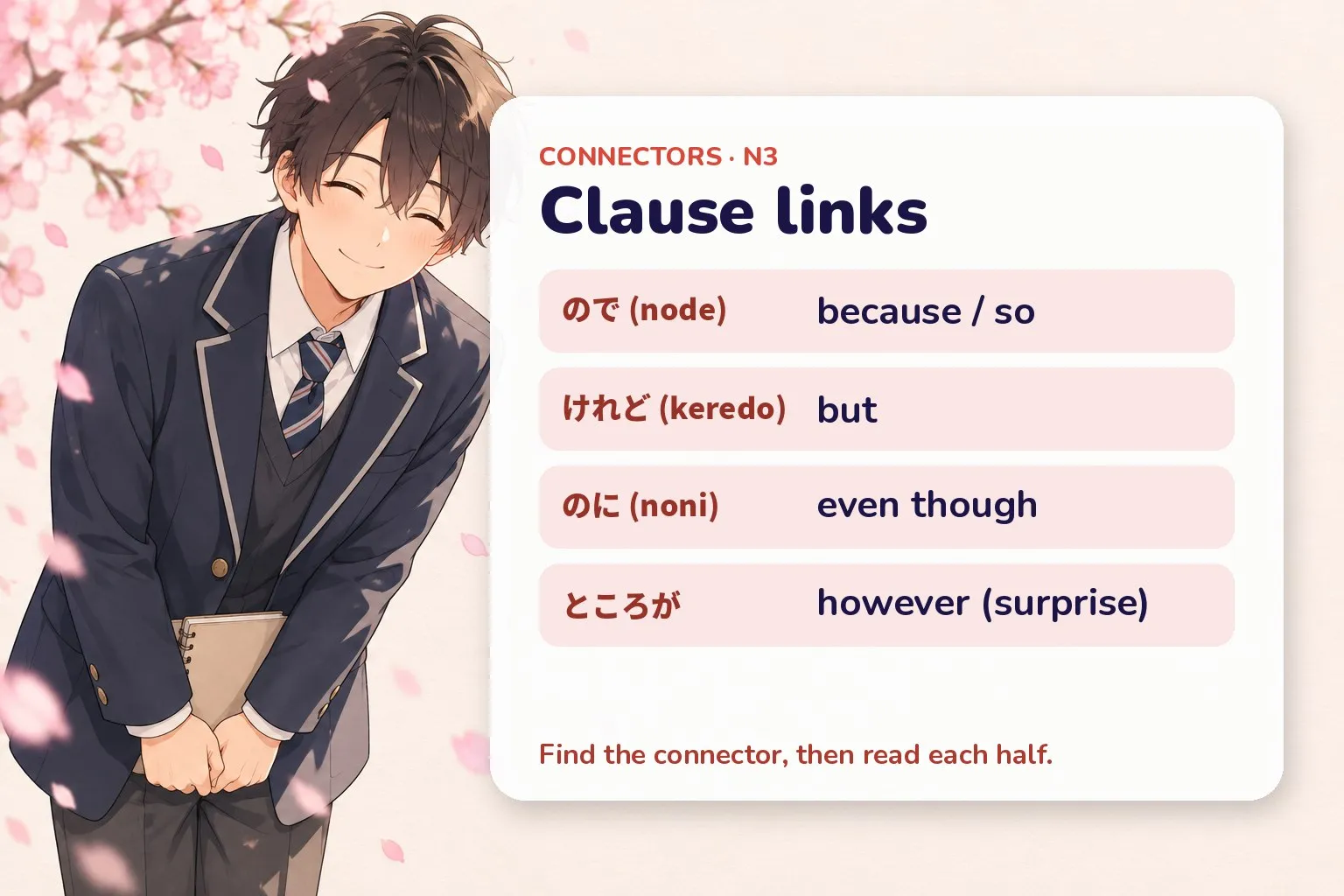
Quick recap before you practise.
Quiz
Intermediate reading quiz
7 questions · pick an answer and you'll see straight away if it's right.
-
Show answer
reread a short passage with a new goal each pass — Reread a connected passage with a purpose each pass: gist, grammar, aloud.
-
Show answer
very anxious — とても不安でした (totemo fuan deshita) = 'I was very anxious'.
-
Show answer
because / so — ので (node) gives a reason: 'because / so'.
-
Show answer
a student in the same class — 同じクラスの学生が声をかけてくれました (onaji kurasu no gakusei ga koe o kakete kuremashita) = 'a classmate spoke to me'.
-
Show answer
polite speech (keigo) — 敬語の練習もできます (keigo no renshū mo dekimasu) = 'can also practise polite speech'.
-
Show answer
even though — のに (noni) means 'even though', marking an unexpected contrast.
-
Show answer
they show how clauses relate (cause, contrast, result) — ので (node), けれど (keredo) and のに (noni) tell you how the halves of a long sentence relate.
Next
- Build the grammar behind the sentences in the Japanese grammar section
- Warm up with the elementary text first: Japanese Reading Practice: Elementary
- New here? Start with Start Learning Japanese Here
All Japanese practice topics
Vocabulary, pronunciation, phrases, practice and exam help, ordered by level. Pick a topic and go straight to it. New lessons go live every day, so topics marked Coming soon fill in over the next weeks.
Practice
N5 3 topics · 1 ready
- 01 Japanese Reading Practice: Beginner
- 02 Hiragana Reading & Writing Practice Coming soon
- 03 Katakana Reading & Writing Practice Coming soon
N4 4 topics · 2 ready
- 04 How to Practise Japanese Listening
- 05 Japanese Reading Practice: Elementary
- 06 Japanese Particles Review Set Coming soon
- 07 Sentence-Ending Particles Practice Coming soon
N3 4 topics · 2 ready
- 08 Shadowing to Improve Japanese Speaking
- 09 Japanese Reading Practice: Intermediate You are here
- 10 How to Practise Japanese Writing Coming soon
- 11 Giving & Receiving (ageru/kureru/morau) Practice Coming soon
N2 2 topics · 1 ready
- 12 Japanese Reading Practice: Upper-Intermediate
- 13 Japanese Keigo Practice Set Coming soon