Japanese Reading Practice: Upper-Intermediate
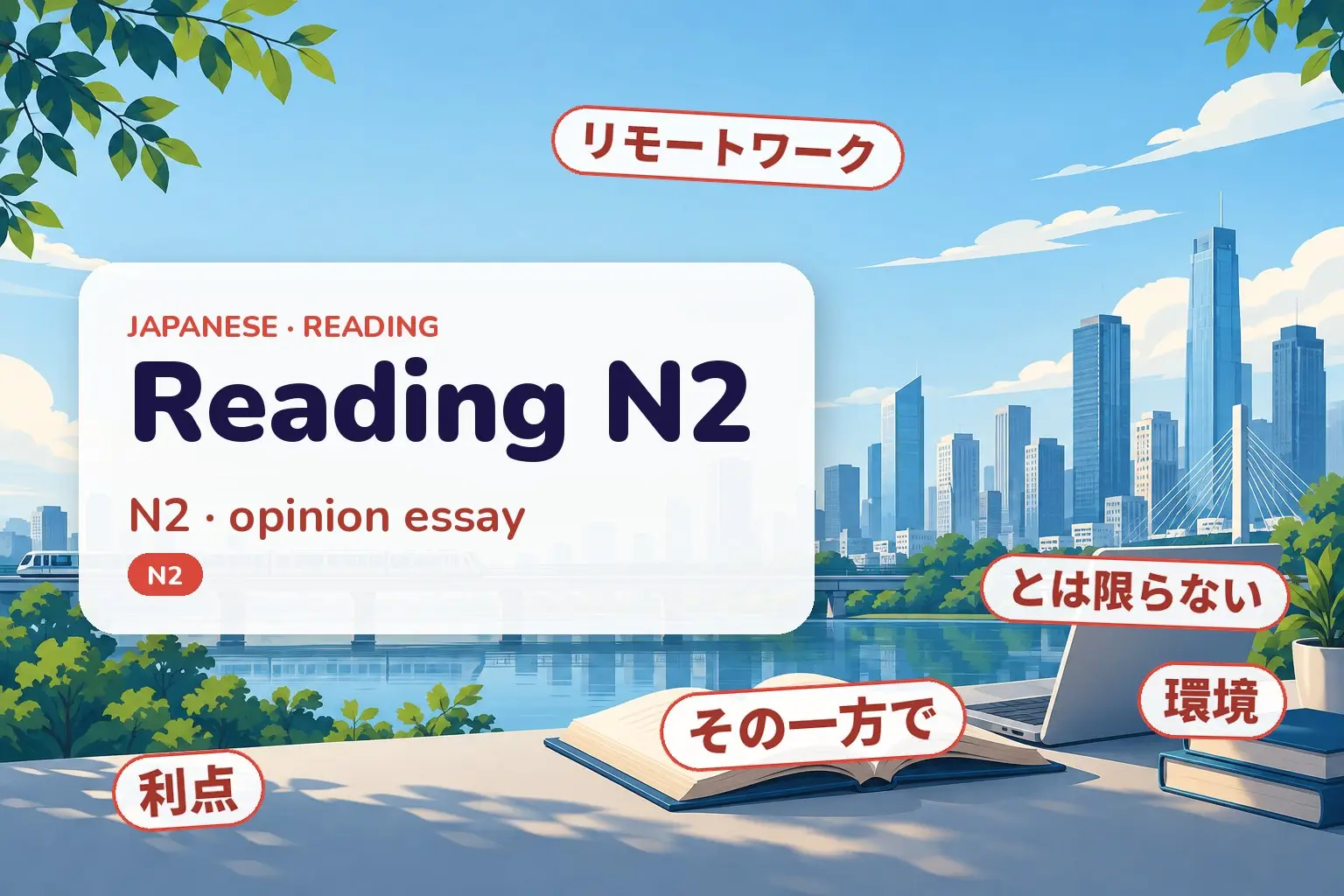
Upper-intermediate Japanese reading (N2) means short opinion essays where the writer weighs two sides. The new skill is tracking the argument through connectors like その一方で (sono ippō de, 'on the other hand') and endings like とは限らない (to wa kagiranai, 'not necessarily').
Level: N2. (Note: the JLPT publishes no official grammar list; the level shown is the common textbook convention.) Upper-intermediate reading is a real step up from intermediate: the text is now a short opinion essay, and the writer weighs one side against another. The skill is to follow the argument, not just the events.
By the end of this page you can…
…read a short N2 opinion essay about remote work, follow how the writer balances advantages and drawbacks, and answer questions about the writer’s position.
How to read an upper-intermediate text
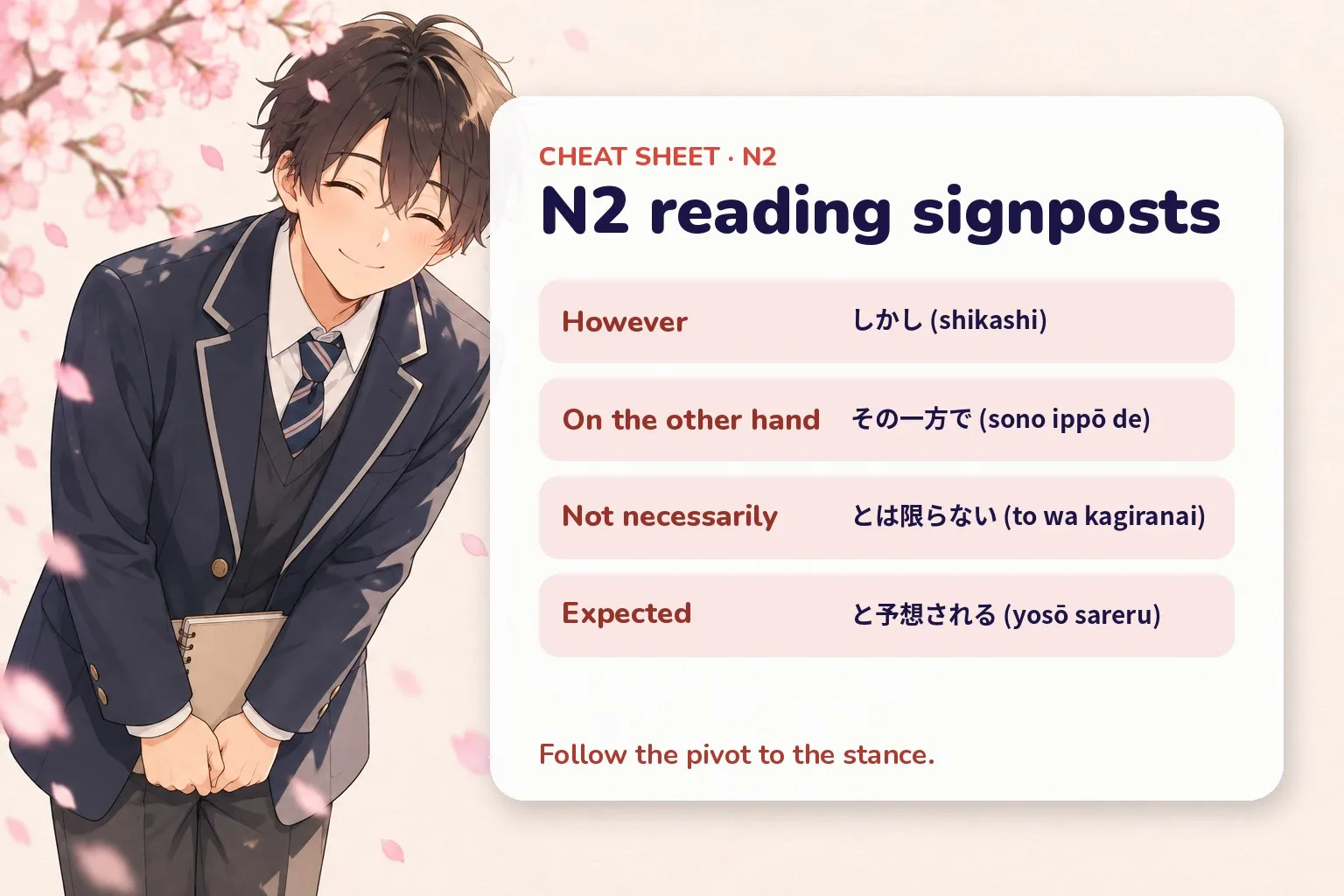
At this level, meaning hangs on connectors and hedged endings. Learn the signposts and a dense paragraph opens up: しかし (shikashi, “however”) and その一方で (sono ippō de, “on the other hand”) pivot to the opposite side, だからといって (dakara to itte, “that said”) blocks a hasty conclusion, and the ending とは限らない (to wa kagiranai) means “it is not necessarily so”. Writers also soften claims with ではないだろうか (de wa nai darō ka, “isn’t it the case that…?”) and mark expectation with と予想される (to yosō sareru, “it is expected that”). Read to the end of each sentence before deciding what the writer actually claims.
The graded text
Read this short essay one line at a time. Each line shows the Japanese, its reading, and the English.
- 近年、リモートワークという働き方が急速に広がってきた。Kinnen, rimōto wāku to iu hatarakikata ga kyūsoku ni hirogatte kita.In recent years, the style of working called remote work has spread rapidly.
- 以前は、会社に通勤するのが当たり前だと考えられていた。Izen wa, kaisha ni tsūkin suru no ga atarimae da to kangaerarete ita.In the past, commuting to the office was taken for granted.考えられていた = passive, 'was considered'
- しかし、技術の発達にともなって、自宅で働く人が増えている。Shikashi, gijutsu no hattatsu ni tomonatte, jitaku de hataraku hito ga fuete iru.However, along with advances in technology, more people are working from home.にともなって = 'along with'
- リモートワークの最大の利点は、通勤時間を節約できることだろう。Rimōto wāku no saidai no riten wa, tsūkin jikan o setsuyaku dekiru koto darō.The greatest advantage of remote work is probably being able to save commuting time.
- その一方で、同僚とのコミュニケーションが減るという問題もある。Sono ippō de, dōryō to no komyunikēshon ga heru to iu mondai mo aru.On the other hand, there is also the problem that communication with colleagues decreases.その一方で = 'on the other hand'
- 家にいると、仕事と生活の区別がつきにくくなりがちだ。Ie ni iru to, shigoto to seikatsu no kubetsu ga tsukinikuku nari gachi da.When you are at home, it tends to become hard to separate work and life.〜がち = 'tend to'
- だからといって、オフィス勤務が優れているとは限らない。Dakara to itte, ofisu kinmu ga sugurete iru to wa kagiranai.That said, it does not necessarily mean office work is better.とは限らない = 'not necessarily'
- 大切なのは、自分に合った働き方を選ぶことではないだろうか。Taisetsu na no wa, jibun ni atta hatarakikata o erabu koto de wa nai darō ka.What matters, surely, is choosing a way of working that suits you, isn't it?ではないだろうか = a softened claim
- 企業の側も、社員が働きやすい環境を整える必要がある。Kigyō no gawa mo, shain ga hatarakiyasui kankyō o totonoeru hitsuyō ga aru.Companies, too, need to create an environment in which employees can work comfortably.
- 今後、働き方はさらに多様化していくと予想される。Kongo, hatarakikata wa sarani tayōka shite iku to yosō sareru.From now on, ways of working are expected to diversify further.と予想される = 'it is expected that'
- 変化を恐れず、新しい方法を試す姿勢が求められている。Henka o osorezu, atarashii hōhō o tamesu shisei ga motomerarete iru.An attitude of trying new methods without fearing change is what is called for.
Key vocabulary
These are some of the most useful upper-intermediate words in the essay.
| Word | Reading | English |
|---|---|---|
| 通勤 | tsūkin | commuting |
| 当たり前 | atarimae | obvious, taken for granted |
| 発達 | hattatsu | development, advance |
| 利点 | riten | advantage |
| 節約 | setsuyaku | saving, economising |
| 同僚 | dōryō | colleague |
| 区別 | kubetsu | distinction |
| 勤務 | kinmu | work, duty |
| 環境 | kankyō | environment |
| 多様化 | tayōka | diversification |
Check you understood
- What has spread rapidly in recent years? (Remote work, リモートワーク (rimōto wāku).)
- What does the writer call the greatest advantage? (Saving commuting time, 通勤時間 (tsūkin jikan).)
- What drawback does the writer raise? (Less communication with colleagues; work and life blur.)
- Does the writer conclude that office work is better? (No — とは限らない (to wa kagiranai), “not necessarily”.)
- What does the writer say matters most? (Choosing a way of working that suits you.)
Extension: read a little more every day
Once this essay feels easy, change the goal rather than the text at first: read it aloud for smooth rhythm, then cover the English and translate each line, then summarise the writer’s argument in one sentence of your own. When you are ready for new material, choose N2 graded readers, newspaper opinion columns (社説 (shasetsu), “editorials”) or essay blogs, and keep each session short. If you want to warm up on something gentler first, revisit the intermediate reading passage.
Practice
Upper-intermediate reading practice
Try each one, then press Check. No sign-up, nothing is sent anywhere — it all runs in your browser.
Hint: to wa kagira-nai
Show answer
to wa kagiranai — とは限らない (to wa kagiranai) = 'it is not necessarily so'.
3 Match each word with its meaning.
- 利点 (riten)
- 同僚 (dōryō)
- 環境 (kankyō)
- 多様化 (tayōka)
Show answer
- 利点 (riten) → advantage
- 同僚 (dōryō) → colleague
- 環境 (kankyō) → environment
- 多様化 (tayōka) → diversification
These are common N2 nouns from the essay.
Quick recap before you practise.
Quiz
Upper-intermediate reading quiz
7 questions · pick an answer and you'll see straight away if it's right.
-
Show answer
reread a short essay with a new goal each pass — Reread a short argument with a purpose each pass: gist, grammar, then the writer's stance.
-
Show answer
remote work — リモートワーク (rimōto wāku) が急速に広がってきた = 'remote work has spread rapidly'.
-
Show answer
however — しかし (shikashi) = 'however', a pivot to a contrasting idea.
-
Show answer
less communication with colleagues — 同僚とのコミュニケーションが減る (dōryō to no komyunikēshon ga heru) = 'communication with colleagues decreases'.
-
Show answer
it is not necessarily so — とは限らない (to wa kagiranai) = 'not necessarily', blocking an overstated claim.
-
Show answer
choosing a way of working that suits you — 自分に合った働き方を選ぶこと (jibun ni atta hatarakikata o erabu koto) = 'choosing a way of working that suits you'.
-
Show answer
they show the writer's stance and how the sides relate — Connectors like その一方で (sono ippō de) and endings like ではないだろうか (de wa nai darō ka) carry the argument.
Next
- Build the grammar behind the sentences in the Japanese grammar section
- Warm up with the intermediate text first: Japanese Reading Practice: Intermediate
- New here? Start with Start Learning Japanese Here
All Japanese practice topics
Vocabulary, pronunciation, phrases, practice and exam help, ordered by level. Pick a topic and go straight to it. New lessons go live every day, so topics marked Coming soon fill in over the next weeks.
Practice
N5 3 topics · 1 ready
- 01 Japanese Reading Practice: Beginner
- 02 Hiragana Reading & Writing Practice Coming soon
- 03 Katakana Reading & Writing Practice Coming soon
N4 4 topics · 2 ready
- 04 How to Practise Japanese Listening
- 05 Japanese Reading Practice: Elementary
- 06 Japanese Particles Review Set Coming soon
- 07 Sentence-Ending Particles Practice Coming soon
N3 4 topics · 2 ready
- 08 Shadowing to Improve Japanese Speaking
- 09 Japanese Reading Practice: Intermediate
- 10 How to Practise Japanese Writing Coming soon
- 11 Giving & Receiving (ageru/kureru/morau) Practice Coming soon
N2 2 topics · 1 ready
- 12 Japanese Reading Practice: Upper-Intermediate You are here
- 13 Japanese Keigo Practice Set Coming soon