Japanese Reading Practice: Beginner
Beginner Japanese reading means working through short, fully glossed texts built from the most common N5 words. Read for the gist first, then reread for details, checking each word's reading and meaning before you move on.
Level: N5. (Note: the JLPT publishes no official grammar list; the level shown is the common textbook convention.) Reading at the beginner stage is not about speed or long texts. It is about short passages you can almost fully understand, read slowly and more than once, with every word’s reading in front of you.
By the end of this page you can…
…read a short N5 self-introduction, say each word, and answer simple questions about it.
How to read a beginner text
Three habits make beginner reading work. Keep the text short (a few sentences), reread it with a new purpose each time, and say the readings aloud so sound and meaning stick together.
The graded text
Read this short self-introduction one line at a time. Each line shows the Japanese, its reading, and the English.
- はじめまして。Hajimemashite.Nice to meet you.
- わたしは たなかです。Watashi wa Tanaka desu.I am Tanaka.name
- がくせいです。Gakusei desu.I am a student.role
- とうきょうに すんでいます。Tōkyō ni sunde imasu.I live in Tokyo.place
- まいにち でんしゃで がっこうに いきます。Mainichi densha de gakkō ni ikimasu.Every day I go to school by train.
- ともだちと ひるごはんを たべます。Tomodachi to hiru-gohan o tabemasu.I eat lunch with a friend.
- ばんごはんの あとで ほんを よみます。Ban-gohan no ato de hon o yomimasu.After dinner I read a book.
- どうぞ よろしく おねがいします。Dōzo yoroshiku onegai shimasu.Pleased to meet you (closing).
Key vocabulary
These are some of the most common beginner words in the text.
| Word | Reading | English |
|---|---|---|
| わたし | watashi | I, me |
| がくせい | gakusei | student |
| とうきょう | Tōkyō | Tokyo |
| まいにち | mainichi | every day |
| でんしゃ | densha | train |
| がっこう | gakkō | school |
| ともだち | tomodachi | friend |
| ひるごはん | hiru-gohan | lunch |
| ほん | hon | book |
| よみます | yomimasu | read |
Check you understood
- Who is speaking, and what do they do? (A student named Tanaka.)
- Where do they live? (Tokyo.)
- How do they get to school? (By train, every day.)
- What do they do after dinner? (Read a book.)
Extension: read a little more every day
Once this text feels easy, change the goal rather than the text at first: read it aloud for smooth rhythm, then cover the English and translate each line yourself. When you are ready for new material, choose graded readers or simple dialogues at the same level, and keep each session short.
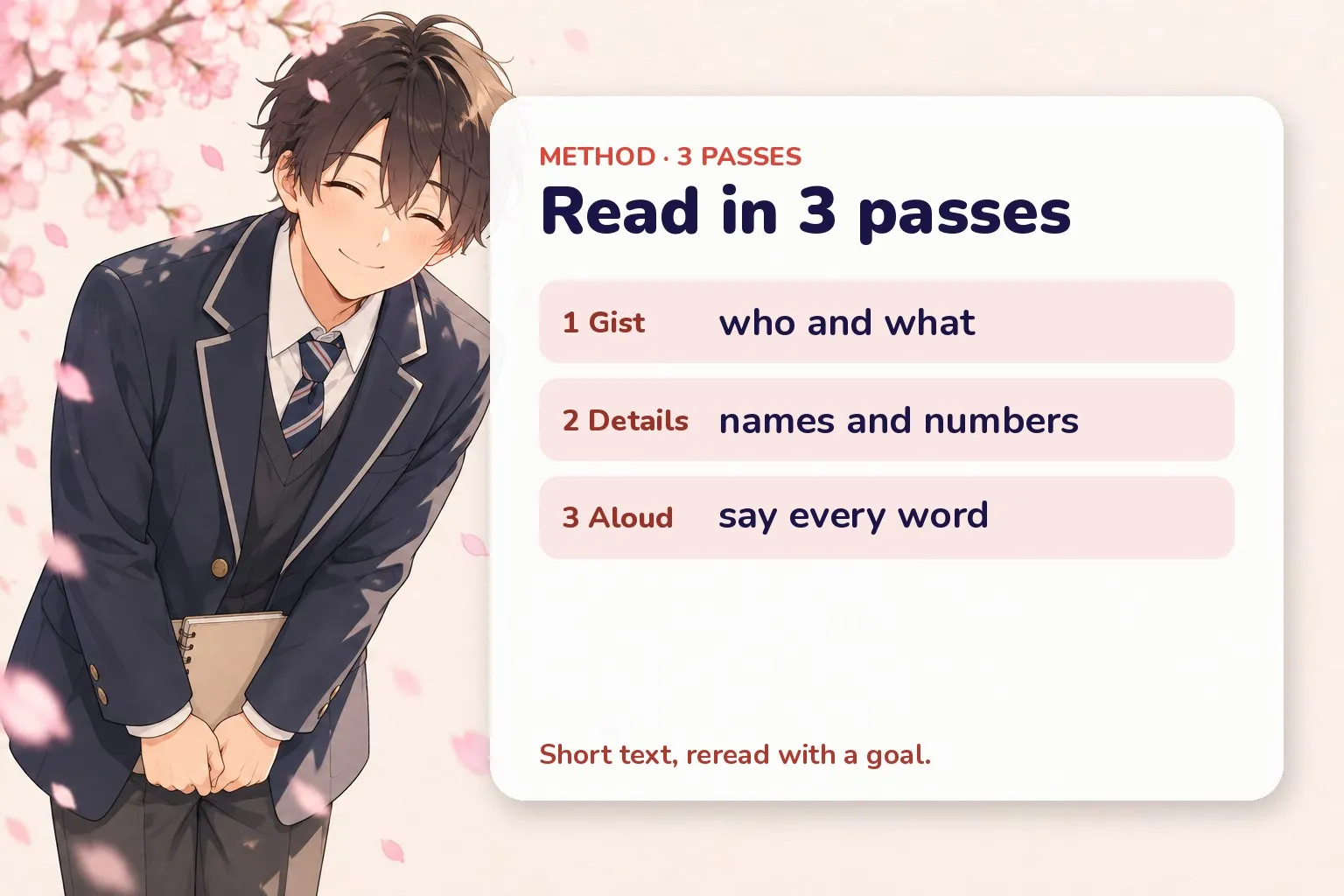
Quick recap before you practise.
Practice
Reading practice
Try each one, then press Check. No sign-up, nothing is sent anywhere — it all runs in your browser.
Hint: starts with g
Show answer
gakusei — がくせい (gakusei) means student.
3 Match each word with its meaning.
- でんしゃ (densha)
- がっこう (gakkō)
- ともだち (tomodachi)
- ほん (hon)
Show answer
- でんしゃ (densha) → train
- がっこう (gakkō) → school
- ともだち (tomodachi) → friend
- ほん (hon) → book
These are common N5 words from the text.
Quiz
Beginner reading quiz
7 questions · pick an answer and you'll see straight away if it's right.
-
Show answer
reread a short text with a new goal each pass — Short texts, reread with a purpose, build beginner reading best.
-
Show answer
Tokyo — とうきょうに すんでいます (Tōkyō ni sunde imasu) = 'I live in Tokyo.'
-
Show answer
student — がくせい (gakusei) means student.
-
Show answer
read a book — ばんごはんの あとで ほんを よみます (Ban-gohan no ato de hon o yomimasu) = 'After dinner I read a book.'
-
Show answer
the gist — who and what — First pass for the gist, later passes for details and exact words.
-
Show answer
friend — ともだち (tomodachi) means friend.
-
Show answer
linking sound to meaning fixes words faster — Saying the readings aloud ties sound to meaning and speeds up recall.
Next
- Build the grammar behind the sentences in the Japanese grammar section
- Train your ear with How to Practise Japanese Listening
- New here? Start with Start Learning Japanese Here
All Japanese practice topics
Vocabulary, pronunciation, phrases, practice and exam help, ordered by level. Pick a topic and go straight to it. New lessons go live every day, so topics marked Coming soon fill in over the next weeks.
Practice
N5 3 topics · 1 ready
- 01 Japanese Reading Practice: Beginner You are here
- 02 Hiragana Reading & Writing Practice Coming soon
- 03 Katakana Reading & Writing Practice Coming soon
N4 4 topics · 2 ready
- 04 How to Practise Japanese Listening
- 05 Japanese Reading Practice: Elementary
- 06 Japanese Particles Review Set Coming soon
- 07 Sentence-Ending Particles Practice Coming soon
N3 4 topics · 2 ready
- 08 Shadowing to Improve Japanese Speaking
- 09 Japanese Reading Practice: Intermediate
- 10 How to Practise Japanese Writing Coming soon
- 11 Giving & Receiving (ageru/kureru/morau) Practice Coming soon
N2 2 topics · 1 ready
- 12 Japanese Reading Practice: Upper-Intermediate
- 13 Japanese Keigo Practice Set Coming soon