Japanese Pronunciation Overview
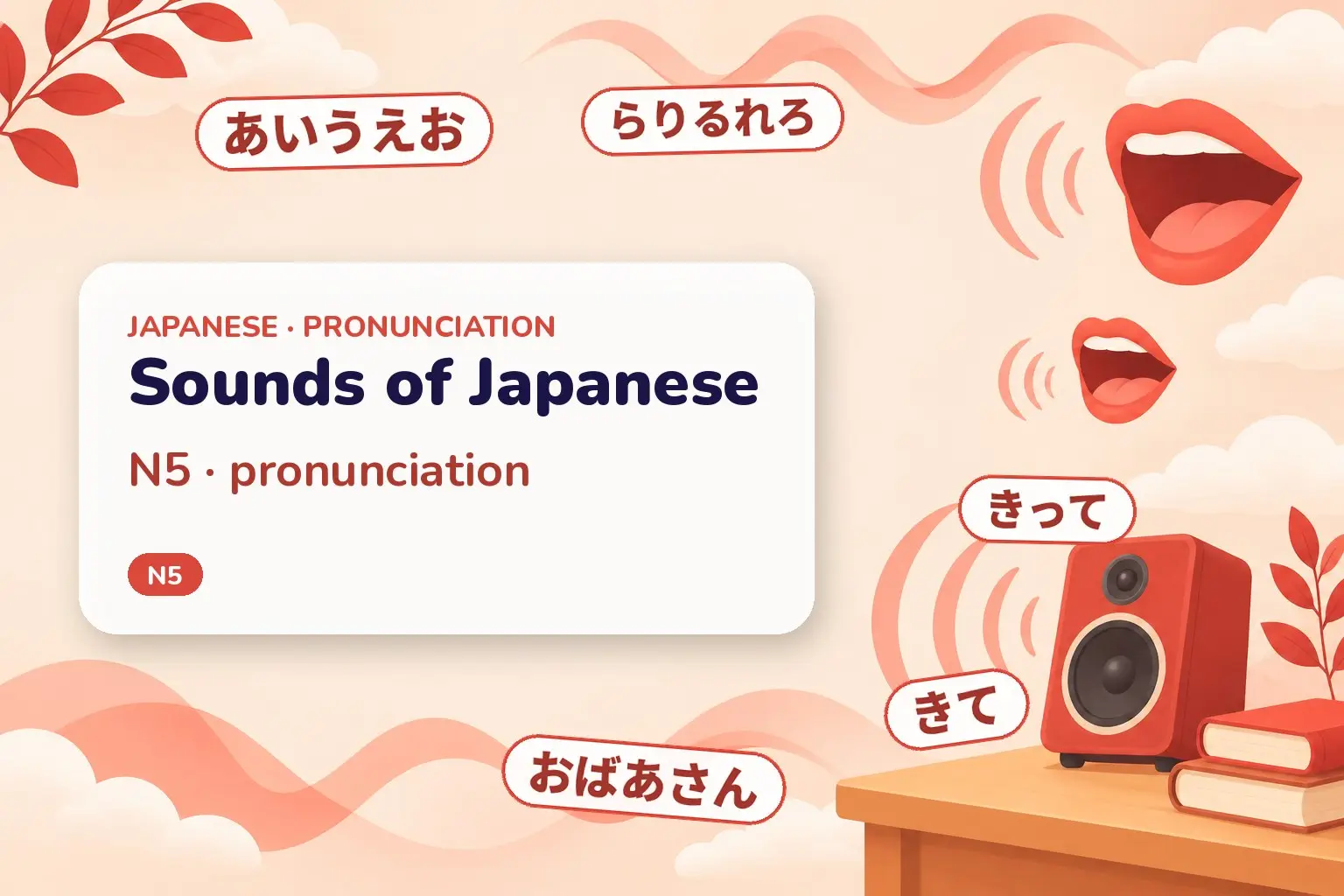
Japanese has only five vowel sounds and a steady, even rhythm built from equal beats called mora. There is no heavy stress like English; instead, meaning can shift with pitch. Get the five vowels, long vowels and double consonants right and you will be clear.
On this page11 sections · tap to jump
- 01By the end of this page you can…
- 02Sound is built from mora (even beats)
- 03The five vowels
- 04Long vowels and double consonants change meaning
- 05Sounds English speakers get wrong
- 06Pitch accent, not stress
- 07How to say it
- 08Listen and repeat with the audio
- 09How to use the audio on this site
- 10Practice
- 11Quiz
Level: N5. Japanese pronunciation is kinder to beginners than it looks. There are only five vowels, the rhythm is even, and the writing system spells the sounds reliably. The few things that trip people up — long vowels, the small double-consonant beat, and pitch — are easy to hear once you know to listen for them. This page shows you what to focus on first.
By the end of this page you can…
…say the five Japanese vowels, feel the even mora rhythm, hear long vowels and double consonants, and use the audio here to practise.
Sound is built from mora (even beats)
Japanese rhythm is not built from stressed and unstressed syllables like English. It is built from mora — short, equal beats. Each kana is one beat, and you give every beat the same length. The word さくら (sakura, cherry blossom) is three even beats: sa-ku-ra, none louder than the others.
A few things count as their own separate beat: a long vowel, the final ん (n), and the small っ (the double-consonant pause). Counting beats correctly is the key to a natural rhythm.
The five vowels
Learn these five and they never change:
| Vowel | Sound | Example | Reading |
|---|---|---|---|
| あ | “ah” as in father | あき (autumn) | aki |
| い | “ee” as in see, short | いえ (house) | ie |
| う | “oo” as in food, lips relaxed | うみ (sea) | umi |
| え | “eh” as in bed | えき (station) | eki |
| お | “oh” as in or, no glide | おと (sound) | oto |
Every Japanese word is made from these five vowels (alone or after a consonant). Keep them short and clean — do not let お (o) glide toward “ow”.
Long vowels and double consonants change meaning
Two length features carry meaning, so they are worth getting right:
- Long vowels last two beats. Holding the vowel makes a different word: おばさん (obasan, aunt) versus おばあさん (obāsan, grandmother); おじさん (ojisan, uncle) versus おじいさん (ojīsan, grandfather). The long vowel is shown with ō/ū in romaji.
- The small っ (sokuon) is a one-beat silent pause before a consonant, written as a double letter in romaji: きて (kite, come) versus きって (kitte, stamp); また (mata, again) versus まった (matta, waited). Stop the air for one beat on the double consonant.
Sounds English speakers get wrong
A short list of consonants need attention:
- The r-row ら り る れ ろ (ra ri ru re ro) is a light tap, between an English r, l and d — close to the “dd” in “ladder”. It is never the hard English r.
- ふ (fu) is a soft f made with both lips, not the teeth-on-lip English f.
- つ (tsu) blends t and s: say the “ts” in “cats”, then add the vowel.
- ん (n) is a full beat and changes colour with the next sound (closer to “m” before b/p). In みかん (mikan, mandarin) it is its own beat.
- Devoiced vowels: い (i) and う (u) can go almost silent between certain consonants — すき (suki, to like) often sounds like “ski”.
Pitch accent, not stress
Japanese does not punch one syllable harder. Instead, the pitch (high or low) can differ between words. はし (hashi) can mean “chopsticks” or “bridge” depending on its pitch pattern, which also varies by region. You do not need to study pitch charts as a beginner — just copy the audio closely and your pitch will drift the right way.
How to say it
Three habits fix most beginner errors:
- Even beats: tap the table once per mora as you say さくら (sakura) — sa-ku-ra, equal taps.
- Hold long vowels: stretch おばあさん (obāsan) a full beat longer than おばさん (obasan).
- Light r: flick the tongue once for ら (ra); do not use the English r.
Listen and repeat with the audio
Press play on each word, then say it back. These contrast the features above.
- あ、い、う、え、おa, i, u, e, othe five vowelsshort and clean, no glide
- さくらsakuracherry blossomthree even beats: sa-ku-ra
- おばさんobasanaunt / middle-aged womanshort a
- おばあさんobāsangrandmotherlong ā, one beat longer
- おじさんojisanuncle
- おじいさんojīsangrandfatherlong ī
- きてkitecomeno pause
- きってkittestamp (postage)small っ: a one-beat silent pause
- らりるれろra ri ru re rothe r-rowa light tap, not the English r
- ふじさんFujisanMount Fujisoft ふ (fu) with both lips
- つくえtsukuedeskつ (tsu) blends t and s
- みかんmikanmandarin orangeん (n) is its own beat
- せんせいsenseiteacherlong e sound
- とうきょうTōkyōTokyofour beats, two long o's
- がっこうgakkōschoolsmall っ then a long o
- ありがとうarigatōthank youlong o at the end
How to use the audio on this site
Every example and quiz word has a play button that uses your browser voice. Make it work for you:
- Tap the beats. Play a word and tap once per mora so your rhythm stays even.
- Hold the long ones. Repeat おばあさん (obāsan) and gakkō until the long beat feels natural.
- Record and compare. Record yourself, then play the example again and listen for the gap.
- Shadow it. Speak at the same time on the next play, matching the pitch you hear.
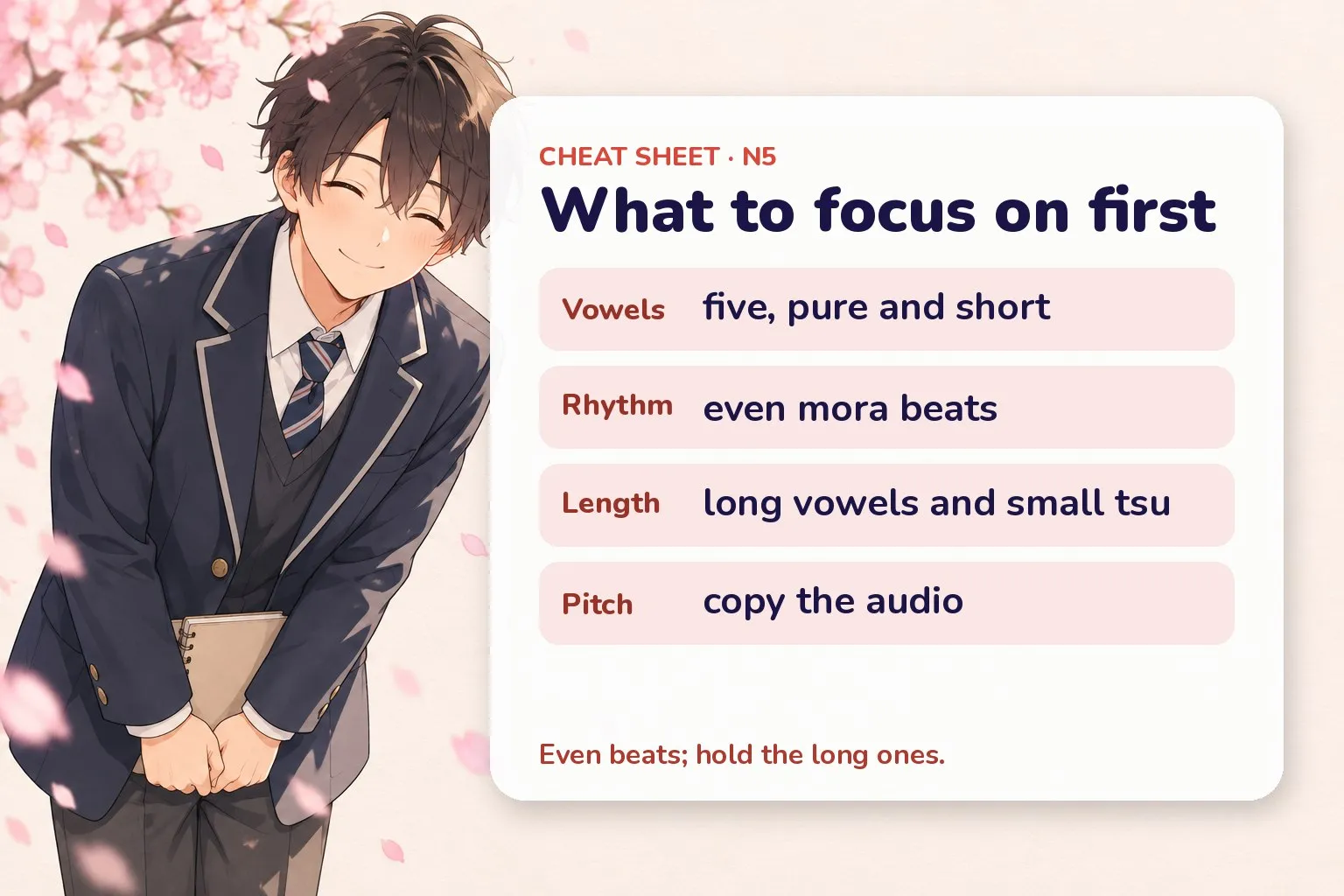
Quick recap before you practise.
Practice
Japanese pronunciation practice
Try each one, then press Check. No sign-up, nothing is sent anywhere — it all runs in your browser.
Hint: double the consonant for the silent beat
Show answer
kitte — きって (kitte) has the one-beat pause; きて (kite) does not.
4 Match each word to the feature it shows.
- おばあさん (obāsan)
- きって (kitte)
- みかん (mikan)
- つくえ (tsukue)
Show answer
- おばあさん (obāsan) → long vowel
- きって (kitte) → double consonant
- みかん (mikan) → final n as a beat
- つくえ (tsukue) → the tsu sound
Long vowel, small っ, the ん beat, and つ (tsu) are the features to hear.
Quiz
Japanese pronunciation overview quiz
8 questions · pick an answer and you'll see straight away if it's right.
-
Show answer
equal beats called mora — Each kana is one even beat; keep every beat the same length.
-
Show answer
five — a, i, u, e, o — only five, and they never change.
-
Show answer
a long vowel held an extra beat — The long vowel adds a beat and changes 'aunt' to 'grandmother'.
-
Show answer
a one-beat silent pause before a consonant — It is a held, silent beat written as a double consonant in romaji.
-
Show answer
a light tap near 'dd' in ladder — A quick tap of the tongue, not the English r.
-
Show answer
the ts in cats plus a vowel — Blend t and s: 'ts' as in cats, then the vowel.
-
Show answer
no — it uses even beats and pitch — There is no heavy stress; keep beats even and copy the pitch you hear.
-
Show answer
copy the audio closely — Shadowing good audio nudges your pitch the right way without charts.
Next
- Build words into sentences with the です (desu) copula
- Browse every topic in the Japanese grammar section
- New here? Start with Start Learning Japanese Here
All Japanese pronunciation & writing topics
Vocabulary, pronunciation, phrases, practice and exam help, ordered by level. Pick a topic and go straight to it. New lessons go live every day, so topics marked Coming soon fill in over the next weeks.
Pronunciation & writing
N5 9 topics · 1 ready
- 01 Japanese Pronunciation Overview You are here
- 02 Hiragana Chart (Complete) Coming soon
- 03 Katakana Chart (Complete) Coming soon
- 04 Dakuten & Handakuten (゛ ゜) Coming soon
- 05 Yoon: Combined Kana (きゃ しゅ ちょ kya shu cho) Coming soon
- 06 Long Vowels & Small Tsu (Sokuon) Coming soon
- 07 Kanji & Kana Stroke Order Rules Coming soon
- 08 Romaji: Systems & Why to Move Beyond It Coming soon
- 09 Essential N5 Kanji Set Coming soon
N4 4 topics
- 10 Introduction to Kanji Coming soon
- 11 Kanji Radicals (Bushu) Coming soon
- 12 Kanji Readings: On'yomi vs Kun'yomi Coming soon
- 13 Essential N4 Kanji Set Coming soon
N3 2 topics
- 14 Japanese Pitch Accent (Intro) Coming soon
- 15 When to Use Kana vs Kanji Coming soon