Italian Vowels: The 7 Sounds
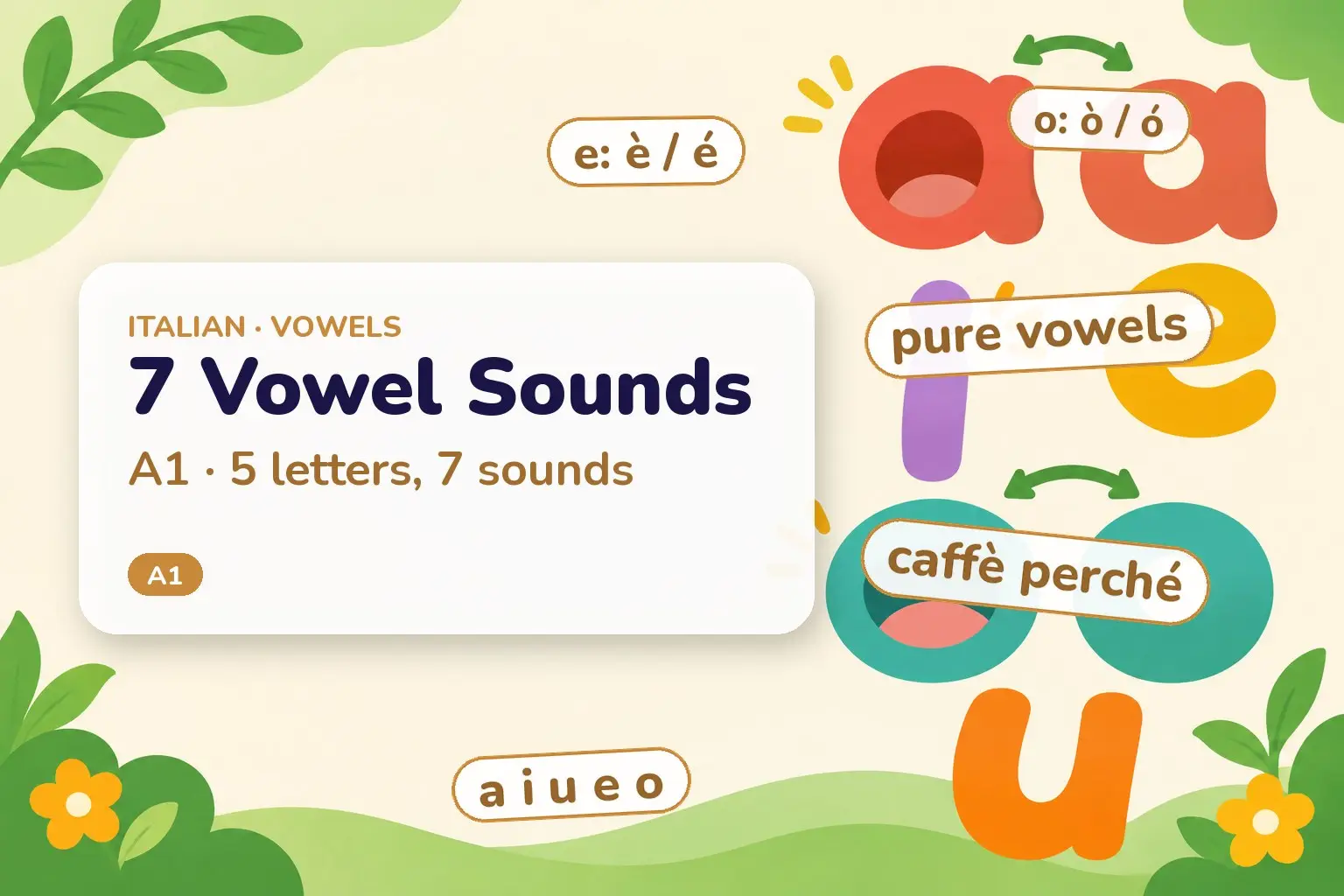
Italian has five vowel letters but seven vowel sounds, because a stressed e and o each have an open version (è, ò) and a closed one (é, ó). The vowels a, i and u have one clear sound each and never reduce to a schwa.
Level: A1. Italian spelling is wonderfully regular, and its vowels are the heart of that clear, musical sound. There are only five vowel letters — a, e, i, o, u — but seven vowel sounds, because a stressed e and a stressed o can each be “open” or “closed”. The good news: three of the five vowels have just one sound.
By the end of this page you can…
…pronounce the five Italian vowels purely and fully, understand why there are seven sounds, hear the open/closed difference in stressed e and o, and read the grave and acute accents.
Five letters, seven sounds
Three vowels are completely stable — one clear sound each, every time:
| Letter | Sound (like) | Example |
|---|---|---|
| a | “ah” in father | casa (house) |
| i | “ee” in machine | vino (wine) |
| u | “oo” in food | luna (moon) |
The other two, e and o, split into an open and a closed sound, but only in the stressed syllable:
| Letter | Open | Closed |
|---|---|---|
| e | è, like “e” in bet (caffè, bène) | é, like “ay” without the glide (perché, séra) |
| o | ò, like “o” in for (òtto, buòno) | ó, like “o” in note without the glide (sóle, dóve) |
That is 3 + 2 + 2 = seven sounds. In unstressed syllables, e and o settle to a plain mid value, so you only worry about open vs closed on the stressed vowel.
Keep every vowel pure
The single biggest giveaway of an English accent in Italian is the schwa — the lazy “uh” English uses in unstressed syllables (the “a” in “about”, the “o” in “lemon”). Italian never does this. Every vowel keeps its full, clear value wherever it falls in the word.
- banana is “bah-NAH-nah” — three full a’s, not “buh-NAN-uh”.
- telefono is “te-LE-fo-no” — every vowel sounded, not “TEL-uh-fuhn”.
Open vs closed: minimal pairs
In careful standard Italian, the open/closed choice can distinguish a few words. These minimal pairs show it:
| Open (è / ò) | Closed (é / ó) |
|---|---|
| pèsca (peach) | pésca (fishing) |
| bòtte (blows, hits) | bótte (barrel) |
| è (is) | — |
| vénti (twenty) is closed | — |
Do not panic about these: most are rare, context makes them obvious, and even native speakers vary (see the note below). Getting a, i, u pure and keeping every vowel full matters far more at A1.
Written accents
Italian writes an accent on a vowel mainly to mark stress on a final syllable, and the accent’s shape shows open or closed:
- grave (`) — the usual one, on open vowels and on a, i, u: città (city), caffè (coffee), così (so), più (more), però (but).
- acute (´) — on a closed e, chiefly in words ending in -ché and a few others: perché (because/why), né (nor), sé (oneself).
These accents are compulsory where the rules require them: caffè without its accent is simply misspelled.
How to say it
- a — “ah”, open and full: casa.
- i — “ee”: vino.
- u — “oo”: luna (never the English “yoo”).
- è / ò (open) — “e” in bet, “o” in for: caffè, otto.
- é / ó (closed) — a pure “ay”/“oh” with no glide: perché, sole.
Example words
- casahousepure a: 'KAH-za'
- vinowinei = 'ee'
- lunamoonu = 'oo', never 'yoo'
- bananabananathree full a's, no schwa
- telefonotelephoneevery vowel clear: te-LE-fo-no
- caffècoffeeopen è, grave accent, stress on the end
- perchébecause / whyclosed é, acute accent
- solesunclosed ó: 'SOH-leh'
- ottoeightopen ò: 'AWT-to'
- buonogoodopen ò in the stressed syllable
- seraeveningclosed é: 'SEH-ra'
- benewellopen è: 'BEH-ne'
- pescapeach OR fishingopen è = peach, closed é = fishing
- amicofriend (male)final -o shows masculine
- amicafriend (female)final -a shows feminine; say it fully
- cittàcitygrave accent marks final stress
- piùmoregrave on u: 'pyoo'
- dovewhereclosed ó: 'DOH-veh'
Why vowels make Italian easy to read
Because vowels are pure and the spelling is regular, Italian reads aloud almost exactly as written. Once you fix the five letters, keep every vowel full, and add the open/closed nuance on stressed e and o, you can pronounce a brand-new word on sight.
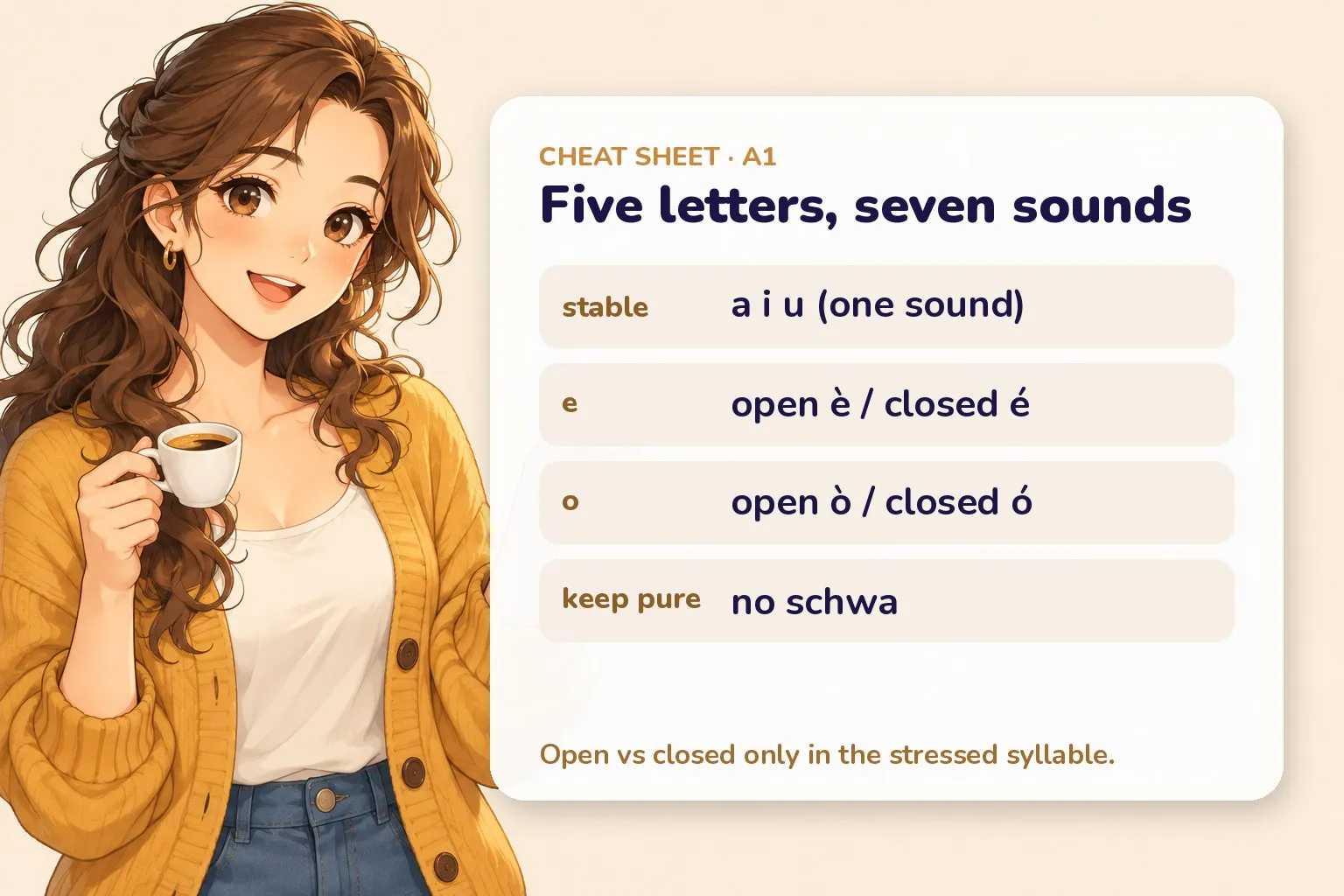
Quick recap before the quiz.
Practice
Italian vowels practice
Try each one, then press Check. No sign-up, nothing is sent anywhere — it all runs in your browser.
Hint: where the emphasis falls
Show answer
stressed — Open vs closed e/o is only distinguished in the stressed syllable.
4 Match each vowel to its sound.
- a
- i
- u
- è
Show answer
- a → ah (father)
- i → ee (machine)
- u → oo (food)
- è → e (bet)
a, i, u are stable; è is the open e.
Quiz
Italian vowels and their sounds
8 questions · pick an answer and you'll see straight away if it's right.
-
Show answer
5 letters and 7 sounds — Five vowel letters, seven sounds.
-
Show answer
a, i, u — a, i and u never change; e and o split.
-
Show answer
e and o — Only e and o have an open and a closed version.
-
Show answer
grave accent marking final stress — Grave accent, open è, stress on the final syllable.
-
Show answer
acute accent on a closed é — Acute accent on the closed é at the end.
-
Show answer
'oo' as in food — Pure 'oo': LOO-na, never 'yoo'.
-
Show answer
they show gender and number — The final vowel often marks grammar: -o masculine, -a feminine.
-
Show answer
variable by region; the Tuscan standard is a guide — It varies regionally; the Florentine standard is a reference, not a universal rule.
Next
- Spell it out first: The Italian Alphabet
- Get the full sound picture: Italian pronunciation overview
- Start the course: Start Learning Italian Here
All Italian pronunciation & writing topics
Vocabulary, pronunciation, phrases, practice and exam help, ordered by level. Pick a topic and go straight to it. New lessons go live every day, so topics marked Coming soon fill in over the next weeks.
Pronunciation & writing
A1 6 topics · 6 ready
- 01 Italian Pronunciation Overview
- 02 The Italian Alphabet
- 03 Italian Vowels (7 Sounds) You are here
- 04 Italian Double Consonants (Doppie)
- 05 Italian C & G: Hard vs Soft
- 06 The Silent H & Spelling in Italian