Italian Double Consonants (Doppie) Explained
Italian double consonants — le doppie — are held noticeably longer than single ones, and that length changes the word: nono (ninth) versus nonno (grandfather). You make them by lingering on the consonant and cutting the vowel in front of it short.
Level: A1. A written double letter in Italian — tt, nn, ll, ss — is not decoration and it is not silent. It tells you to hold that consonant clearly longer than a single one. Italian calls these le doppie, and getting them right is one of the biggest steps from “reading the words” to “sounding Italian”, because the length alone can switch one word for another.
By the end of this page you can…
…hear the difference between a single and a double consonant, pronounce a geminate by holding it, and know why the double also shortens the vowel in front of it.
What a double consonant is
A geminate (the technical word for a double consonant) is a consonant held for noticeably longer than its single version. English does this only across word boundaries — the long “k” in “book-case”, the long “n” in “ten nails” — never inside a single word. Italian does it inside words all the time, and it is written with two letters.
The effect is real and meaningful. Compare these minimal pairs, words that differ only in the length of one consonant:
| Single | Double | Meaning |
|---|---|---|
| nono | nonno | ninth / grandfather |
| nona | nonna | ninth (fem.) / grandmother |
| note | notte | notes / night |
| pala | palla | shovel / ball |
| casa | cassa | house / cash desk, crate |
| sete | sette | thirst / seven |
| sono | sonno | I am / sleep |
| copia | coppia | copy / couple |
| capello | cappello | hair / hat |
| caro | carro | dear / cart |
Mix them up and you really do say something else: Ho sete means “I’m thirsty”, but Ho sette means “I have seven”.
How to pronounce a double consonant
The trick depends on the kind of consonant:
- Stops (tt, pp, cc, bb, dd, gg): close your mouth on the consonant, pause for a split second with the air blocked, then release. In gatto (cat) you briefly stop on the “t” before the “o” — “GAT-to”, with a tiny held beat.
- Continuous sounds (ss, ll, mm, nn, rr, ff, vv): simply keep the sound going longer. palla (ball) stretches the “l”: “PAL-la”. mamma holds the “m”.
- rr gets a longer, stronger trill than a single r: carro (cart) rolls more than caro (dear).
The double also shortens the vowel before it
There is a two-for-one bonus. A stressed vowel before a single consonant is long; before a double consonant it is short. So the two parts of the word trade length:
- casa (house): long “a”, short “s” — “CAA-sa”.
- cassa (cash desk): short “a”, long “s” — “CAS-sa”.
Even if you do not fully lengthen the consonant yet, shortening the vowel helps a listener hear the double.
Two things that are NOT doubles
- cq spells the long k. The “kk” sound is written cq, not cc, after a vowel: acqua (water), acquisto (purchase). It is pronounced like a double c.
- gl and gn are single sounds. gl (as in moglie, wife) and gn (as in gnocchi or bagno, bath) are each one special sound, not a doubled consonant — do not try to lengthen them as geminates.
And note that q never doubles and h is always silent and never doubles either.
How to say it
- tt, pp, cc — block the air, hold a beat, release: gatto, troppo, bocca.
- ss, ll, nn, mm — just keep the sound going: rosso, bello, anno, donna.
- rr — a longer, stronger roll than single r: terra, birra.
- cq — a long k written c + q: acqua.
- vowel + double — clip the vowel short: fatto ≈ “FAT-to”, not “FAA-to”.
Example words
- nonnograndfatherhold the n; compare nono = ninth
- nonnagrandmotherlong n; compare nona
- nottenightheld tt; compare note = notes
- pallaballstretch the l; compare pala = shovel
- cassacash desk / cratelong s; compare casa = house
- settesevenheld tt; compare sete = thirst
- sonnosleeplong n; compare sono = I am
- cappellohatdouble p then double l; compare capello = hair
- gattocatblock on the t, then release
- mammamumhold the m
- troppotoo muchheld pp
- rossoredlong s
- bellobeautifulstretch the l
- annoyearlong n; ano means something else entirely
- birrabeera longer rolled rr
- acquawaterthe long k is spelled cq
- pizzapizzadouble z, held
- freddocoldheld dd
Why the doppie are worth the effort
Italian spelling is otherwise wonderfully regular, so the doubles are one of the few places where a single letter decides the meaning. Spend time on minimal pairs like nonno / nono and sete / sette early, and you avoid a whole class of mix-ups — and you immediately sound more natural, because native ears notice a missing geminate at once.
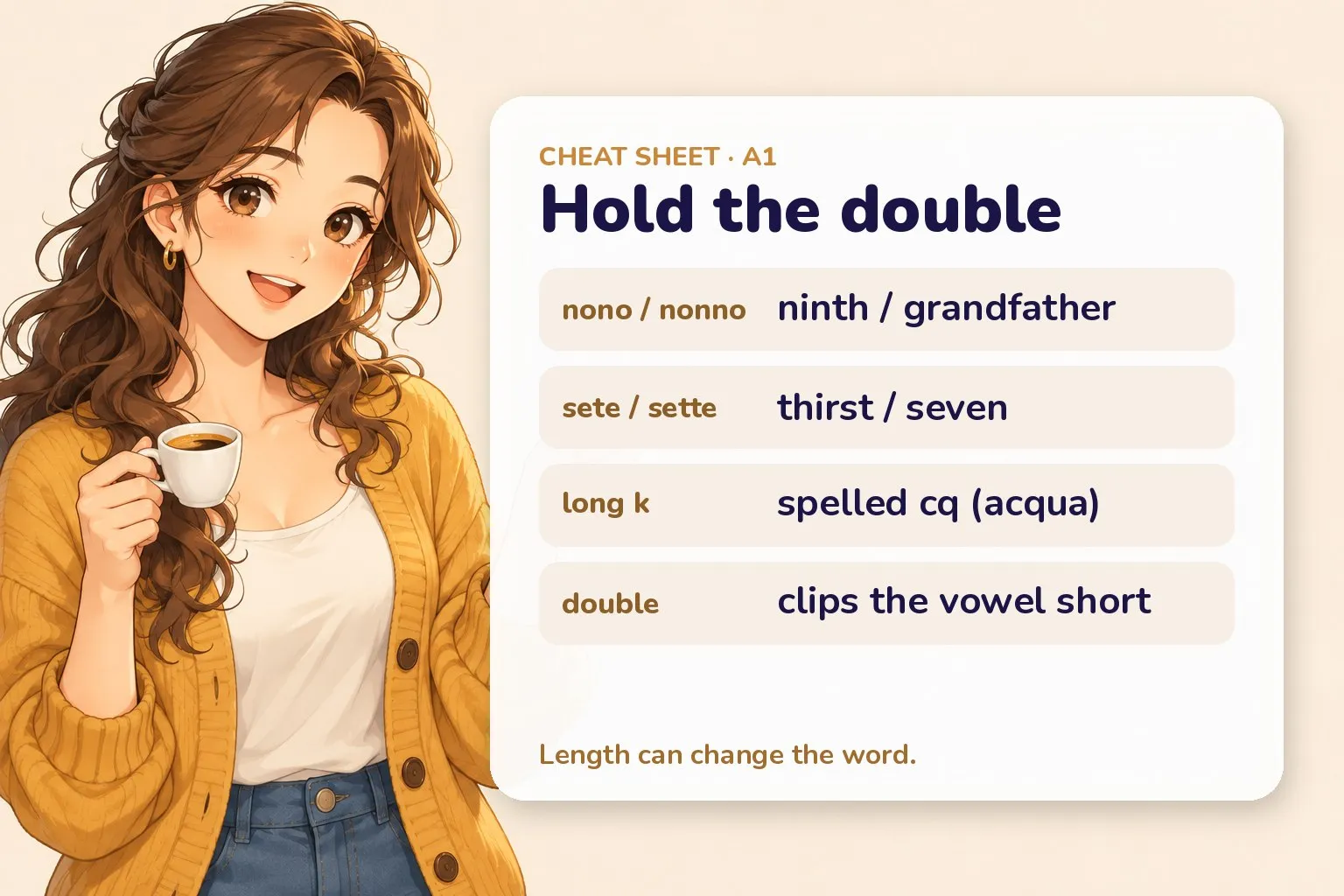
Quick recap before the quiz.
Practice
Double consonants practice
Try each one, then press Check. No sign-up, nothing is sent anywhere — it all runs in your browser.
Hint: acqua
Show answer
cq — The long k is written cq: acqua.
3 Match each pair to its meanings.
- casa / cassa
- note / notte
- sete / sette
- caro / carro
Show answer
- casa / cassa → house / cash desk
- note / notte → notes / night
- sete / sette → thirst / seven
- caro / carro → dear / cart
Each pair differs only in a single versus double consonant.
Quiz
Italian double consonants
10 questions · pick an answer and you'll see straight away if it's right.
-
Show answer
held longer than a single one — It is one consonant held noticeably longer — a geminate.
-
Show answer
the length of the n — The double n (grandfather) versus single n (ninth) changes the word.
-
Show answer
block the air, hold a beat, release — Close on the t, pause briefly, then release into the vowel.
-
Show answer
short — casa has a long a; cassa has a short a before the double s.
-
Show answer
I have seven — sette = seven; sete = thirst. The double t changes it.
-
Show answer
cq — It is written cq: acqua.
-
Show answer
gl in moglie — gl is a single special sound, not a geminate.
-
Show answer
q — q never doubles; the long k is written cq instead.
-
Show answer
the single n gives a different word (pain, not pen) — pena = pain, penna = pen — the double n is meaningful.
-
Show answer
minimal pair — They differ only in one consonant's length — a minimal pair.
Next
- The vowels that go with them: Italian vowels and their sounds
- Spell it out first: the Italian alphabet
- See the whole sound system: Italian pronunciation overview
- New here? Start Learning Italian Here
All Italian pronunciation & writing topics
Vocabulary, pronunciation, phrases, practice and exam help, ordered by level. Pick a topic and go straight to it. New lessons go live every day, so topics marked Coming soon fill in over the next weeks.
Pronunciation & writing
A1 6 topics · 6 ready
- 01 Italian Pronunciation Overview
- 02 The Italian Alphabet
- 03 Italian Vowels (7 Sounds)
- 04 Italian Double Consonants (Doppie) You are here
- 05 Italian C & G: Hard vs Soft
- 06 The Silent H & Spelling in Italian