Italian Spelling Rules and the Apostrophe
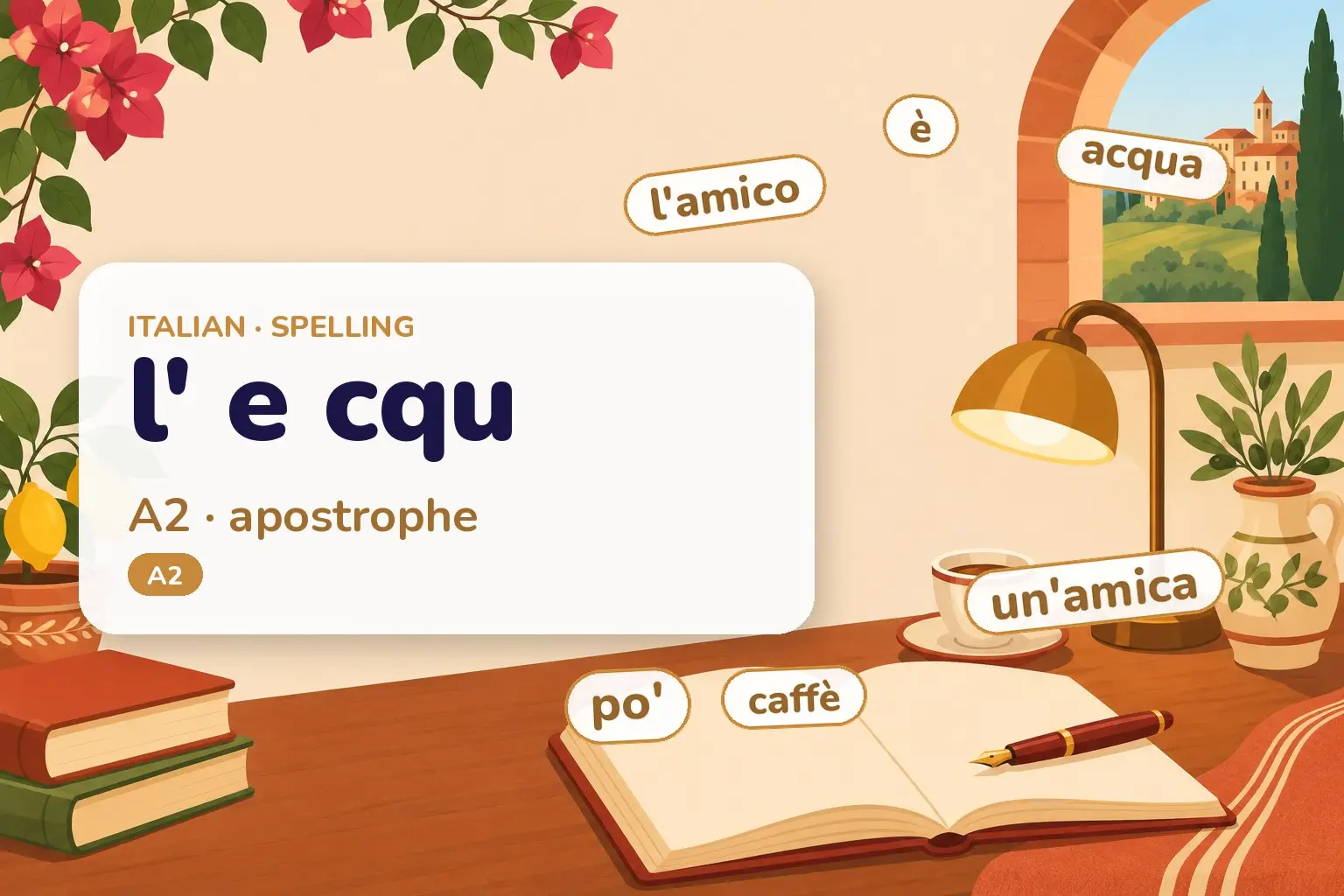
Italian drops a final vowel before another vowel and marks it with an apostrophe: lo amico becomes l'amico. An accent differs from an apostrophe: è ('is') takes an accent, po' an apostrophe. The 'kw' sound is spelled qu, doubled to cqu in acqua and forms like nacque.
On this page10 sections · tap to jump
Level: A2. A few Italian spelling habits cause most of the written mistakes learners make: when to glue words together with an apostrophe, when a mark is an accent and not an apostrophe, and how to spell the “kw” sound. Sort these out and your Italian looks native on the page.
By the end of this page you can…
…elide words correctly with an apostrophe (l’amico), tell an apostrophe apart from an accent (è vs e’), write po’ and short commands with the right mark, and spell the “kw” sound as qu or cqu.
Elision: dropping a vowel before a vowel
Elision (Italian elisione) drops a final unstressed vowel when the next word begins with a vowel, and marks the missing letter with an apostrophe. It makes two words run together smoothly:
- lo amico → l’amico (the friend)
- la ora → l’ora (the hour)
- una amica → un’amica (a female friend)
- di Italia → d’Italia (of Italy)
- dello acqua → dell’acqua (some water)
Elision is normal with the articles lo, la, una, the prepositions di, da, and words like questo/questa, bello/bella, santo/santa (Sant’Angelo). There is no space after the apostrophe: write l’amico, never l’ amico.
Apostrophe vs accent — they are not the same mark
Learners mix these up constantly, but they do different jobs:
| Mark | Job | Example |
|---|---|---|
| accent (è, à, ì, ò, ù) | sits on a vowel to show stress or meaning | è (is), caffè, città, perché |
| apostrophe (’) | replaces a dropped letter between/after words | l’amico, d’Italia, po’ |
The classic trap is è vs e’. È (with an accent) means “is”; there is no correct Italian word e’ with an apostrophe. Likewise perché, caffè, città and virtù carry an accent on the final stressed vowel — never an apostrophe.
po’ and cut-off words (troncamento)
Some words end in an apostrophe because a letter or syllable has been cut off (Italian troncamento), not elided before a vowel:
- po’ = a shortened poco (“a little”): un po’ di pane. It is never pò with an accent.
- Short imperatives: va’ (go), da’ (give), di’ (say), fa’ (do), sta’ (stay) — the apostrophe marks the cut-off ending.
The difference from elision: elision happens before a vowel (l’amico), while this cut-off can happen before a consonant too (un po’ di…, va’ via).
The “kw” sound: qu and cqu
The sound “kw” is spelled qu followed by a vowel: quattro (four), questo (this), quando (when), acqua (water). It doubles to cqu in two small groups: acqua and the words built from it, and the passato remoto of a handful of -cere verbs (nacque, piacque, tacque, giacque, nocque):
| Spelling | Words |
|---|---|
| qu (normal) | quattro, questo, quando, qui, quale |
| cqu (acqua family) | acqua, acquisto, acquolina |
| cqu (passato remoto) | nacque, piacque, tacque, giacque, nocque |
The letter q is practically never doubled as qq — the rare word soqquadro (“disarray”) is the one standard exception — and you never write cu for the “kw” sound in these words. Outside these groups, keep it simple: single qu.
Example words and sentences
- l'amicothe (male) friendlo + amico elided
- l'amicathe (female) friendla + amica elided
- un amicoa (male) friendun has no apostrophe
- un'amicaa (female) frienduna elided to un'
- l'orathe hourla + ora
- d'Italiaof Italydi + Italia elided
- dell'acquasome waterdello/della + acqua
- Com'è bello!How beautiful it is!come + è elided; è has an accent
- È tardi.It's late.è = 'is', accent not apostrophe
- Vorrei un caffè.I'd like a coffee.caffè: accent on final vowel
- Abito in città.I live in the city.città: final-vowel accent
- Perché non vieni?Why don't you come?perché with accent
- Vorrei un po' di pane.I'd like a little bread.po' = poco, apostrophe before a consonant
- Va' a casa!Go home!va': cut-off imperative
- Bevo un bicchiere d'acqua.I drink a glass of water.acqua spelled cqu
- Ho fatto un acquisto.I made a purchase.acquisto: cqu family
- Quattro amici sono qui.Four friends are here.quattro, qui: normal qu
- Quando parte il treno?When does the train leave?quando: normal qu
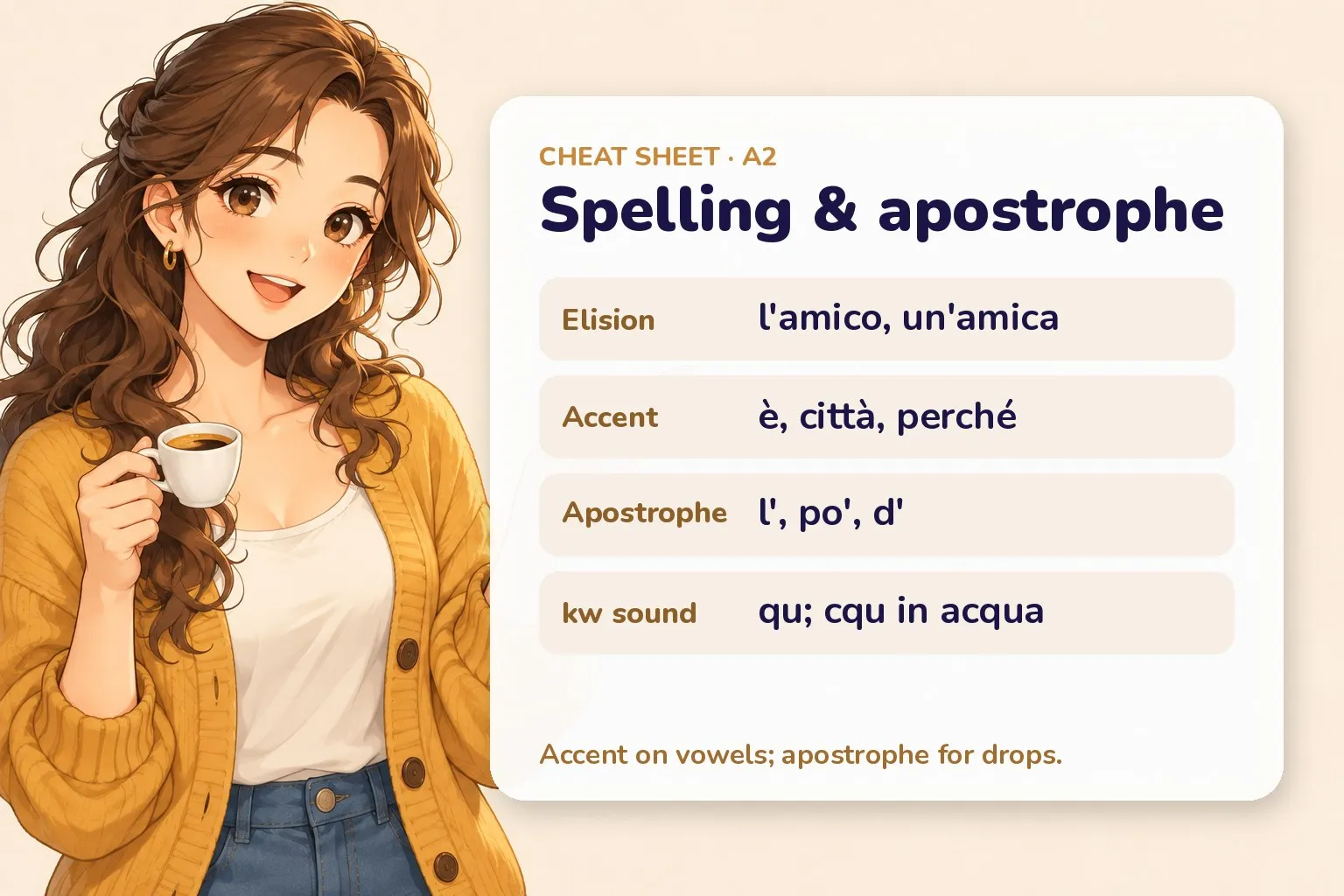
Quick recap before the quiz.
How to say it
- qu — always “kw”: quattro ≈ “KWAHT-tro”, questo ≈ “KWES-to”.
- cqu — a longer “kkw”: acqua ≈ “AHK-kwa”, held slightly longer than single qu.
- elided words run together with no pause: l’amico ≈ “LAH-mee-ko”, one smooth word.
- final accented vowel takes the stress: caffè ≈ “kaf-FEH”, città ≈ “cheet-TAH”.
Practice
Spelling and apostrophe practice
Try each one, then press Check. No sign-up, nothing is sent anywhere — it all runs in your browser.
Hint: shortened poco
Show answer
po' — po' ends in an apostrophe (cut-off of poco), never pò with an accent.
4 Match each mark to its job.
- è
- l'
- città
- po'
Show answer
- è → accent = 'is'
- l' → apostrophe = elision
- città → accent on final vowel
- po' → apostrophe = cut-off word
Accents sit on vowels; apostrophes replace dropped letters.
Hint: accent on the final vowel
Show answer
è — caffè takes an accent on the final stressed vowel.
Quiz
Italian spelling and the apostrophe
10 questions · pick an answer and you'll see straight away if it's right.
-
Show answer
a vowel — Elision happens before a vowel: lo amico → l'amico.
-
Show answer
l'ora — la elides to l' before the vowel: l'ora.
-
Show answer
un amico (a male friend) — Masculine un drops nothing, so no apostrophe: un amico.
-
Show answer
is — è = 'is'; there is no correct word e' with an apostrophe.
-
Show answer
when the stress is on the final vowel (città, perché) — Final-syllable stress is marked: città, caffè, perché.
-
Show answer
po' — po' is a cut-off of poco and takes an apostrophe, never an accent.
-
Show answer
va' — va' (go) is the troncamento form with an apostrophe.
-
Show answer
qu — qu + vowel: quattro, questo, quando.
-
Show answer
acqua — Water is acqua — part of the small cqu family.
-
Show answer
d' — di elides to d' before a vowel: d'Italia.
Recap cheat-sheet
| Point | Rule |
|---|---|
| Elision | drop final vowel before a vowel: l’amico |
| un vs un’ | un amico (m., no mark); un’amica (f.) |
| Accent | on a vowel for stress/meaning: è, città |
| Apostrophe | replaces a dropped letter: l’, po’, d’ |
| po’ | cut-off of poco, apostrophe not accent |
| kw sound | qu (quattro); cqu in acqua family + nacque, piacque |
Next
- Hard and soft c and g: Italian c and g sounds
- Hold the long ones: Italian double consonants
- Spell the letters out loud: the Italian alphabet
- New here? Start Learning Italian Here
All Italian pronunciation & writing topics
Vocabulary, pronunciation, phrases, practice and exam help, ordered by level. Pick a topic and go straight to it. New lessons go live every day, so topics marked Coming soon fill in over the next weeks.
Pronunciation & writing
A1 6 topics · 6 ready
A2 2 topics · 2 ready
- 07 Italian Stress & Written Accents
- 08 Italian Spelling Rules & Apostrophe You are here