Italian C and G: Hard vs Soft Sounds
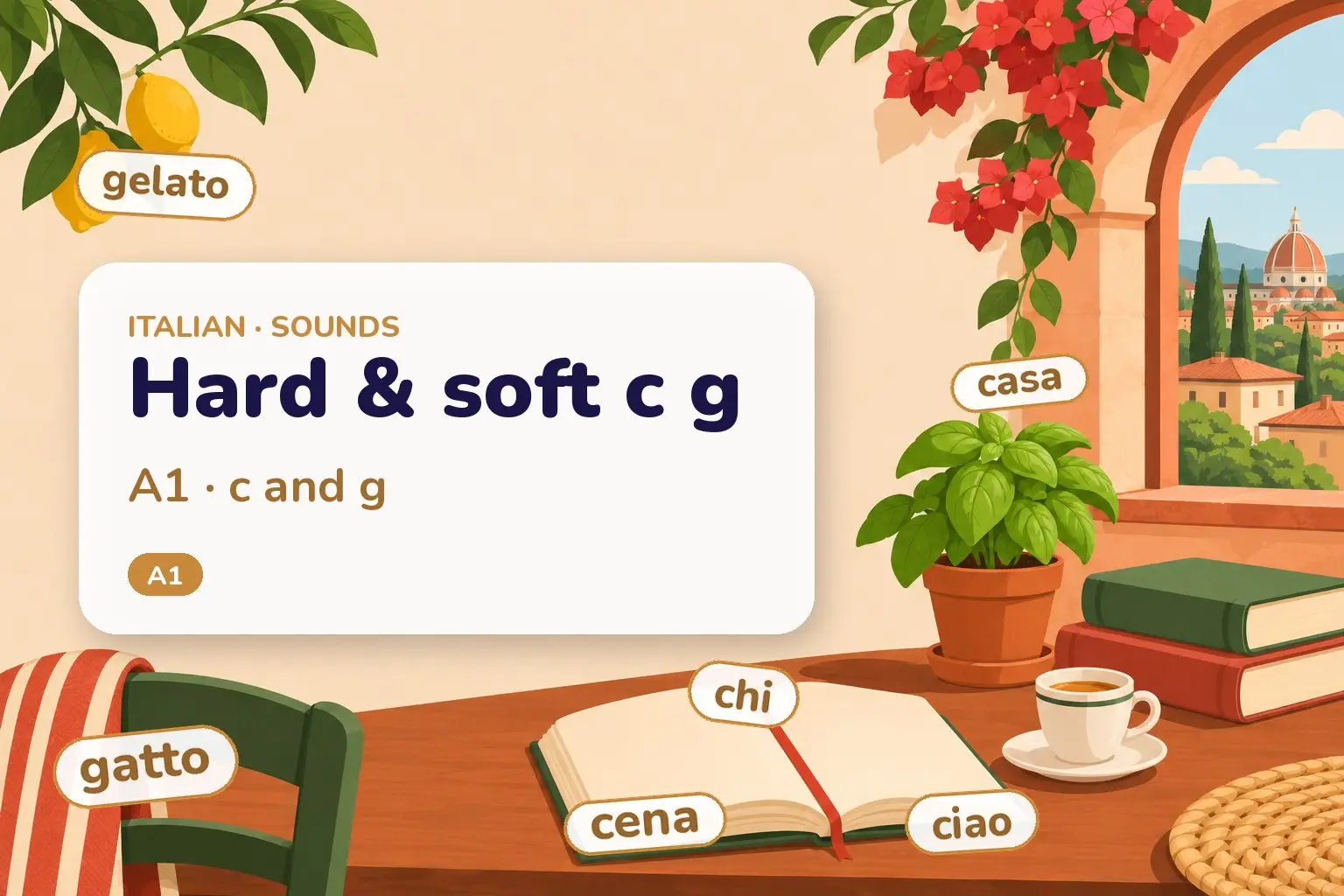
In Italian, c and g are hard (like k and g in 'go') before a, o and u, but soft (like 'ch' in church and 'j' in jam) before e and i. An h keeps them hard (che, ghi) and an i makes them soft before a/o/u (ciao, giallo).
On this page10 sections · tap to jump
Level: A1. The letters c and g each have two sounds in Italian — one hard, one soft — and which one you use depends entirely on the vowel that follows. The rule is completely regular, so once you learn it there are no exceptions to memorise. This page also covers the special clusters gn, gli and sc.
By the end of this page you can…
…read any Italian c or g correctly, use the silent h and silent i to switch the sound, and pronounce gn, gli, sc and sch the Italian way.
The core rule: it’s all about the next vowel
Both c and g are hard before a, o, u and before a consonant, and soft before e and i.
- Hard c = the “k” in cat: casa (“house”), cosa (“thing”), cultura (“culture”).
- Soft c = the “ch” in church: cena (“dinner”), città (“city”), cinema.
- Hard g = the “g” in go: gatto (“cat”), gondola, gusto (“taste”).
- Soft g = the “j” in jam: gelato (“ice cream”), giro (“turn / tour”), gennaio (“January”).
Keeping it hard: add an h
To keep a hard sound before e or i, Italian slips in a silent h: ch and gh.
- che (“that / what”), chi (“who”), chiesa (“church”), perché (“because”) — all hard “k”.
- spaghetti, ghiaccio (“ice”), laghi (“lakes”), righe (“lines”) — all hard “g”.
The h is never pronounced on its own. Its only purpose is to stop e and i from softening the letter.
Making it soft: add an i
To make a soft sound before a, o or u, Italian inserts a silent i: ci and gi.
- ciao (“hi / bye”), cioccolato (“chocolate”), ciuccio — soft “ch”.
- giallo (“yellow”), giorno (“day”), giusto (“right / fair”) — soft “j”.
Here the i is not a separate vowel — you do not say “chee-ao” for ciao, just “chow”. The i simply signals the soft sound.
The special clusters: gn, gli, sc
Three combinations have their own fixed sounds:
- gn = the “ny” in canyon: gnocchi (“nyOH-kee”), bagno (“bath”), signore (“sir”), lasagne.
- gli = the “lli” in million, a liquid palatal sound: famiglia (“family”), figlio (“son”), aglio (“garlic”), and the little word gli (“the”, masculine plural).
- sc depends on the next vowel, just like c and g: it is “sh” before e or i — pesce (“fish”), scena (“scene”), sciare (“to ski”) — and “sk” before a, o, u — scala (“stairs”), scuola (“school”). Adding h keeps it hard: sch = “sk”, as in scherzo (“joke”).
How to say it
- hard c / g — “k” and “g in go”: casa ≈ “KAH-za”, gatto ≈ “GAHT-toh”.
- soft c / g — “ch” and “j”: cena ≈ “CHEH-na”, gelato ≈ “jeh-LAH-toh”.
- gn — “ny” as in canyon: bagno ≈ “BAH-nyoh”.
- gli — “lli” as in million: figlio ≈ “FEE-lyoh”.
- sc — “sh” before e/i (pesce ≈ “PEH-sheh”), “sk” before a/o/u (scuola ≈ “SKWOH-la”).
Example words
- casahousehard c before a: 'KAH-za'
- cosathinghard c before o
- culturaculturehard c before u
- cenadinnersoft c before e: 'CHEH-na'
- cittàcitysoft c before i
- chethat / whatch = hard k: 'keh'
- chiwhochi = hard 'kee'
- ciaohi / byesoft c + silent i: 'chow'
- cioccolatochocolatesoft c; silent i
- gattocathard g before a
- gustotastehard g before u
- gelatoice creamsoft g before e: 'jeh-LAH-toh'
- giornodaysoft g + silent i: 'JOR-noh'
- spaghettispaghettigh = hard g before e
- ghiaccioicegh = hard g before i
- gnocchignocchi (dumplings)gn = 'ny'
- bagnobathroomgn = 'ny': 'BAH-nyoh'
- famigliafamilygli = 'lli' as in million
- pescefishsc before e = 'sh'
- scuolaschoolsc before u = 'sk'
A worked contrast: cena vs casa, gelato vs gatto
Say the pairs together and the rule becomes muscle memory: cena (“CHEH-na”, soft, before e) against casa (“KAH-za”, hard, before a); gelato (“jeh-LAH-toh”, soft, before e) against gatto (“GAHT-toh”, hard, before a). Same letter, opposite sound, decided only by the vowel that follows.
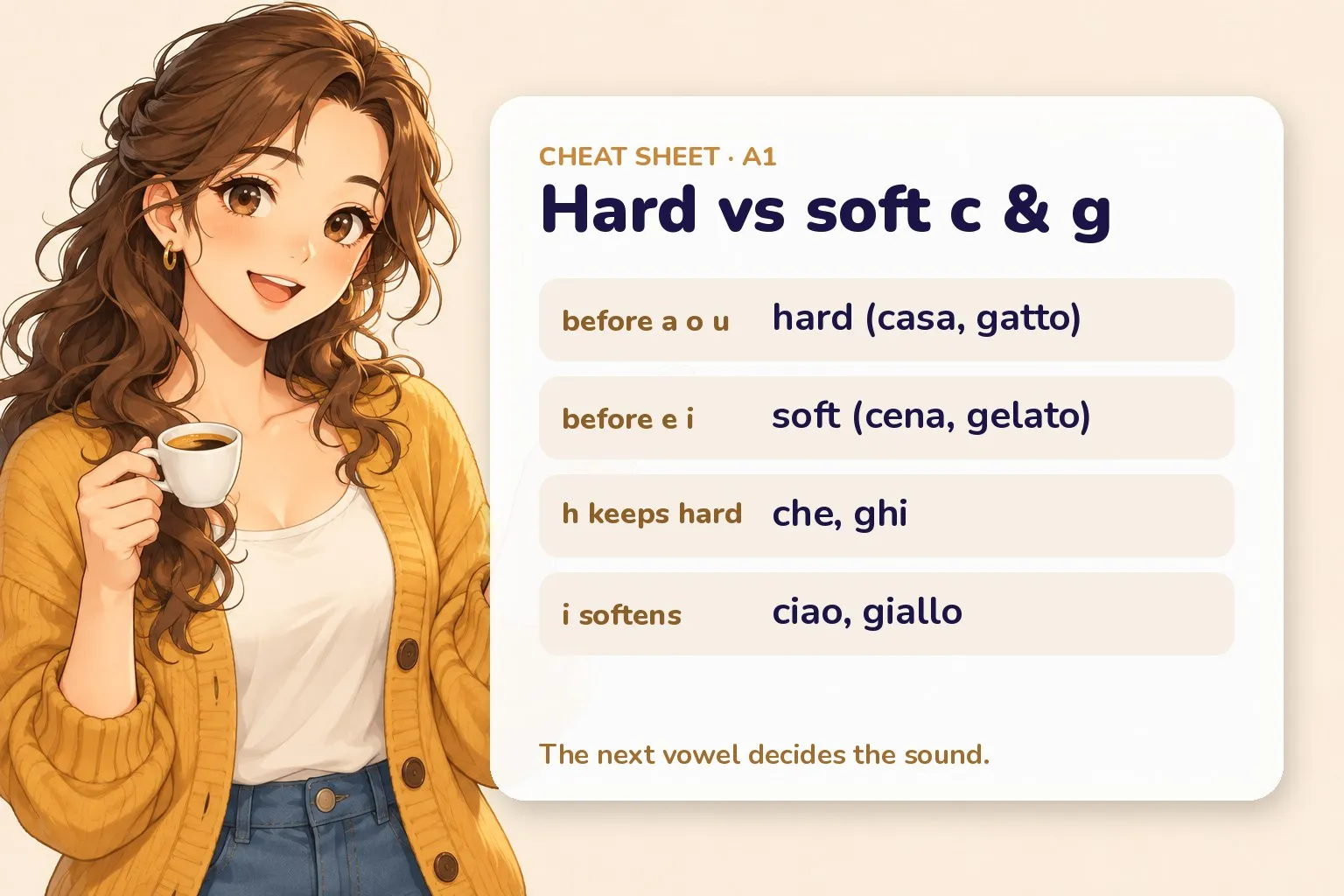
Quick recap before the quiz.
Practice
Italian c and g sounds practice
Try each one, then press Check. No sign-up, nothing is sent anywhere — it all runs in your browser.
Hint: che, chi
Show answer
h — An h blocks the softening: che and chi are hard 'keh' and 'kee'.
4 Match each cluster to its sound.
- gn
- gli
- sc (before e/i)
- ch
Show answer
- gn → 'ny' as in canyon
- gli → 'lli' as in million
- sc (before e/i) → 'sh'
- ch → hard 'k'
gn = ny, gli = lli, sc before e/i = sh, ch = hard k.
Hint: before e/i
Show answer
sh — sc before e or i is 'sh': pesce = 'PEH-sheh'.
Quiz
Italian c and g: hard vs soft
12 questions · pick an answer and you'll see straight away if it's right.
-
Show answer
e and i — e and i soften c and g; a, o, u keep them hard.
-
Show answer
hard 'k' — c before a is hard: casa = 'KAH-za'.
-
Show answer
soft 'j' — g before e is soft, like 'j' in jam: gelato.
-
Show answer
It keeps the c hard before e/i — The silent h blocks softening, keeping a hard 'k'.
-
Show answer
'chow' — The i is silent; ciao = 'chow'.
-
Show answer
hard 'g' — gh keeps the g hard before e: spa-GHET-tee.
-
Show answer
the 'ny' in canyon — gn = the 'ny' in canyon: bagno = 'BAH-nyoh'.
-
Show answer
the 'lli' in million — gli is the liquid 'lli' sound, as in million.
-
Show answer
'sk' — sc before a/o/u is 'sk': scuola = 'SKWOH-la'.
-
Show answer
'sh' — sc before e/i is 'sh': pesce = 'PEH-sheh'.
-
Show answer
i — A silent i softens the g: giallo = 'JAHL-loh'.
-
Show answer
città — c before i is soft: città = 'cheet-TAH'.
Next
- Start with the letters: the Italian alphabet
- The vowel sounds behind the rule: Italian vowels
- Length that changes meaning: Italian double consonants
- See the whole sound system: Italian pronunciation overview
All Italian pronunciation & writing topics
Vocabulary, pronunciation, phrases, practice and exam help, ordered by level. Pick a topic and go straight to it. New lessons go live every day, so topics marked Coming soon fill in over the next weeks.
Pronunciation & writing
A1 6 topics · 6 ready
- 01 Italian Pronunciation Overview
- 02 The Italian Alphabet
- 03 Italian Vowels (7 Sounds)
- 04 Italian Double Consonants (Doppie)
- 05 Italian C & G: Hard vs Soft You are here
- 06 The Silent H & Spelling in Italian