Italian Pronunciation Overview for Beginners
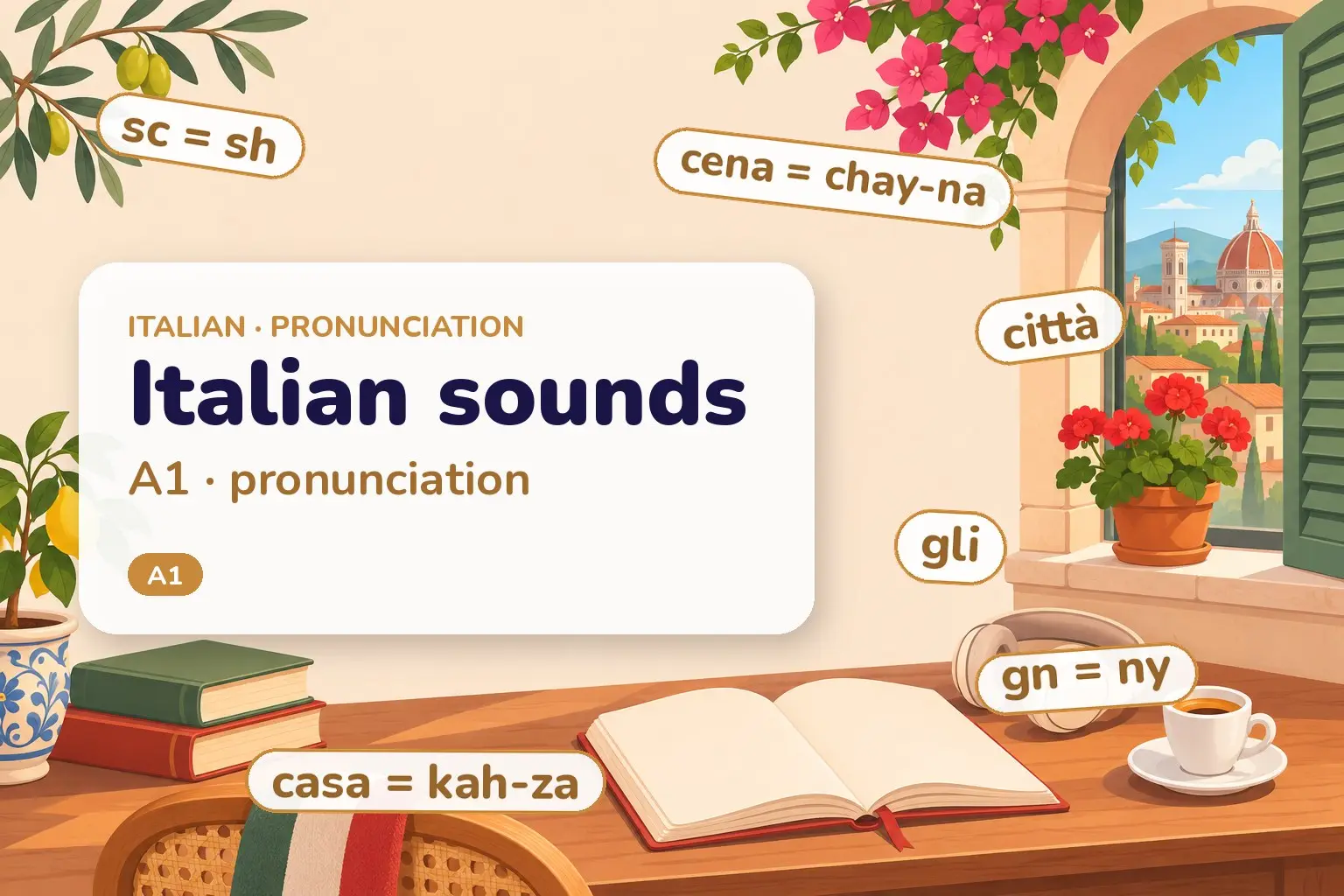
Italian is read almost exactly as written. Master five clean vowels, the soft and hard sounds of c and g, the clusters gli, gn and sc, and double consonants, and you can pronounce nearly any Italian word on sight.
Level: A1 (beginner). Italian is one of the most “what you see is what you say” languages in Europe. Learn a short set of rules for the letters that change, and the spelling tells you the sound.
By the end of this page you can…
…say the five Italian vowels cleanly, know when c and g are soft or hard, and read gli, gn, sc and double consonants.
Five pure vowels
Italian has exactly five vowel sounds, and they stay the same wherever they appear:
- a — like a in father (casa, house)
- e — like e in bet (bene, well)
- i — like ee in see (vino, wine)
- o — like o in more (sole, sun)
- u — like oo in food (luna, moon)
Keep them short and crisp; Italian does not glide vowels the way English does. Every vowel is pronounced, even in a run like aiuola.
Soft and hard c and g
This is the rule that unlocks menus and names. The letters c and g change sound depending on the next letter:
- Before e or i, they are soft: c = “ch” (cena = “CHAY-na”, dinner), g = “j” (gelato = “jeh-LAH-to”).
- Before a, o, u or a consonant, they are hard: c = “k” (casa = “KAH-za”), g = “g” as in “go” (gatto = “GAHT-to”).
To keep a hard sound before e/i, Italian inserts an h: ch and gh are always hard — chi = “kee”, spaghetti = “spah-GHET-tee”. To make a soft sound before a/o/u, it inserts an i that is not itself pronounced: ciao = “chow”, giorno = “JOR-no”.
How to say it
The special clusters and consonants English speakers need:
| Letter(s) | How to say it |
|---|---|
| ch / gh | Always hard “k” / “g”: chi = “kee”, laghi = “LAH-ghee”. |
| ci / gi before a/o/u | Soft, the i is silent: ciao = “chow”, giardino = “jar-DEE-no”. |
| gli | Like the “lli” in million: famiglia = “fa-MEEL-ya”. |
| gn | Like the “ny” in canyon: gnocchi = “NYOK-kee”, bagno = “BAN-yo”. |
| sc before e/i | Like “sh”: pesce = “PESH-eh”, sci = “shee”. |
| z | “ts” or “dz”: grazie = “GRAHT-tsyeh”, zero = “DZEH-ro”. |
| r | Tapped or rolled with the tongue, not the English r. |
| h | Always silent: ho = “oh”, hanno = “AHN-no”. |
Double consonants
A double consonant (tt, ll, nn, ss…) is held longer than a single one — a small pause on the sound. It is not decoration: it can change the word.
- nonno (grandfather) vs nono (ninth)
- pizza vs a single-z spelling would sound wrong
- sette (seven) with a clear long “tt”
Where the stress falls
Most Italian words are stressed on the second-to-last syllable: amico (“a-MEE-co”), gelato (“ge-LA-to”). When the stress falls on the final vowel, Italian marks it with a written accent: città (city), caffè (coffee), perché (why/because). A few common words are stressed earlier, which you simply learn with the word.
Example words
- casahousehard c before a: 'KAH-za'
- cenadinnersoft c before e: 'CHAY-na'
- gattocathard g; double t held
- gelatoice creamsoft g before e: 'jeh-LAH-to'
- ciaohi / byeci before a = 'chow'
- chiwhoch = hard k: 'kee'
- spaghettispaghettigh = hard g; double t
- famigliafamilygli = 'lli' in million
- gnocchignocchign = 'ny'; cch = hard k
- pescefishsc before e = 'sh'
- graziethank youz = 'ts'
- cittàcityaccent marks final stress
- nonnograndfatherlong nn, vs nono = ninth
- benewellclear pure vowels
- hoI haveh is silent: 'oh'
Using the audio
Each example has a Listen button that uses your device’s built-in voice (the browser’s speech feature), so it is a close guide rather than a native recording. Play a word, then repeat it, paying attention to the vowels and any double consonant. Short, frequent repeats beat one long session.
A note on regional variation
Pronunciation shifts across Italy — open and closed e and o, and the exact sound of z, differ between regions, and the r may be tapped or more strongly rolled. This overview follows the widely taught standard; the regional versions are all mutually understood.
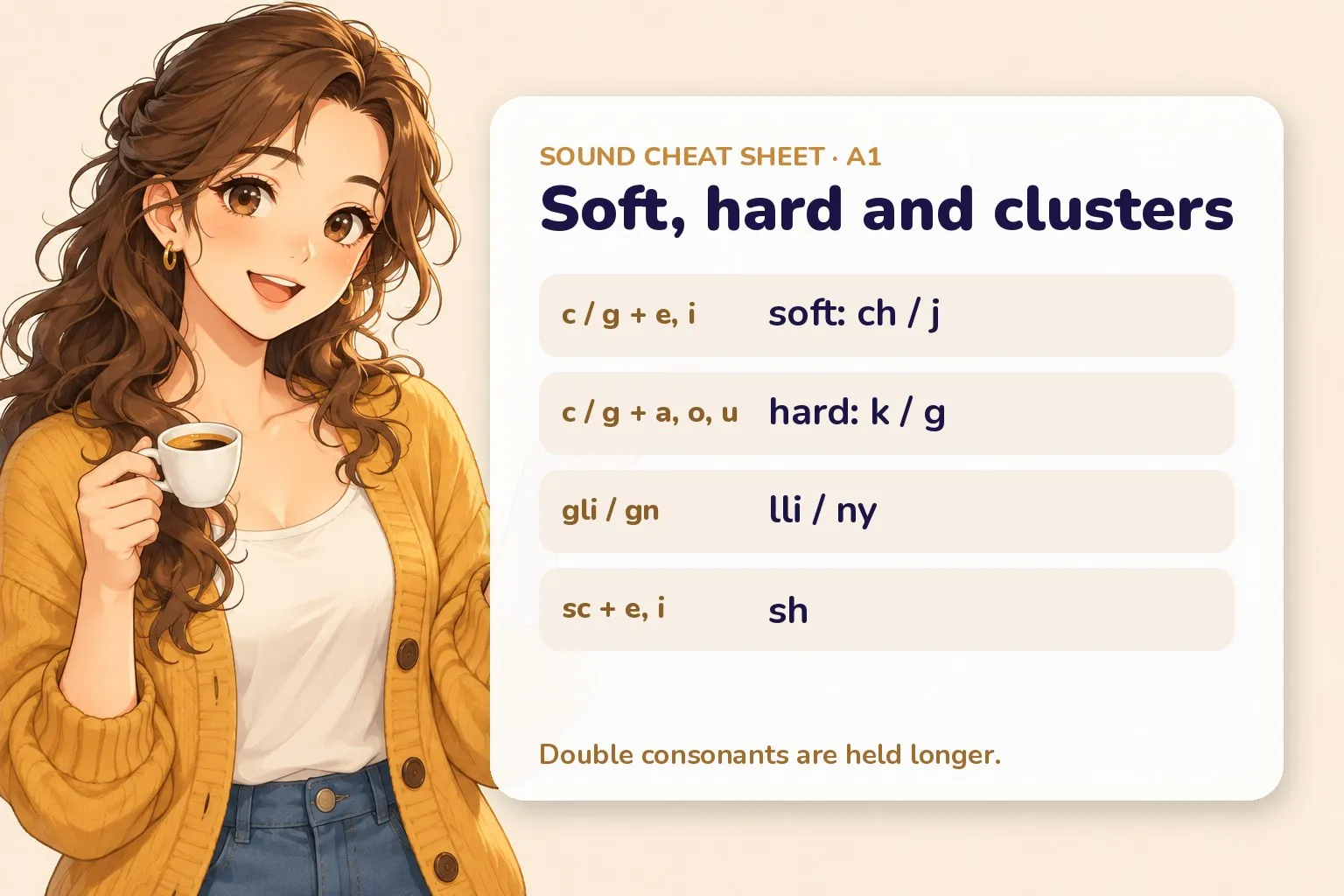
Quick recap of the sounds that change.
Where to go next
Put the sounds to work in real sentences: open Start Learning Italian Here for the course map, learn the verb essere in the present, and get definite articles right so you read il, lo and gli correctly. Browse everything in the Italian grammar section.
Practice
Italian sounds practice
Try each one, then press Check. No sign-up, nothing is sent anywhere — it all runs in your browser.
1 Match each cluster to its sound.
- gli
- gn
- sc(e/i)
- ch
Show answer
- gli → lli in million
- gn → ny in canyon
- sc(e/i) → sh
- ch → hard k
gli = lli, gn = ny, sce/sci = sh, ch = k.
Hint: you don't say it
Show answer
silent — Italian h is always silent.
Quiz
Italian pronunciation basics
8 questions · pick an answer and you'll see straight away if it's right.
-
Show answer
five — Five: a, e, i, o, u, kept pure.
-
Show answer
ch — Soft c = 'ch': cena = 'CHAY-na'.
-
Show answer
g as in go — Hard g: gatto = 'GAHT-to'.
-
Show answer
hard 'k' — ch/gh keep a hard k/g before e/i: chi = 'kee'.
-
Show answer
the lli in million — gli = the 'lli' sound in million.
-
Show answer
the ny in canyon — gn = 'ny': gnocchi = 'NYOK-kee'.
-
Show answer
held longer than a single one — Double consonants are lengthened: nonno vs nono.
-
Show answer
silent — h is always silent: ho = 'oh'.
Next
- Start the course: Start Learning Italian Here
- Learn your first verb: essere in the present
All Italian pronunciation & writing topics
Vocabulary, pronunciation, phrases, practice and exam help, ordered by level. Pick a topic and go straight to it. New lessons go live every day, so topics marked Coming soon fill in over the next weeks.
Pronunciation & writing
A1 6 topics · 1 ready
- 01 Italian Pronunciation Overview You are here
- 02 The Italian Alphabet Coming soon
- 03 Italian Vowels (7 Sounds) Coming soon
- 04 Italian Double Consonants (Doppie) Coming soon
- 05 Italian C & G: Hard vs Soft Coming soon
- 06 The Silent H & Spelling in Italian Coming soon
A2 2 topics
- 07 Italian Stress & Written Accents Coming soon
- 08 Italian Spelling Rules & Apostrophe Coming soon
B1 1 topics
- 09 Italian Intonation & Rhythm Coming soon