The Italian Alphabet (21 Letters + 5 Foreign)
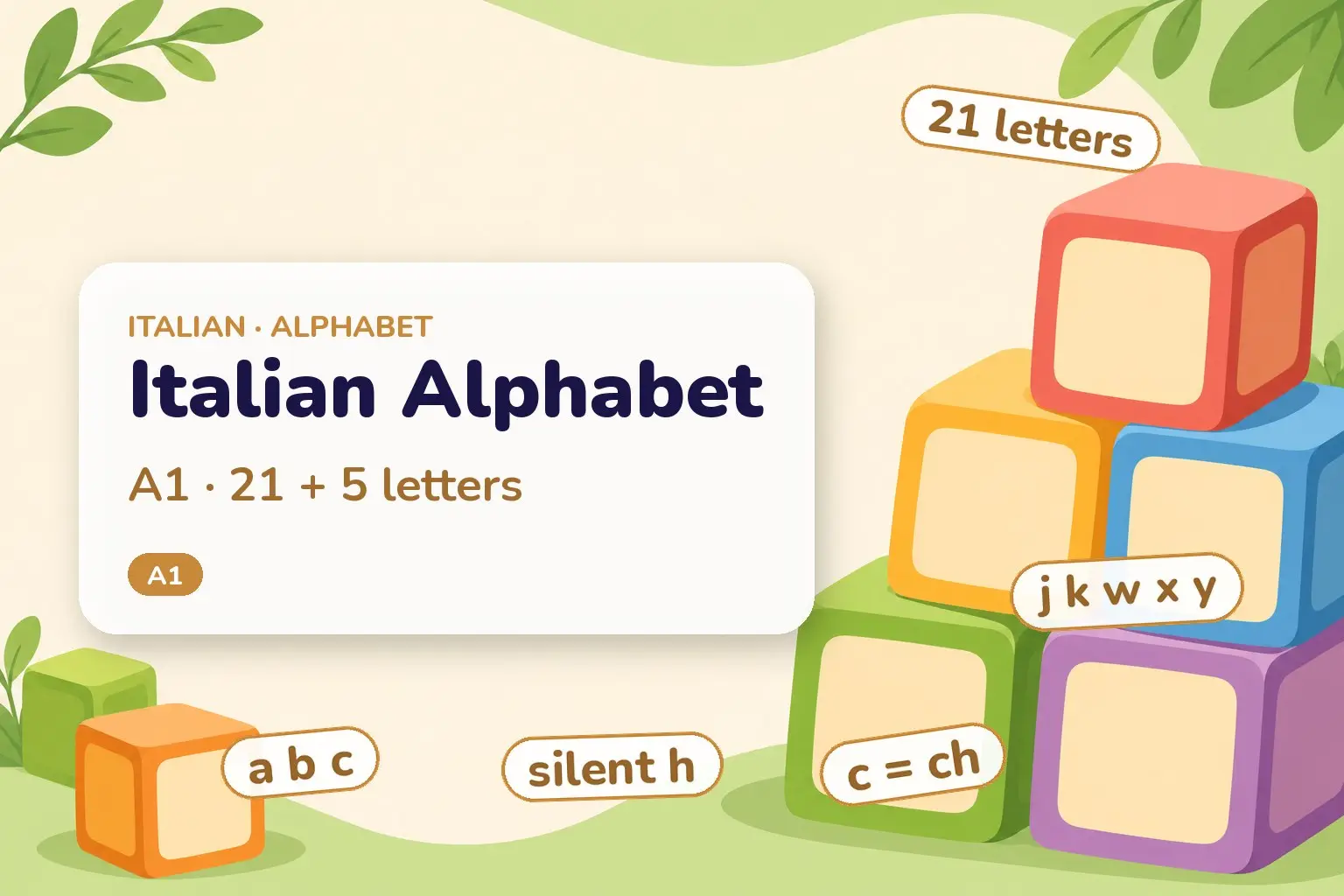
The Italian alphabet has 21 native letters — five vowels and sixteen consonants. The letters j, k, w, x and y are only used in foreign words and names, so they are learned separately. The letter h is always silent.
Level: A1 (beginner). The Italian alphabet is short — only 21 letters — and almost perfectly phonetic: once you know the letters, you can read nearly any word aloud. Five more letters (j, k, w, x, y) turn up only in foreign words, so you learn them on the side.
By the end of this page you can…
…name every Italian letter, spell a word aloud, handle the silent h, and read the written accents on vowels like città and caffè.
The 21 native letters
Italian drops five letters that English keeps, leaving 21: five vowels (a, e, i, o, u) and sixteen consonants. The letter names are what you need for spelling aloud:
| Letter | Name | Letter | Name |
|---|---|---|---|
| a | a | n | enne |
| b | bi | o | o |
| c | ci (“chee”) | p | pi |
| d | di | q | cu |
| e | e | r | erre |
| f | effe | s | esse |
| g | gi (“jee”) | t | ti |
| h | acca | u | u |
| i | i | v | vu / vi |
| l | elle | z | zeta |
| m | emme |
Notice there is no j, k, w, x or y in this list. The letter h has the name acca and is always silent — it is a spelling helper, not a sound.
The five foreign letters
| Letter | Name | Shows up in |
|---|---|---|
| j | i lunga (“long i”) | jeans, Jesolo |
| k | cappa | karaoke, km |
| w | doppia vu | weekend, wifi |
| x | ics | taxi, xilofono |
| y | ipsilon / i greca | yogurt, yoga |
These five appear in loanwords, foreign names, scientific terms and a few place names, but they are not part of the native alphabet. If you count them in, the total is 26, just like English.
The silent h and written accents
The silent h does two jobs:
- In ch and gh it keeps c and g hard before e and i: che (“keh”), chi (“kee”), ghiro (“GEE-ro”), spaghetti.
- In a few short words it just marks them apart: ho (I have) vs o (or), hai (you have) vs ai (to the).
Written accents sit only on vowels and almost always fall on the last syllable to show stress: città (city), caffè (coffee), perché (because), lunedì (Monday), però (but). A grave accent (`) is the common one; an acute (´) appears on some closed e and o sounds (perché).
How to say it
- c / g before e, i — soft “ch” / “j”: cena (“CHEH-na”), giorno (“JOR-no”).
- ch / gh — hard “k” / “g”: chiesa (“KYEH-za”), spaghetti.
- h — silent, always.
- z — “ts” or “dz”: pizza, zero.
- double consonants — held longer: bello, mamma.
Example words
- amicofriendc before o is hard: 'a-MEE-ko'
- cenadinnerc before e is soft: 'CHEH-na'
- gelatoice creamg before e is soft: 'jeh-LAH-to'
- gattocatg before a is hard; double t held
- chiesachurchch = hard k: 'KYEH-za'
- spaghettispaghettigh = hard g; double t
- hoI havesilent h; sounds like 'o'
- hotelhotelsilent h at the start
- cittàcityaccent marks final stress: 'cheet-TAH'
- caffècoffeegrave accent on the last e
- perchébecause / whyacute accent on the closed e
- nonnograndfatherdouble n — not 'nono' (ninth)
- pizzapizzazz = long ts
- yogurtyogurtforeign y = ipsilon
- taxitaxiforeign x = ics
Spelling a word aloud
To spell Milano: “emme – i – elle – a – enne – o”. For perché: “pi – e – erre – ci – acca – e accentata” (accented e). For a foreign surname with a w, say doppia vu; for a y, say ipsilon.
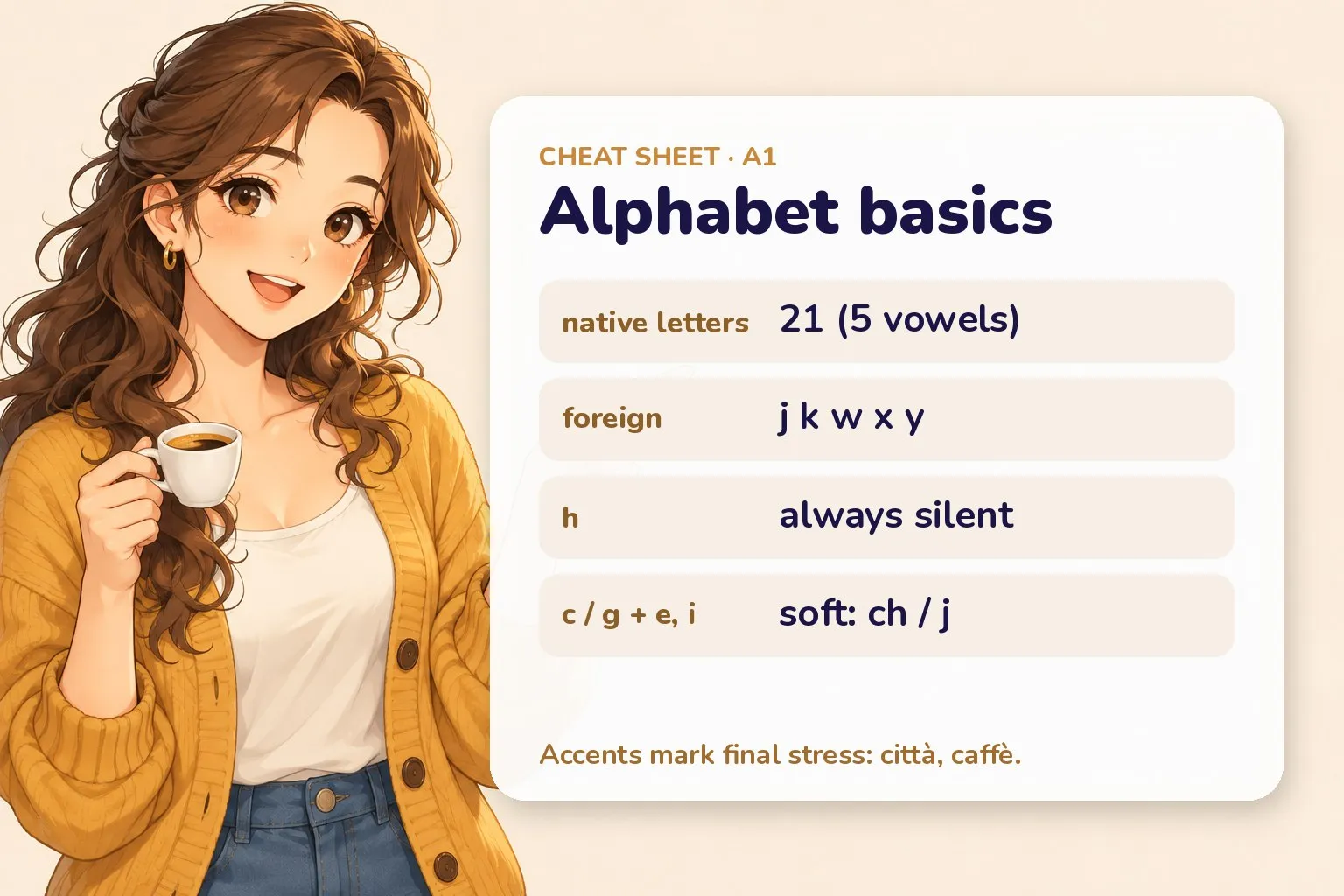
Quick recap before the quiz.
Practice
Italian alphabet practice
Try each one, then press Check. No sign-up, nothing is sent anywhere — it all runs in your browser.
Hint: three letters
Show answer
ics — x is called ics.
4 Match each foreign letter to its Italian name.
- j
- k
- w
- y
Show answer
- j → i lunga
- k → cappa
- w → doppia vu
- y → ipsilon
These five letters appear only in loanwords and names.
Quiz
The Italian alphabet
8 questions · pick an answer and you'll see straight away if it's right.
-
Show answer
21 letters — 21 native letters: 5 vowels and 16 consonants.
-
Show answer
j, k, w, x, y — j, k, w, x, y are used only in loanwords and names.
-
Show answer
always silent — h (acca) is silent.
-
Show answer
hard, like 'k' — ch keeps the hard k sound: che = 'keh'.
-
Show answer
soft 'ch' — c before e/i is soft: cena = 'CHEH-na'.
-
Show answer
doppia vu — w is doppia vu ('double v').
-
Show answer
the double n is held longer and means a different word — nonno = grandfather, nono = ninth; the doubled consonant is held.
-
Show answer
only vowels, usually marking final stress — Accents mark a stressed final vowel: città, caffè, perché.
Next
- Get the sounds in order: Italian pronunciation overview
- Start the course: Start Learning Italian Here
- Your first grammar: Italian noun gender and the Italian grammar section
All Italian pronunciation & writing topics
Vocabulary, pronunciation, phrases, practice and exam help, ordered by level. Pick a topic and go straight to it. New lessons go live every day, so topics marked Coming soon fill in over the next weeks.
Pronunciation & writing
A1 6 topics · 2 ready
- 01 Italian Pronunciation Overview
- 02 The Italian Alphabet You are here
- 03 Italian Vowels (7 Sounds) Coming soon
- 04 Italian Double Consonants (Doppie) Coming soon
- 05 Italian C & G: Hard vs Soft Coming soon
- 06 The Silent H & Spelling in Italian Coming soon
A2 2 topics
- 07 Italian Stress & Written Accents Coming soon
- 08 Italian Spelling Rules & Apostrophe Coming soon
B1 1 topics
- 09 Italian Intonation & Rhythm Coming soon