Italian Intonation and Rhythm: Questions and Melody
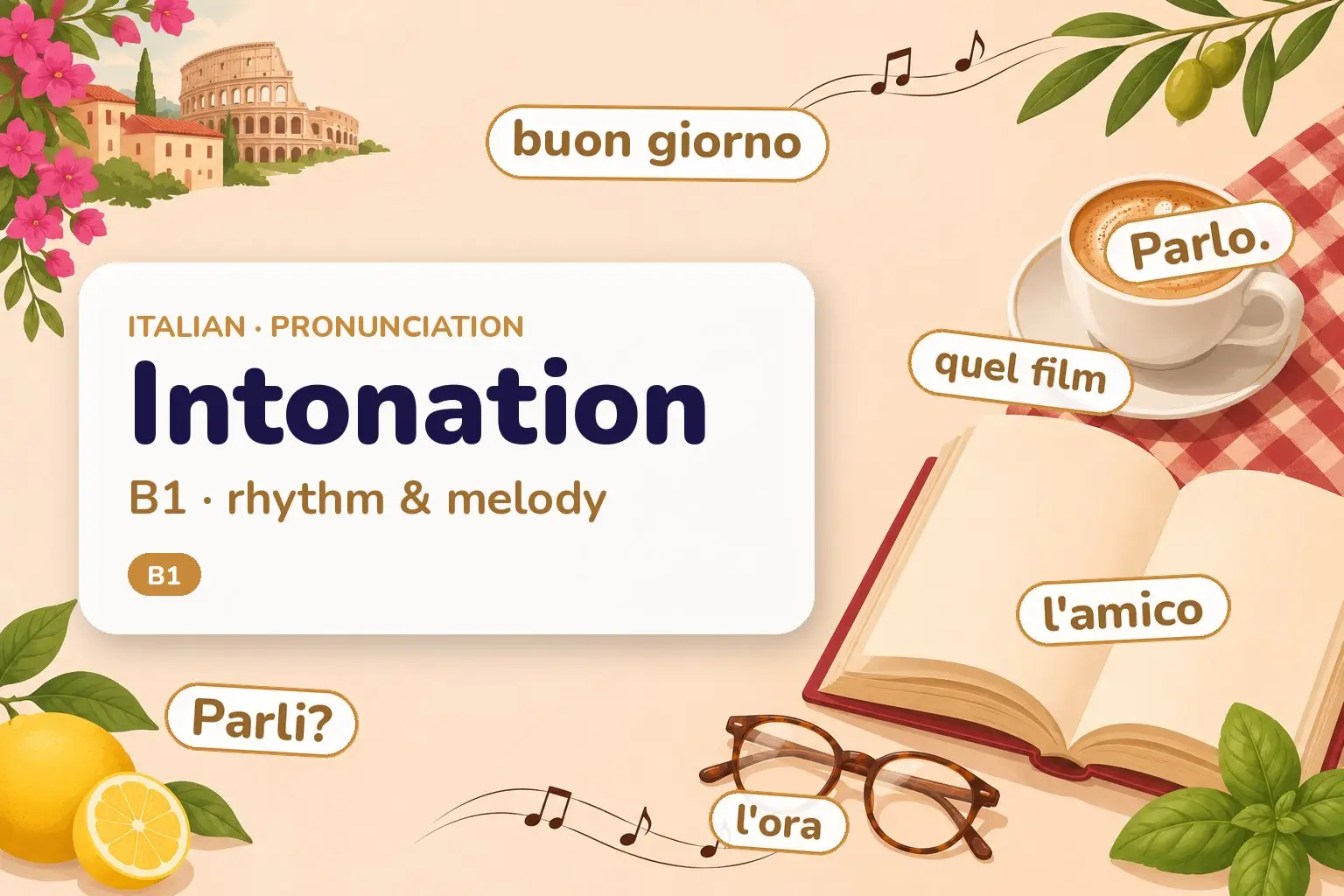
Italian is spoken with an even, syllable-based rhythm: every vowel is given roughly equal weight and most syllables end in a vowel. Melody carries meaning — your voice rises at the end of a yes/no question (Vieni?) and falls for a statement (Vengo). Elision and truncation keep the flow smooth.
On this page10 sections · tap to jump
Level: B1. You can know every Italian word and still sound foreign if the music is wrong. Italian has a steady, vowel-rich rhythm and a small set of melodies that do real grammatical work — above all, turning a statement into a question with the voice alone.
By the end of this page you can…
…keep an even Italian rhythm with full, clean vowels, raise your voice correctly for a yes/no question and drop it for a statement, and smooth your speech with elision and truncation the way native speakers do.
The rhythm: even and vowel-rich
English is stress-timed: it rushes over unstressed syllables and squashes their vowels into a vague “uh” (a schwa). Italian does the opposite. It is close to syllable-timed — every syllable gets a fairly equal slice of time, and every vowel keeps its full, pure value whether stressed or not.
Two habits create the Italian sound:
- Clean vowels everywhere. The o in dottore is a clear “o” in all three syllables, never reduced. An English speaker instinctively weakens the first and last; resist that.
- Syllables that end in a vowel. Most Italian syllables are open (they finish on a vowel): ca-sa, a-mi-co, ta-vo-lo. This gives the language its flowing, musical quality and keeps consonants crisp rather than clustered.
Length lives in the double consonants, not in squashed vowels: fatto holds the “t” longer than fato. If that contrast is new, work through Italian double consonants alongside this page.
The melody: questions rise, statements fall
Italian often keeps the same word order for a statement and a yes/no question, so the melody is what marks the difference. Your pitch does the grammar.
- Statement — pitch falls at the end: Parli italiano. (“You speak Italian.”) ↘
- Yes/no question — pitch rises at the end: Parli italiano? (“Do you speak Italian?”) ↗
- Wh-question (with chi, cosa, dove, quando, perché) — usually falls, like a statement, because the question word already signals a question: Dove abiti? (“Where do you live?”) ↘
- Exclamation — a higher, fuller contour: Che bello! (“How lovely!”)
| Type | Example | Melody |
|---|---|---|
| Statement | Vieni con me. | falling ↘ |
| Yes/no question | Vieni con me? | rising ↗ |
| Wh-question | Dove vai? | falling ↘ |
| Exclamation | Che bella giornata! | high, full |
Elision: dropping a vowel before a vowel
When a short word ending in a vowel meets a word starting with a vowel, Italian often elides — it drops the first vowel and joins the two with an apostrophe. This keeps the flow and avoids a clumsy vowel-on-vowel gap.
- lo amico → l’amico (the friend)
- la ora → l’ora (the hour)
- una amica → un’amica (a female friend)
- di Italia → d’Italia (of Italy)
- dove è → dov’è (where is)
Elision is most regular with the articles lo/la → l’ and with una → un’ (note the apostrophe marks the dropped a). Not every vowel meeting elides — uno and masculine un never take an apostrophe — but the common article cases are worth automating.
Truncation (apocope): dropping without an apostrophe
Truncation, or troncamento, also shortens a word, but it drops a final vowel or whole syllable with no apostrophe and can happen before a consonant too. It is a rhythm smoother, not a spelling of two vowels meeting.
- buono giorno → buon giorno (good day)
- quello film → quel film (that film)
- bello ragazzo → bel ragazzo (handsome boy)
- Santo Marco → San Marco (Saint Mark)
- uno libro → un libro (a book)
The rare words that keep an apostrophe in truncation are set phrases like un po’ (a little, from poco) and be’ (well). Otherwise, truncation leaves a clean, shortened word.
How to say it
- Even timing — one steady beat per syllable: do-me-ni-ca ≈ “DO-me-ni-ca”, all vowels clear.
- Rising question — lift the last syllable: Vieni? ≈ “VYEH-ni?” with the pitch climbing.
- Falling statement — let the last syllable drop: Vengo. ≈ “VEN-go” settling down.
- Elision joins smoothly — l’amico is one flowing word, “LA-mee-ko”, no gap.
Example sentences
- Parli italiano.You speak Italian.statement, falling pitch
- Parli italiano?Do you speak Italian?same words, rising pitch = question
- Dove abiti?Where do you live?wh-question, falling pitch
- Che bella giornata!What a lovely day!exclamation, high contour
- Vieni con me?Are you coming with me?yes/no question, voice rises
- Sì, vengo con te.Yes, I'm coming with you.statement answer, falling
- l'amicothe friendlo + amico → l'amico (elision)
- l'orathe hourla + ora → l'ora (elision)
- un'amicaa (female) frienduna + amica → un'amica (apostrophe)
- Dov'è la stazione?Where is the station?dove è → dov'è (elision)
- Buon giorno, signora.Good day, madam.buono → buon (truncation, no apostrophe)
- Quel film è bellissimo.That film is wonderful.quello → quel (truncation)
- È un bel ragazzo.He's a handsome boy.bello → bel (truncation)
- Visitiamo San Marco.We visit Saint Mark's.Santo → San before a name
- Vorrei un po' d'acqua.I'd like a little water.un po' keeps its apostrophe; di → d'
- Casa mia è vicina.My house is nearby.even rhythm, clear final vowels
- Hai capito?Did you understand?yes/no question, rising; silent h
- Non ho capito.I didn't understand.statement, falling
- Perché non vieni?Why don't you come?wh-question with perché, falling
- Che cosa fai stasera?What are you doing tonight?wh-question, falling pitch
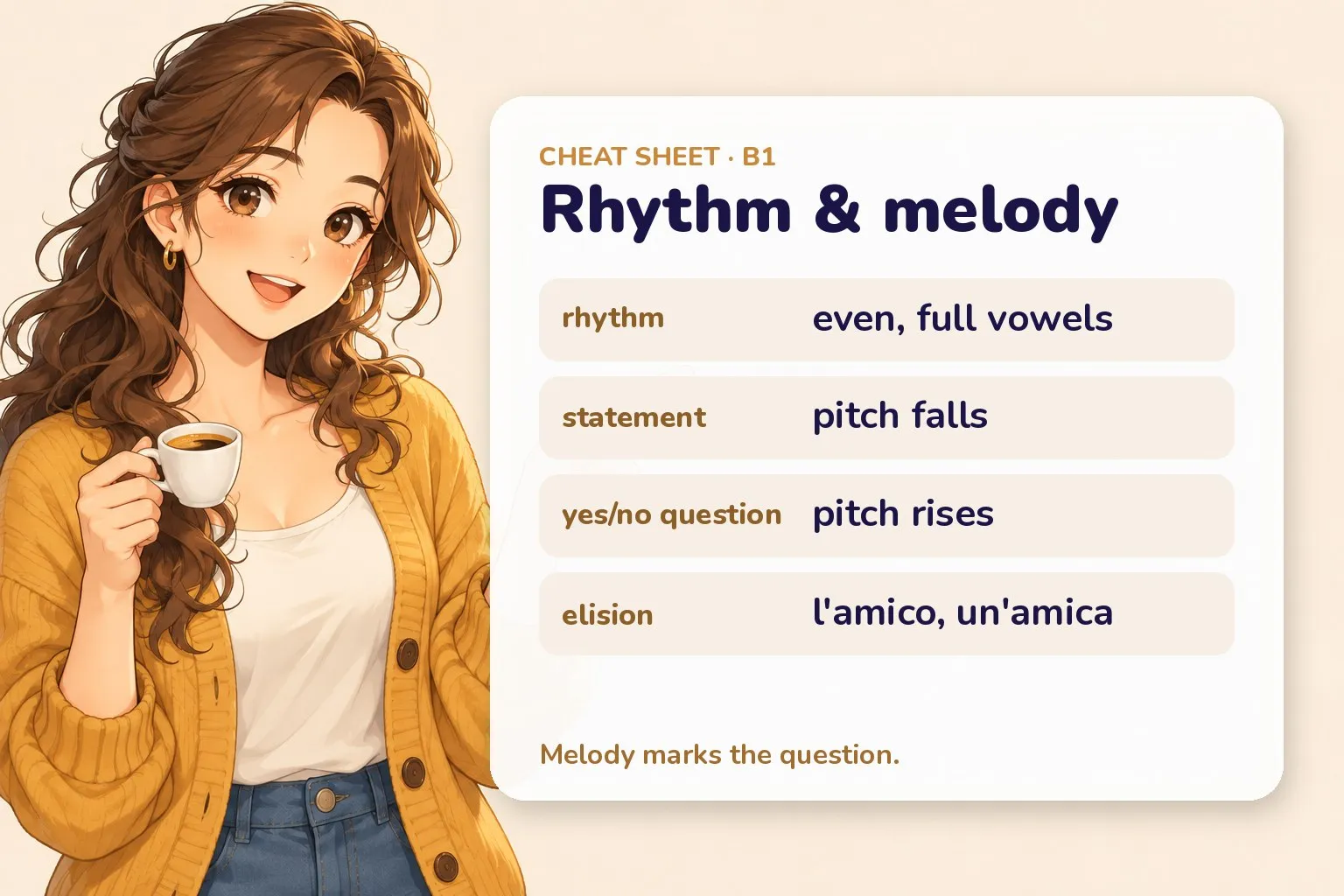
Quick recap before the quiz.
Practice
Intonation and rhythm practice
Try each one, then press Check. No sign-up, nothing is sent anywhere — it all runs in your browser.
Hint: drop the o
Show answer
l'amico — lo + amico → l'amico; the o is dropped and an apostrophe joins them.
Hint: where is
Show answer
dov'è — dove è → dov'è (elision before a vowel).
5 Match each sentence type to its melody.
- statement
- yes/no question
- wh-question
- exclamation
Show answer
- statement → falling
- yes/no question → rising
- wh-question → falling
- exclamation → high, full
Melody, not word order, usually marks a yes/no question in Italian.
Quiz
Italian intonation and rhythm
12 questions · pick an answer and you'll see straight away if it's right.
-
Show answer
kept full and clear in every syllable — Italian keeps full, pure vowels; it does not reduce unstressed ones.
-
Show answer
a vowel (open syllables) — Open syllables ending in a vowel give Italian its flowing rhythm.
-
Show answer
a rising melody — The words stay the same; the pitch rises to signal the question.
-
Show answer
falling — Statements end on a falling melody: Vengo. ↘
-
Show answer
falls like a statement — The question word already marks the question, so the melody falls.
-
Show answer
l'amico — Elision drops the o and adds an apostrophe: l'amico.
-
Show answer
un'amica — una → un' with an apostrophe before a vowel: un'amica.
-
Show answer
quel film — quello → quel is truncation (no apostrophe); the others are elisions.
-
Show answer
San Marco — Santo → San before a name: San Marco (truncation).
-
Show answer
double consonants — Double consonants are held longer: fatto vs fato.
-
Show answer
l'ora — la + ora → l'ora.
-
Show answer
un po' — un po' (from poco) keeps an apostrophe; buon/quel/bel do not.
Recap cheat-sheet
| Feature | Italian habit |
|---|---|
| Rhythm | even, syllable-based, full vowels |
| Statement | pitch falls ↘ |
| Yes/no question | pitch rises ↗ (same words) |
| Wh-question | pitch falls ↘ |
| Elision | l’amico, un’amica (apostrophe) |
| Truncation | buon giorno, quel film (no apostrophe) |
Next
- Where the stress falls and the written accents: Italian stress and written accents
- The held sounds that carry length: Italian double consonants
- The pure vowels behind the rhythm: Italian vowel sounds
- New here? Start Learning Italian Here
All Italian pronunciation & writing topics
Vocabulary, pronunciation, phrases, practice and exam help, ordered by level. Pick a topic and go straight to it. New lessons go live every day, so topics marked Coming soon fill in over the next weeks.
Pronunciation & writing
A1 6 topics · 6 ready
A2 2 topics · 2 ready
B1 1 topics · 1 ready
- 09 Italian Intonation & Rhythm You are here