Italian Stress and Written Accents
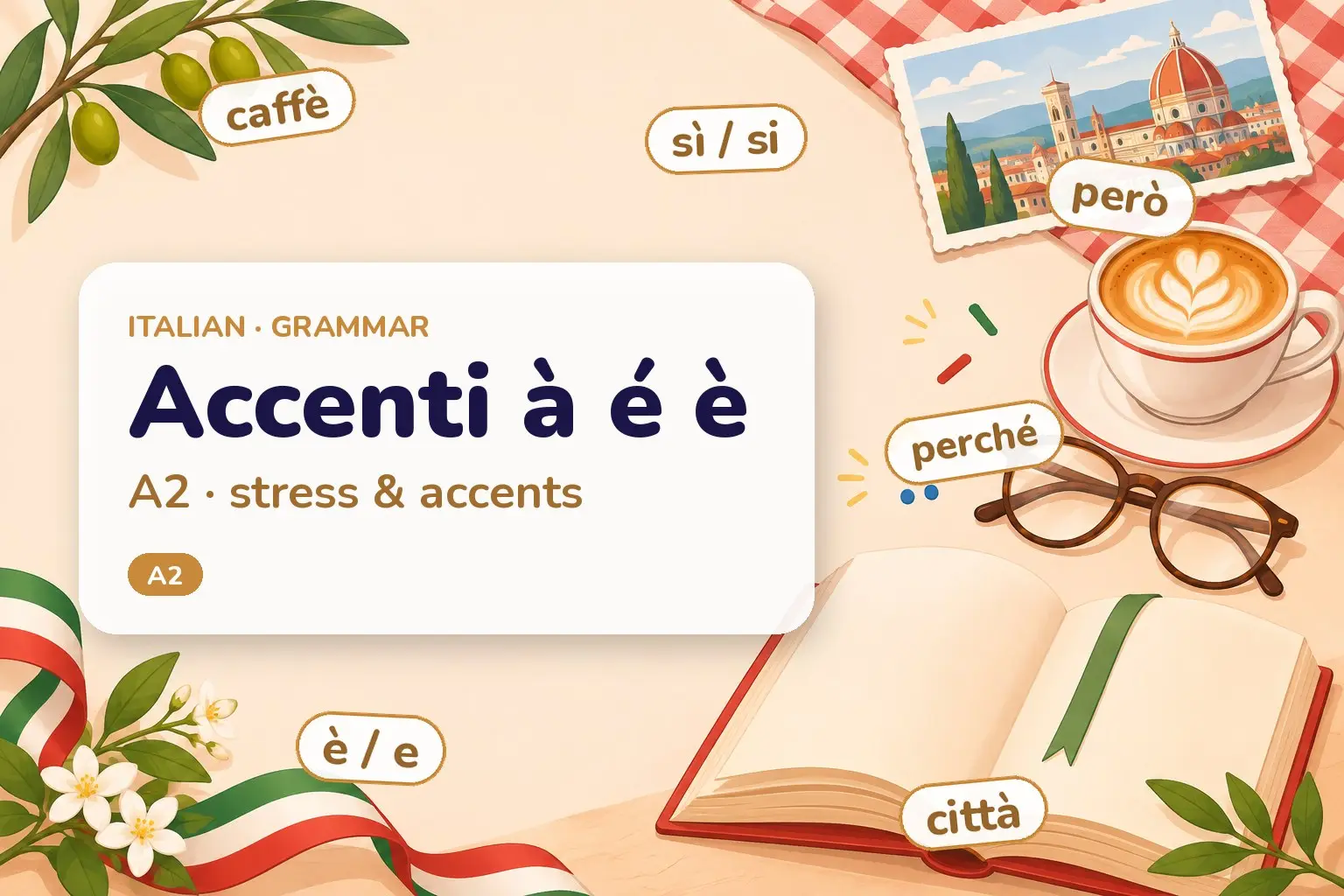
Most Italian words are stressed on the second-to-last syllable, so no accent mark is written. You add a written accent only when the stress falls on the final vowel — città, caffè, perché — or on a few short words to tell them apart, like è versus e.
Level: A2. Italian spelling tells you very little about where to stress a word — except in one situation, where a written accent makes it explicit. This page sorts out when Italian prints an accent, which accent it prints, and how to find the stress the rest of the time.
By the end of this page you can…
…put the stress on the right syllable for most words, write the accent on final-stressed words like città and perché, choose grave or acute correctly, and tell apart the little pairs such as è / e and dà / da.
Where the stress falls
Stress is the syllable you say with the most force. Italian has a strong default: the penultimate (second-to-last) syllable, in the large group called parole piane: a-mi-co, par-la-re, ca-sa, bel-lis-si-mo. If you guess the penultimate, you are right most of the time.
Two other patterns exist:
- Final stress (parole tronche): the last syllable, always written with an accent — cit-tà, caf-fè, per-ché, lu-ne-dì.
- Interior stress (parole sdrucciole): the third-to-last syllable, never written — ta-vo-lo, a-bi-ta-no, dif-fi-ci-le. You simply have to learn or hear these.
Grave or acute?
The two marks are the grave (sloping down to the right: à è ì ò ù) and the acute (sloping up: é). The rule is about the quality of the vowel:
- a, i, o, u at the end always take the grave: città, così, però, più.
- e can be either. Use the acute é for a closed e (a tighter sound) and the grave è for an open e (a more open sound).
| Final e | Accent | Examples |
|---|---|---|
| closed e (tighter) | é (acute) | perché, poiché, affinché, né, sé, ventitré |
| open e (more open) | è (grave) | caffè, cioè, tè, ahimè |
The monosyllables that need an accent
A handful of one-syllable words take an accent only to separate them from an identical word with a different meaning. Learn them as fixed pairs:
| With accent | Meaning | Without accent | Meaning |
|---|---|---|---|
| è | (he/she) is | e | and |
| dà | (he/she) gives | da | from / by |
| là / lì | there | la / li | the / them |
| né | nor / neither | ne | of it / some |
| sé | himself / herself | se | if |
| sì | yes | si | oneself (reflexive) |
| dì | day | di | of |
Stress can change the word
Because interior stress is unmarked, two words can look identical and mean different things depending on where you put the force. A dictionary shows the stress with a mark that is not written in normal text:
- àn-co-ra (anchor) vs an-cò-ra (still / again)
- ca-pi-ta-no (they happen) vs ca-pi-tà-no (captain)
- par-lo (I speak) vs par-lò (he/she spoke — final stress, so written)
Notice the last pair: parlò is stressed on the final vowel, so it earns a written accent, while parlo does not.
Truncation is not an accent
Don’t confuse accents with truncation (troncamento), where a word simply drops its final vowel before another word: buono → buon giorno, uno → un libro, quello → quel film, santo → San Marco. Truncation usually needs no apostrophe and no accent (the rare exceptions, un po’ and be’, keep an apostrophe). This is a separate topic from where the stress goes.
How to say it
- Default stress — hit the second-to-last syllable: a-MI-co, par-LA-re.
- Final accent — push the last vowel hard: cit-TÀ, caf-FÈ, per-CHÉ.
- é vs è — perché has a tight “ay”; caffè has an open “eh”.
- Unmarked interior stress — learn it word by word: TA-vo-lo, dif-FI-ci-le.
Example words
- amicofriendpenultimate stress, no accent: a-MI-co
- parlareto speakpenultimate: par-LA-re
- cittàcityfinal stress → grave accent
- caffècoffeeopen final e → grave è
- perchéwhy / becauseclosed final e → acute é
- lunedìMondayfinal i → grave: lu-ne-DÌ
- peròbut / howeverfinal o → grave: pe-RÒ
- piùmorefinal u → grave: PIÙ
- tavolotableinterior stress, unwritten: TA-vo-lo
- difficiledifficultinterior stress: dif-FI-ci-le
- è(he/she) isaccented to differ from e ('and')
- eandno accent
- sìyesaccented to differ from reflexive si
- nénorclosed e → acute; differs from ne
- dà(he/she) givesaccented to differ from da ('from')
- ancoraanchor OR stillàncora vs ancòra: stress alone decides
- parlò(he/she) spokefinal stress → written accent
- cioèthat is / i.e.open final e → grave è
- ventitrétwenty-threeclosed final e → acute é
- virtùvirtuefinal u → grave: vir-TÙ
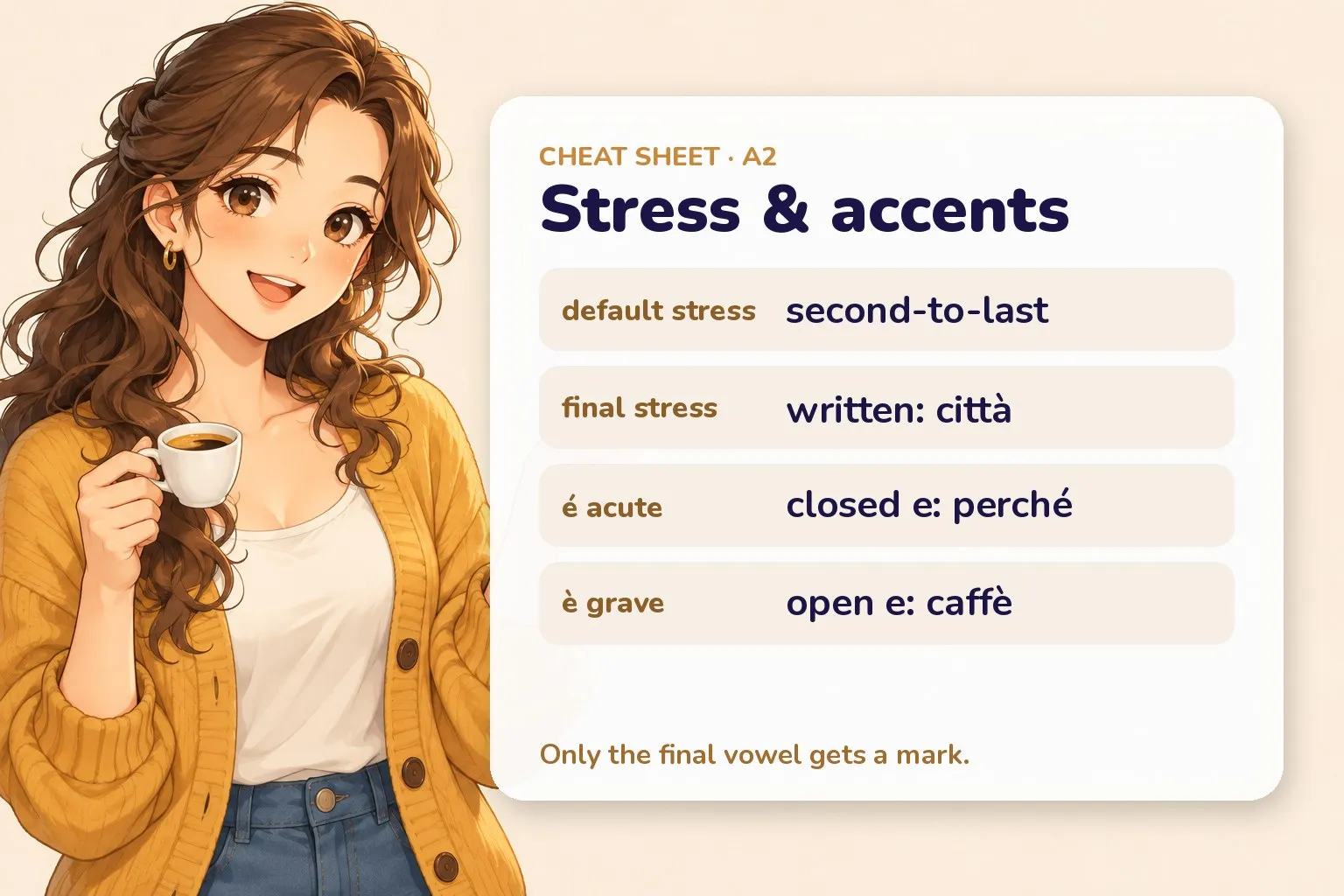
Quick recap before the quiz.
Practice
Stress and accents practice
Try each one, then press Check. No sign-up, nothing is sent anywhere — it all runs in your browser.
Hint: closed final e
Show answer
perché — perché takes the acute é (the -ché family is always acute).
4 Match each accented word to its meaning.
- è
- e
- sì
- si
Show answer
- è → is
- e → and
- sì → yes
- si → oneself
The accent separates è/e and sì/si, which sound almost the same.
Hint: stress on the last vowel
Show answer
parlò — parlò has final stress and so is written with a grave accent; parlo (I speak) has none.
Quiz
Italian stress and written accents
12 questions · pick an answer and you'll see straight away if it's right.
-
Show answer
final vowel — A written accent marks a word stressed on its final vowel.
-
Show answer
-mi- — Penultimate stress: a-MI-co, and so no accent is written.
-
Show answer
amico — amico has penultimate stress, so no accent; the others are final-stressed.
-
Show answer
grave à — a/i/o/u always take the grave: città, così, però, più.
-
Show answer
acute, closed e — The closed final e in the -ché family takes the acute é.
-
Show answer
is — è = 'is'; the bare e means 'and'.
-
Show answer
è / e — è ('is') and e ('and') are the same letters, split by the accent.
-
Show answer
interior and not written — These are sdrucciole: interior stress, never written in normal text.
-
Show answer
which syllable is stressed — Stress alone separates àncora (anchor) from ancòra (again).
-
Show answer
truncation — buono drops its final vowel before giorno: truncation, not an accent.
-
Show answer
sì — sì ('yes') takes an accent to differ from the reflexive si.
-
Show answer
caffè — caffè has an open final e → grave è; the others have a closed e → acute é.
Next
- The vowel sounds themselves: Italian vowel sounds
- When letters double: Italian double consonants
- The c and g sounds: Italian c and g before e and i
- Spell any word aloud: the Italian alphabet
All Italian pronunciation & writing topics
Vocabulary, pronunciation, phrases, practice and exam help, ordered by level. Pick a topic and go straight to it. New lessons go live every day, so topics marked Coming soon fill in over the next weeks.
Pronunciation & writing
A1 6 topics · 6 ready
A2 2 topics · 2 ready
- 07 Italian Stress & Written Accents You are here
- 08 Italian Spelling Rules & Apostrophe