The Silent H and Spelling in Italian
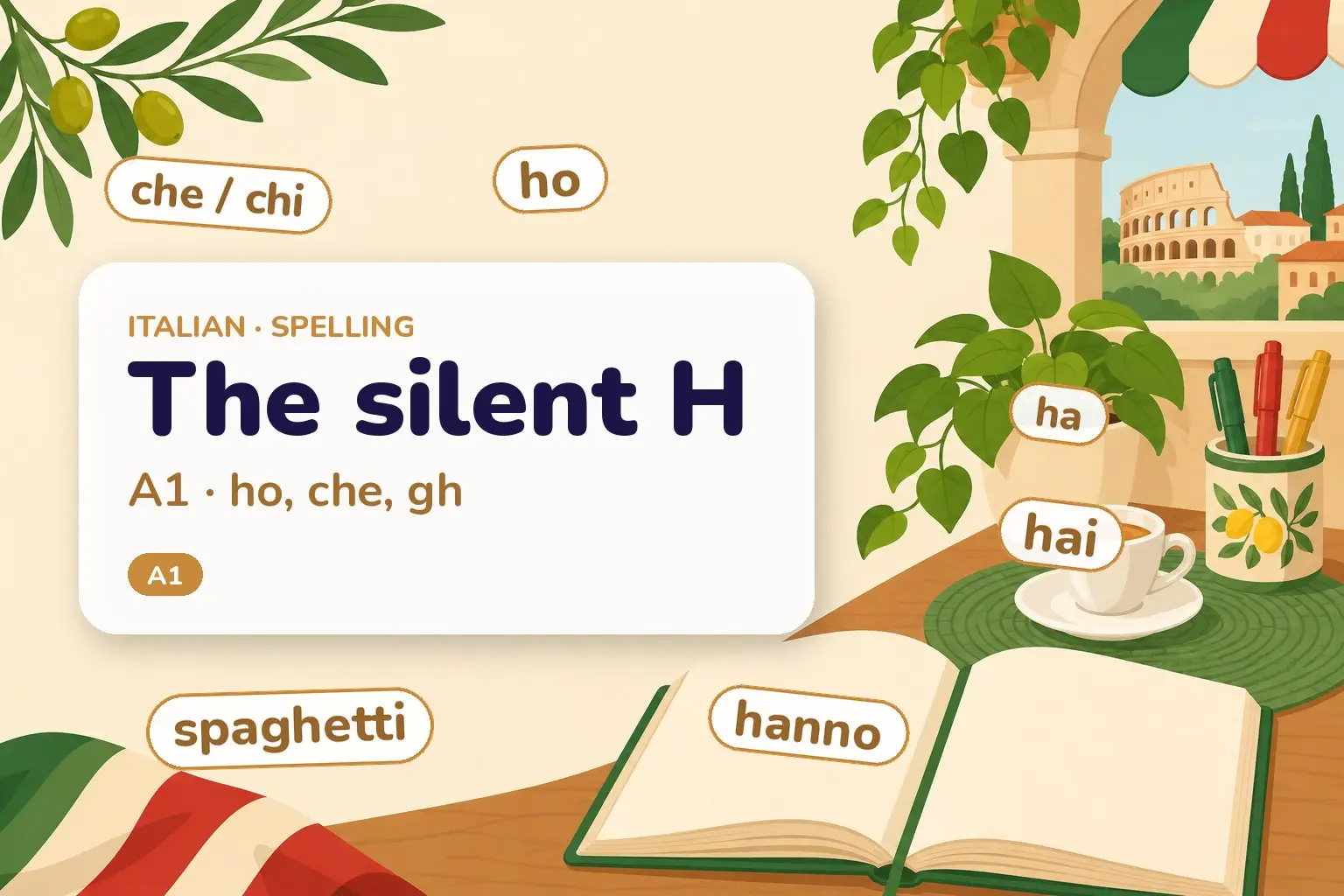
The letter H is silent in Italian — never a sound of its own. It does two jobs: it marks the avere forms ho, hai, ha, hanno (versus o, ai, a, anno), and in ch and gh it keeps a hard c or g before e and i (che, spaghetti).
Level: A1. The Italian H is the quietest letter in the language. You never pronounce it — not at the start of a word, not in the middle, never. But it is not useless: it does two small, important jobs in spelling, and getting it wrong changes words.
By the end of this page you can…
…read every H in Italian as silence, spell the four avere forms ho, hai, ha and hanno correctly, and use ch and gh to keep a hard c or g sound before e and i.
H is always silent
In Italian the letter H has no sound of its own. Unlike English “hat” or “house”, an Italian H is never breathed out. Ho (“I have”) sounds exactly like the letter o; the borrowed word hotel begins with a plain “o” sound, as if it were spelled otel.
Because it is silent, H never stands on its own as a letter that makes a word. It only appears for two spelling reasons, which the rest of this page explains.
Job 1 — the four forms of avere
The verb avere (“to have”) has four present-tense forms that start with a silent H. The H exists only to keep them separate from ordinary words that sound identical.
| avere (to have) | Without H it would be | Which means |
|---|---|---|
| ho (I have) | o | or |
| hai (you have) | ai | to the (a + i) |
| ha (he/she has) | a | to / at |
| hanno (they have) | anno | year |
These four — ho, hai, ha, hanno — are the only common Italian words that begin with H. Everything else with an initial H is a loanword (hotel, hobby, hamburger), still pronounced with the H silent.
Job 2 — ch and gh keep c and g hard
Italian c and g are soft (like English “ch” and “j”) when they come before e or i: cena (“dinner”) is “CHAY-na”, gelato is “jeh-LAH-to”. To keep a hard c (“k”) or g (as in “go”) before those same vowels, Italian slips in a silent H.
| Spelling | Sound | Example |
|---|---|---|
| ce / ci | soft “ch” | cena, ciao |
| che / chi | hard “k” | che, chi, perché |
| ge / gi | soft “j” | gelato, giorno |
| ghe / ghi | hard “g” | spaghetti, ghiaccio |
So the H is a little switch: c alone before e/i is soft, but ch is hard. Chi (“who”) is “kee”, not “chee”; spaghetti has a hard g because of the H.
Example words
- Ho un libro.I have a book.ho = 'o'; H silent
- Hai fame?Are you hungry? (lit. do you have hunger?)hai said like 'ai'
- Lei ha un cane.She has a dog.ha said like 'a'
- Loro hanno tempo.They have time.hanno vs anno (year)
- Che cosa è questo?What is this?che = 'kay', hard c
- Chi sei?Who are you?chi = 'kee', hard c
- Perché no?Why not?-ché hard c, stressed e
- Vorrei degli spaghetti.I'd like some spaghetti.gh = hard g
- C'è del ghiaccio?Is there any ice?ghiaccio = hard g, silent h
- La cena è pronta.Dinner is ready.ce = soft 'ch', no h
- Mi piace il gelato.I like ice cream.ge = soft 'j', no h
- Ciao, come stai?Hi, how are you?ci = soft 'ch'
- Ho visto un hotel.I saw a hotel.hotel: both H silent
- Lui ha un hobby.He has a hobby.loanword hobby, H silent
- Che ore sono?What time is it?che = 'kay'
- Abbiamo funghi freschi.We have fresh mushrooms.gh = hard g: fun-ghi
- Ha ragione.He/She is right.ha like 'a'; H silent
- Quanti anni hai?How old are you?hai = 'ai'; anni not anno
How to say it
The H itself is nothing — these notes are really about the letters around it:
- ch — always a hard “k”: che = “kay”, chi = “kee”, perché = “per-KAY”.
- gh — always a hard “g” as in “go”: spaghetti = “spa-GHET-tee”, funghi = “FOON-ghee”.
- c before e/i (no h) — soft “ch”: cena = “CHAY-na”, ciao = “chow”.
- g before e/i (no h) — soft “j”: gelato = “jeh-LAH-to”, giorno = “JOR-no”.
- ho, hai, ha, hanno — drop the H entirely: “o, ai, a, AN-no”.
A tiny spelling test you can do yourself
Say these aloud and decide if you need an H. Do you have something? Then it is ho / hai / ha / hanno with the H. Is it the word for “or” (o), “to/at” (a), or “year” (anno)? No H. This one question — “is it a form of to have?” — settles nearly every tricky case.
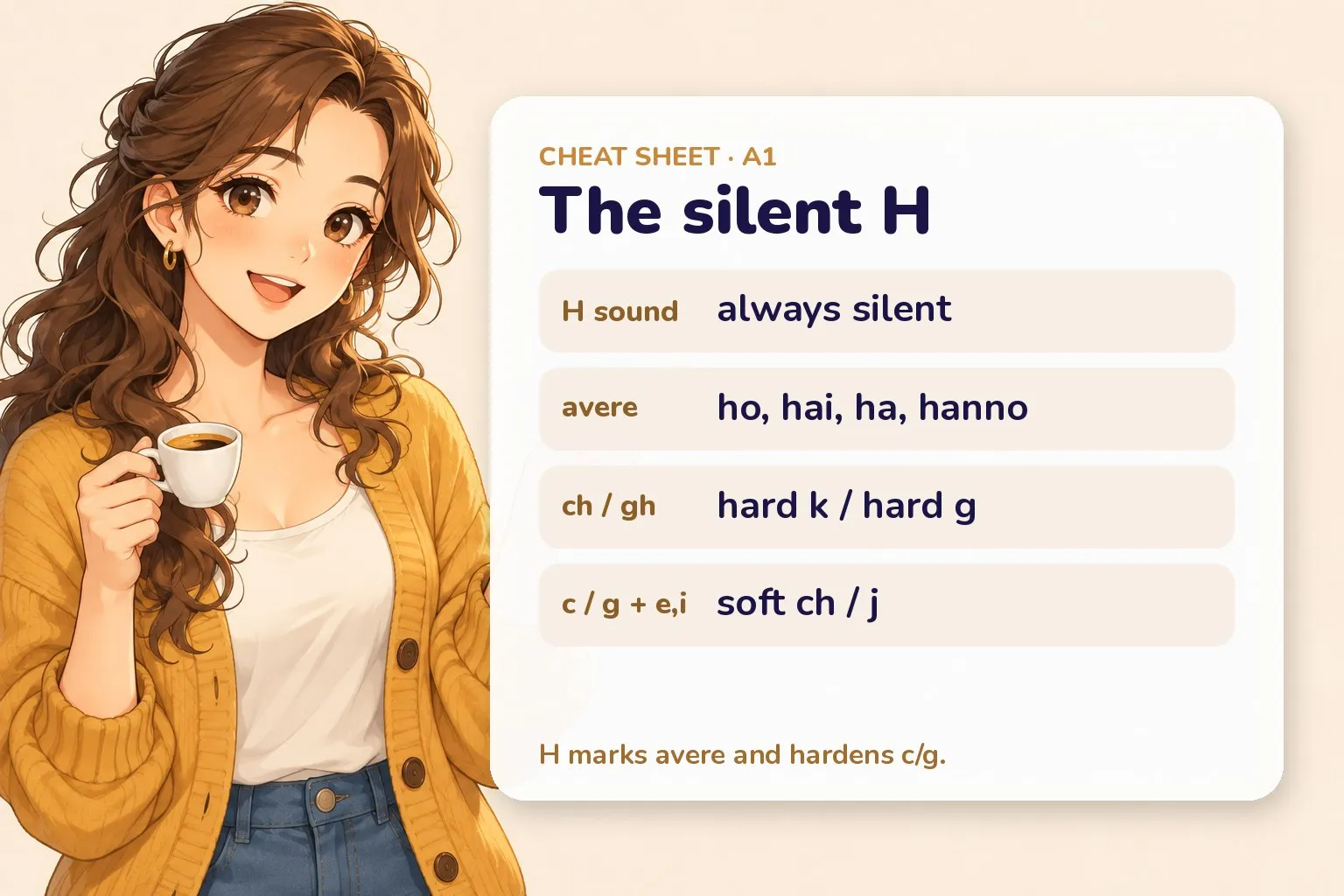
Quick recap before the quiz.
Practice
Silent H and spelling practice
Try each one, then press Check. No sign-up, nothing is sent anywhere — it all runs in your browser.
Hint: a form of avere, with H
Show answer
hanno — hanno = 'they have'; without the H, anno means 'year'.
Hint: hard c
Show answer
kay — ch keeps c hard: che = 'kay'.
5 Match each spelling to its sound.
- che
- ce
- ghi
- gi
Show answer
- che → hard k
- ce → soft ch
- ghi → hard g
- gi → soft j
H after c or g keeps the hard sound before e and i.
Quiz
Italian silent H and spelling
12 questions · pick an answer and you'll see straight away if it's right.
-
Show answer
always silent — H has no sound of its own in Italian.
-
Show answer
o — With the H silent, ho is said exactly like o.
-
Show answer
hanno — hanno = 'they have'; anno (no H) = 'year'.
-
Show answer
separate it from 'a' (to/at) — ha ('has') vs a ('to/at') — the H tells them apart.
-
Show answer
kay (hard) — ch keeps the c hard: che = 'kay'.
-
Show answer
kee — ch = hard k, so chi = 'kee' ('who').
-
Show answer
CHAY-na (soft) — c before e is soft without an H: CHAY-na.
-
Show answer
the h in gh — gh keeps g hard before e/i.
-
Show answer
hotel — hotel is a loanword; its H is silent but it is not avere.
-
Show answer
hai — hai = 'you have'; the H distinguishes it from ai ('to the').
-
Show answer
a spelling mistake — They sound alike but mean different things; the H is required in writing.
-
Show answer
FOON-ghee (hard g) — gh = hard g before i: FOON-ghee.
Recap cheat-sheet
| H does… | Example | Sound |
|---|---|---|
| nothing (always silent) | ho, hotel | o, otel |
| marks avere | ho/hai/ha/hanno | vs o/ai/a/anno |
| ch = hard k | che, chi | kay, kee |
| gh = hard g | spaghetti, funghi | hard g |
| plain c/g + e,i | cena, gelato | soft ch / j |
Next
- The whole alphabet first: Italian pronunciation overview
- The verb behind ho/hai/ha: the Italian grammar section
- Build on it: Passato prossimo with avere
- New here? Start Learning Italian Here
All Italian pronunciation & writing topics
Vocabulary, pronunciation, phrases, practice and exam help, ordered by level. Pick a topic and go straight to it. New lessons go live every day, so topics marked Coming soon fill in over the next weeks.
Pronunciation & writing
A1 6 topics · 6 ready
- 01 Italian Pronunciation Overview
- 02 The Italian Alphabet
- 03 Italian Vowels (7 Sounds)
- 04 Italian Double Consonants (Doppie)
- 05 Italian C & G: Hard vs Soft
- 06 The Silent H & Spelling in Italian You are here