Pinyin Initials: Mandarin Consonants
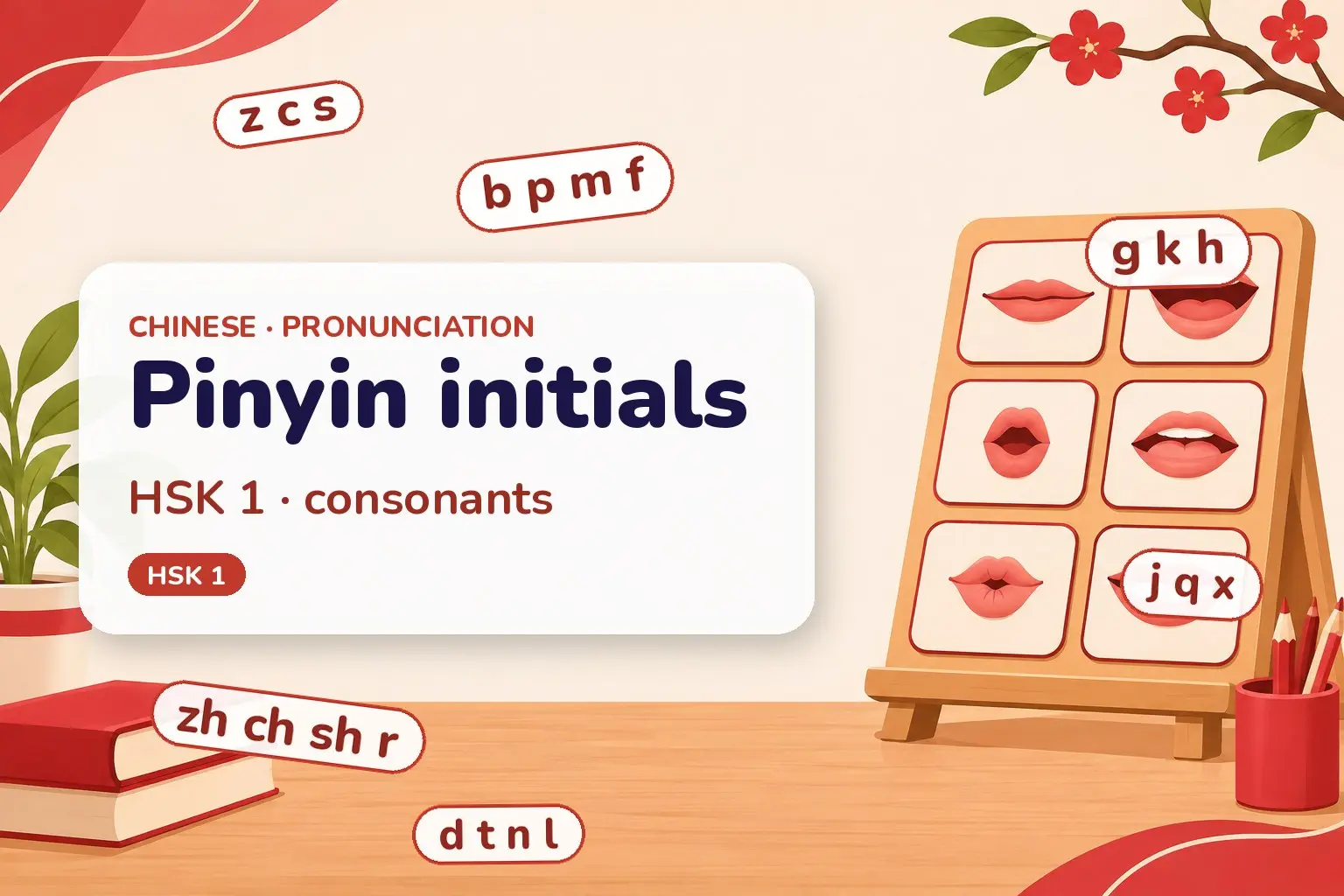
Pinyin initials are the opening consonants of a Mandarin syllable — 21 of them, like b, p and m in 爸 (bà) and 妈 (mā). The hardest contrasts are b/p aspiration, the j q x set, and the retroflex zh ch sh.
Level: HSK 1. Every full Mandarin syllable starts with an initial — 声母 (shēngmǔ) — the opening consonant, like the b in 爸 (bà, “dad”). There are 21 of them. Most are easy for English speakers; a handful need care. This page groups them so the tricky ones stand out.
What an initial is
An initial is the consonant sound at the start of a syllable. In 妈 (mā, “mum”), the initial is m; in 好 (hǎo, “good”), it is h. The rest of the syllable — the vowel part — is the final, 韵母 (yùnmǔ). A few syllables have no initial at all, like 爱 (ài, “to love”), but when there is one, it is always first.
The initials fall into neat groups by where in the mouth they are made. Learning them in groups, with the contrasts side by side, is far easier than memorising a list.
The groups of initials
| Group | Initials | Example | Pinyin |
|---|---|---|---|
| Lips | b p m f | 爸 | bà |
| Tongue-tip | d t n l | 大 | dà |
| Back of mouth | g k h | 高 | gāo |
| Palate (flat tongue) | j q x | 鸡 | jī |
| Retroflex (curled tongue) | zh ch sh r | 中 | zhōng |
| Teeth (flat buzz) | z c s | 早 | zǎo |
The three contrasts that matter
Most mistakes come from three places. Spend your time here.
1. Aspiration: b/p, d/t, g/k, z/c, zh/ch, j/q. The first of each pair has no puff of air; the second has a strong puff. Hold a tissue in front of your mouth: it should not move for 爸 (bà) but should flutter for 怕 (pà, “afraid”). Both are “voiceless” — the difference English speakers miss is the breath, not a b-versus-p voicing.
2. The j q x set. Say these with the tongue flat and forward, near the hard palate, lips slightly spread: 鸡 (jī, “chicken”), 七 (qī, “seven”), 西 (xī, “west”). They only ever combine with i or ü sounds.
3. Retroflex zh ch sh r versus z c s. For 中 (zhōng, “middle”), 吃 (chī, “eat”), 十 (shí, “ten”) and 日 (rì, “sun”), curl the tongue tip up and back. For 早 (zǎo, “early”), 菜 (cài, “dish”) and 三 (sān, “three”), keep the tongue flat at the teeth for a dull buzz. Mixing these up is the most common pronunciation slip.
Initials in action
- 爸bàdad — b, no puff of air
- 怕pàafraid — p, with a puff (aspirated)
- 大dàbig — d, unaspirated
- 他tāhe — t, aspirated
- 高gāotall — g, back of the mouth
- 开kāiopen — k, aspirated
- 鸡jīchicken — j, flat forward tongue
- 七qīseven — q, aspirated version of j
- 西xīwest — x, like a soft 'sh' with a smile
- 中zhōngmiddle — zh, tongue curled back
- 吃chīeat — ch, aspirated retroflex
- 十shíten — sh, retroflex
- 日rìsun/day — r, retroflex, like a buzzed 'r'
- 早zǎoearly — z, flat buzz at the teeth
- 菜càidish — c, aspirated 'ts'
- 三sānthree — s, flat at the teeth
- 妈māmum — m, lips
- 和héand — h, from the back of the throat
Minimal pairs to drill
Say each pair slowly until the difference is clear:
- 爸 (bà) vs 怕 (pà) — b (no puff) vs p (puff).
- 鸡 (jī) vs 七 (qī) — j vs its aspirated partner q.
- 四 (sì) vs 十 (shí) — flat s vs retroflex sh.
- 早 (zǎo) vs 找 (zhǎo) — flat z vs retroflex zh.
Practice
Pinyin initials practice
Try each one, then press Check. No sign-up, nothing is sent anywhere — it all runs in your browser.
3 Match each initial group to how it is made.
- j q x
- zh ch sh r
- z c s
- b p m f
Show answer
- j q x → flat tongue, forward
- zh ch sh r → retroflex (curled back)
- z c s → flat buzz at the teeth
- b p m f → the lips
Groups are defined by where in the mouth the sound is made.
Hint: a lip consonant
Show answer
m — 妈 (mā) begins with the initial m.
Where to go next
Pair these consonants with the vowel sounds and tones in the Chinese pronunciation overview, see how a syllable is spelled in the pinyin system, then start using words with the verb 是 (shì). New here? Begin at Start Learning Chinese Here.
Quiz
Pinyin initials quiz
10 questions · pick an answer and you'll see straight away if it's right.
-
Show answer
21 — There are 21 initials (opening consonants).
-
Show answer
opening consonant — The initial is the opening consonant, 声母 (shēngmǔ).
-
Show answer
aspiration (a puff of air) — p is aspirated, b is not; both are voiceless.
-
Show answer
怕 (pà) — 怕 (pà) is aspirated, so the puff of air moves the tissue.
-
Show answer
flat and forward near the palate — j q x use a flat, forward tongue; they pair only with i or ü sounds.
-
Show answer
retroflex (tongue curled back) — They are retroflex — the tongue tip curls up and back.
-
Show answer
flat at the teeth (a buzz) — z c s are flat, dental sounds — a buzz at the teeth.
-
Show answer
sh — 是 (shì) begins with retroflex sh, not flat s.
-
Show answer
j q x — j q x always take an i or ü sound after them.
-
Show answer
zh ch sh with z c s — Mixing retroflex zh ch sh with flat z c s is the classic mistake.
All Chinese pronunciation & writing topics
Vocabulary, pronunciation, phrases, practice and exam help, ordered by level. Pick a topic and go straight to it. New lessons go live every day, so topics marked Coming soon fill in over the next weeks.
Pronunciation & writing
HSK 1 8 topics · 6 ready
- 01 Chinese Pronunciation Overview
- 02 Pinyin: The Romanisation System
- 03 Pinyin Initials (Consonants) You are here
- 04 Pinyin Finals (Vowels & Endings)
- 05 The Four Tones (and Neutral Tone)
- 06 Character Strokes & Stroke Order
- 07 Essential HSK 1 Characters Coming soon
- 08 How to Type Chinese (Pinyin Input) Coming soon
HSK 2 7 topics · 2 ready
- 09 Tone Change Rules (Tone Sandhi)
- 10 Introduction to Chinese Characters (Hanzi)
- 11 Character Radicals (Bushou) Coming soon
- 12 Measure Words (Classifiers) Intro Coming soon
- 13 Chinese Radicals Reference (214 Kangxi) Coming soon
- 14 Essential HSK 2 Characters Coming soon
- 15 Simplified vs Traditional Characters Coming soon
HSK 3 2 topics
- 16 Phonetic & Semantic Components Coming soon
- 17 Essential HSK 3 Characters Coming soon