Pinyin: The Chinese Romanisation System
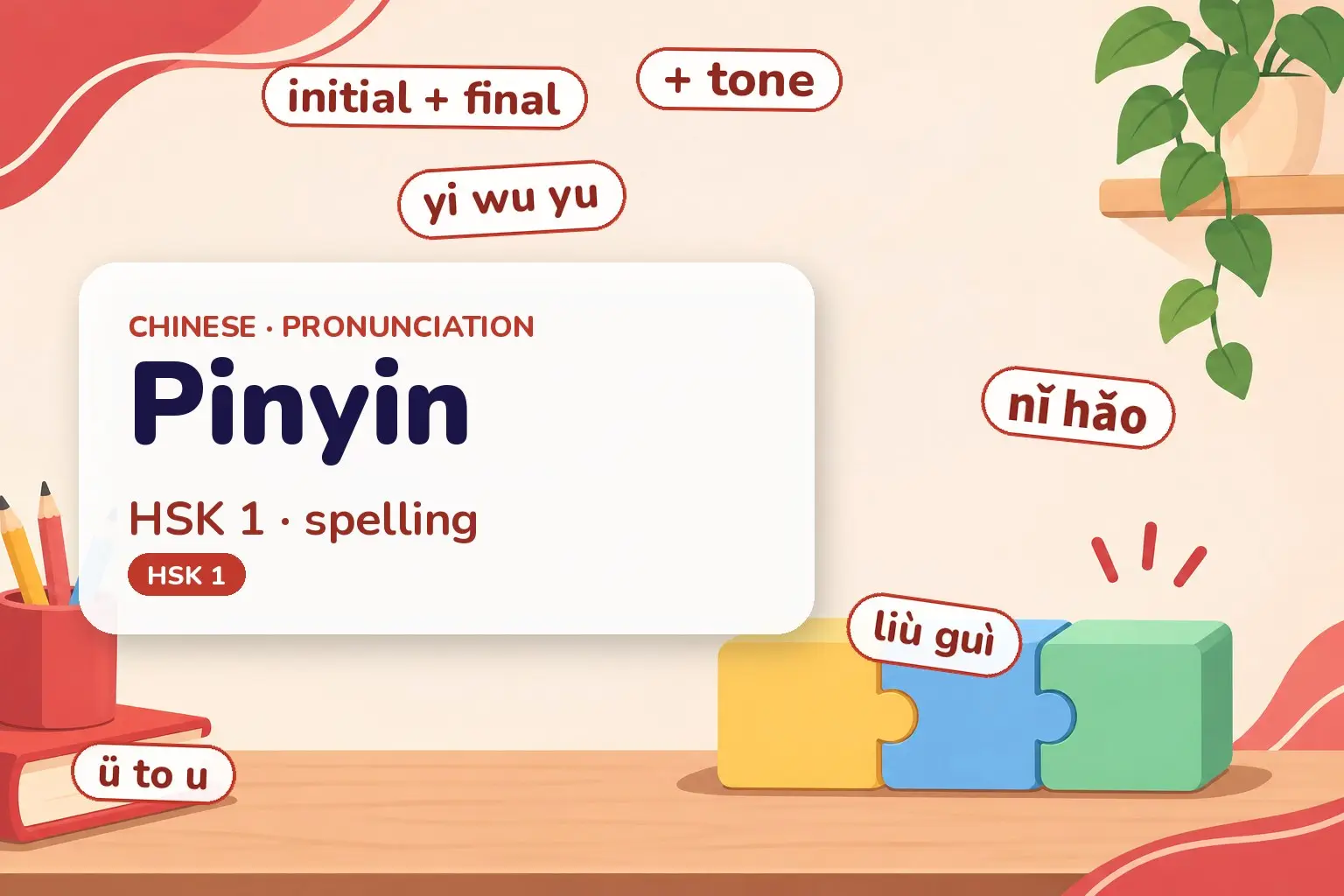
Pinyin is the official system that spells Mandarin sounds in Latin letters. Every syllable is built from an initial (the opening consonant), a final (the rest of the vowel sound), and a tone mark over the main vowel — as in 你好 (nǐ hǎo).
Level: HSK 1. Chinese characters do not tell you how to say them, so Mandarin has an official spelling system in Latin letters: pinyin — 拼音 (pīnyīn), literally “spell-sound”. Learn how a pinyin syllable is put together and you can read the pronunciation of any word from a dictionary or textbook.
What pinyin is
Pinyin is the standard romanisation of Mandarin, set by the Scheme for the Chinese Phonetic Alphabet. It does not replace characters — 你好 (nǐ hǎo) is still written with characters — but it writes the sound of each character so a learner can say it. Every full syllable has three parts:
- an initial — 声母 (shēngmǔ) — the opening consonant, like the n in 你 (nǐ);
- a final — 韵母 (yùnmǔ) — the vowel or vowel-plus-ending that follows, like the ǐ in 你 (nǐ);
- a tone — the pitch, shown by a mark over the main vowel.
Some syllables have no initial at all (just a final, like 爱 (ài), “to love”), but every full syllable has a final and a tone.
Initials and finals
There are about 21 initials (consonant starts) and a set of finals (vowel endings). You do not memorise a list; you meet them syllable by syllable. The table shows the structure, not every combination:
| Part | Role | Examples (with pinyin) |
|---|---|---|
| Initial | opening consonant | 妈 (mā), 大 (dà), 国 (guó) |
| Final | vowel sound + any ending | 啊 (a), 爱 (ài), 安 (ān) |
| Initial + final | a full syllable | 好 (hǎo), 学 (xué), 中 (zhōng) |
The spelling rules that surprise learners
Pinyin has a few fixed conventions. They are not pronunciation changes — the sound is the same — but the written form changes:
- No initial → y or w. When a final starting with i, u or ü has no initial in front of it, you write y or w: i → yi, in → yin, ing → ying; u → wu; ü → yu, üe → yue.
- ü after j, q, x loses its dots. Because j, q, x never go with a plain u, the ü in ju, qu, xu is written without dots. But after n and l the dots stay — nü, 女 (nǚ, woman), must be kept apart from nu, 努 (nǔ).
- Shortened finals. After an initial, iou is written iu, as in 六 (liù); uei is written ui, as in 贵 (guì); and uen is written un, as in 论 (lùn).
Where the tone mark goes
A syllable carries one tone, shown by a mark (ā á ǎ à) over the main vowel. The rule for which vowel:
- If there is an a, the mark goes on it: hǎo, xiǎng.
- No a? Put it on o or e: gǒu, xuě.
- For iu and ui, the mark goes on the second vowel: liù, guì.
- The dot on i is dropped when it takes the mark: nǐ, not nǐ with a dot.
The neutral (light) tone has no mark at all, as in the particle 吗 (ma) or the 子 (zi) in 桌子 (zhuōzi, table).
Pinyin in action
- 你好nǐ hǎohello — n + i (third tone), h + ao (third tone)
- 中国ZhōngguóChina — zh + ong (first), g + uo (second)
- 学生xuéshengstudent — note xu is really xü; sheng is neutral
- 女nǚwoman — nü keeps its dots (not nu)
- 去qùto go — qu is really qü, dots dropped after q
- 六liùsix — iou is written iu, mark on the u
- 贵guìexpensive — uei is written ui, mark on the i
- 爱àito love — no initial; mark goes on the a
- 一yīone — a lone i is written yi
- 五wǔfive — a lone u is written wu
- 月yuèmoon/month — üe with no initial is written yue
- 桌子zhuōzitable — zi is a neutral tone, no mark
- 西安Xī'anXi'an (city) — apostrophe splits xi and an
- 好hǎogood — initial h, final ao, third tone
Practice
Pinyin system practice
Try each one, then press Check. No sign-up, nothing is sent anywhere — it all runs in your browser.
3 Match each pinyin convention to its result.
- ü after j/q/x
- ü after n/l
- iou after an initial
- uei after an initial
Show answer
- ü after j/q/x → written u (qu)
- ü after n/l → keeps dots (nü)
- iou after an initial → written iu (liù)
- uei after an initial → written ui (guì)
These are spelling rules; the sound does not change.
Hint: liù, guì
Show answer
second — For iu and ui the mark sits on the second vowel: liù, guì.
Where to go next
Pinyin tells you how to spell a sound; the Chinese pronunciation overview drills the tones and tricky initials behind it. Then put syllables to work with the verb 是 (shì) and browse the Chinese grammar section. New here? Start at Start Learning Chinese Here.
Quiz
Pinyin romanisation quiz
10 questions · pick an answer and you'll see straight away if it's right.
-
Show answer
the official Latin-letter spelling of Mandarin sounds — Pinyin romanises Mandarin pronunciation in Latin letters.
-
Show answer
no — it writes the sound alongside them — Characters stay; pinyin shows how to say them.
-
Show answer
initial, final, tone — Initial (consonant) + final (vowel sound) + tone.
-
Show answer
yi — A lone i becomes yi, as in 一 (yī).
-
Show answer
plain u — ju, qu, xu — the dots are dropped because plain u never follows j/q/x.
-
Show answer
nü — nü keeps the dots, as in 女 (nǚ), to stay distinct from nu.
-
Show answer
iu — It shortens to iu: 六 (liù).
-
Show answer
the second vowel — On the second vowel: guì, liù.
-
Show answer
no mark at all — Neutral tone has no tone mark, as in 吗 (ma).
-
Show answer
it separates xi and an so it is not read as xian — The apostrophe splits the two syllables to avoid a misreading.
All Chinese pronunciation & writing topics
Vocabulary, pronunciation, phrases, practice and exam help, ordered by level. Pick a topic and go straight to it. New lessons go live every day, so topics marked Coming soon fill in over the next weeks.
Pronunciation & writing
HSK 1 8 topics · 2 ready
- 01 Chinese Pronunciation Overview
- 02 Pinyin: The Romanisation System You are here
- 03 Pinyin Initials (Consonants) Coming soon
- 04 Pinyin Finals (Vowels & Endings) Coming soon
- 05 The Four Tones (and Neutral Tone) Coming soon
- 06 Character Strokes & Stroke Order Coming soon
- 07 Essential HSK 1 Characters Coming soon
- 08 How to Type Chinese (Pinyin Input) Coming soon
HSK 2 7 topics
- 09 Tone Change Rules (Tone Sandhi) Coming soon
- 10 Introduction to Chinese Characters (Hanzi) Coming soon
- 11 Character Radicals (Bushou) Coming soon
- 12 Measure Words (Classifiers) Intro Coming soon
- 13 Chinese Radicals Reference (214 Kangxi) Coming soon
- 14 Essential HSK 2 Characters Coming soon
- 15 Simplified vs Traditional Characters Coming soon
HSK 3 2 topics
- 16 Phonetic & Semantic Components Coming soon
- 17 Essential HSK 3 Characters Coming soon