Chinese Pronunciation Overview
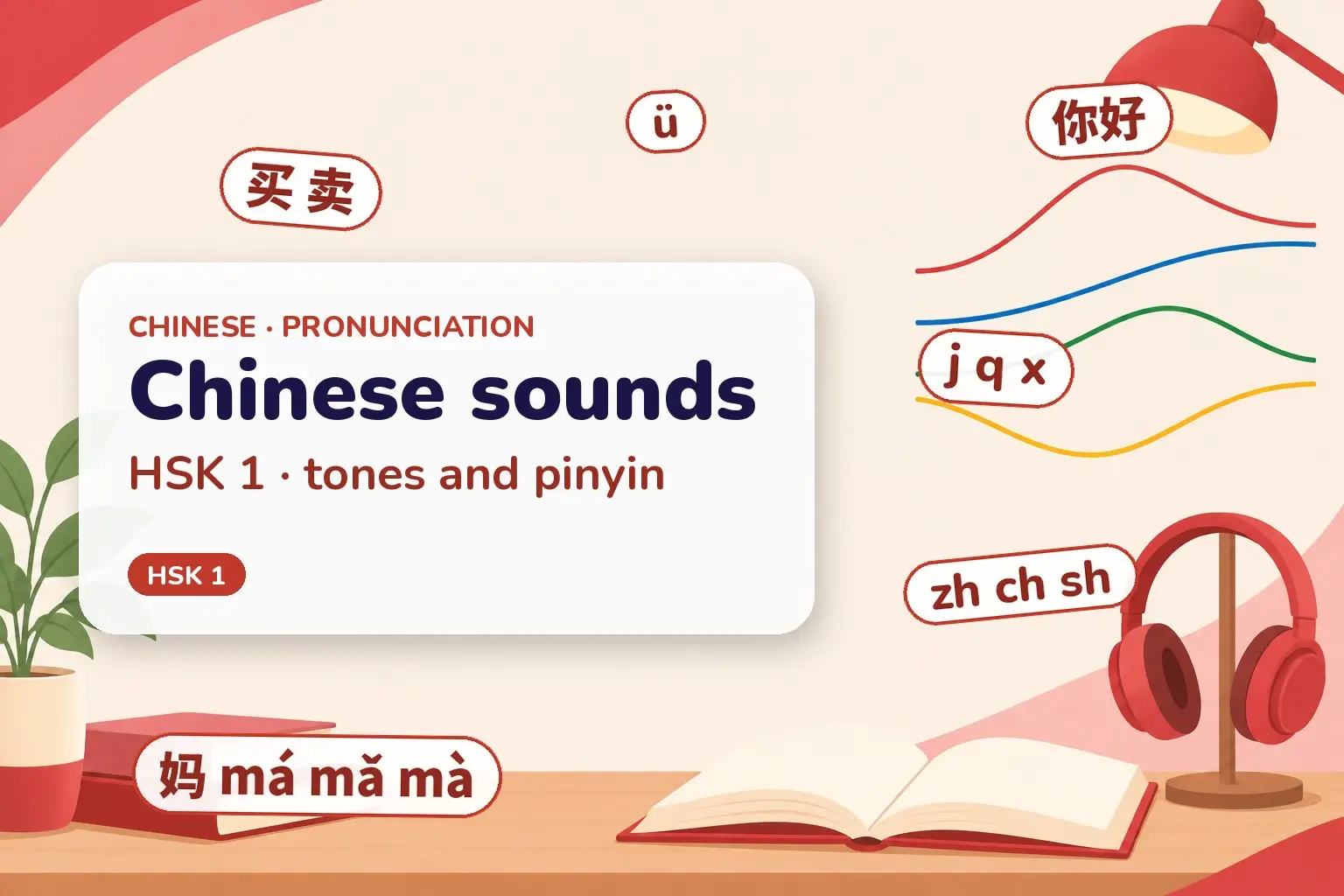
Chinese pronunciation rests on two things: the four tones, which change a word's meaning, and pinyin, the romanisation that spells every sound. Learn mā, má, mǎ, mà and the tricky initials like zh, ch, sh and j, q, x, and the rest follows.
On this page7 sections · tap to jump
Level: HSK 1. Mandarin uses a spelling system in Latin letters called pinyin, so you are never guessing how a syllable sounds. The challenge is not the letters but the tones — the pitch you say a syllable with — because in Chinese the tone is part of the word.
What makes Chinese sound right
Two systems work together:
- The four tones (plus a neutral one). Every full syllable is said with a set pitch shape. First tone (mā) is high and flat, second (má) rises like a question, third (mǎ) dips low then lifts, and fourth (mà) falls sharply. A light, toneless neutral syllable also exists, as in the question word 吗 (ma).
- Pinyin spelling. Pinyin writes each syllable as an initial (the opening consonant) plus a final (the rest). Most letters are close to English, but a few groups are not, and those are where learners slip.
The biggest hurdles
- zh, ch, sh, r (retroflex). Curl the tongue tip up and back toward the roof of the mouth. 吃 (chī, to eat) and 是 (shì, to be) use this set. They are not the English “j, ch, sh”.
- j, q, x (palatal). Flat tongue, tip near the lower teeth, lips spread. 去 (qù, to go) and 谢谢 (xièxie, thank you) use these. English speakers often confuse them with zh, ch, sh — keep the two groups apart.
- z, c, s. Said at the front of the mouth; c is a hard “ts” as in “cats”, not an English “s”.
- The ü vowel. Round your lips as if to say “oo”, then try to say “ee”. It appears in 女 (nǚ, woman) and after j, q, x (where it is written plain u, as in 去 (qù)).
- b/d/g versus p/t/k. Chinese b, d, g are unaspirated (no puff of air), closer to English p, t, k said softly; p, t, k come with a strong puff.
How to use the Listen button
Each example below has a Listen button. It plays the syllable with your device’s built-in voice, which gives a usable model of the tone shape and the vowel, though it is a synthetic voice rather than a native recording. The best drill: play a line, hum just its tone (high, rising, dipping or falling), then say the whole syllable on that pitch. Compare minimal pairs like mǎi and mài back to back until the pitch difference is obvious to your own ear.
Sounds and tones to practise
- 妈māmother — first tone, high and flat
- 麻máhemp — second tone, rising
- 马mǎhorse — third tone, dipping
- 骂màto scold — fourth tone, falling
- 吗maquestion particle — neutral tone
- 买mǎito buy — third tone
- 卖màito sell — fourth tone (compare mǎi)
- 是shìto be — retroflex sh
- 四sìfour — front s (compare shì)
- 十shíten — retroflex sh, rising tone
- 吃chīto eat — retroflex ch
- 去qùto go — palatal q with ü
- 女nǚwoman — the ü vowel
- 谢谢xièxiethank you — palatal x
- 你好nǐ hǎohello — two third tones, said ní hǎo
Practice
Chinese sounds practice
Try each one, then press Check. No sign-up, nothing is sent anywhere — it all runs in your browser.
3 Match each syllable to its tone.
- 妈 (mā)
- 麻 (má)
- 马 (mǎ)
- 骂 (mà)
Show answer
- 妈 (mā) → first, high and flat
- 麻 (má) → second, rising
- 马 (mǎ) → third, dipping
- 骂 (mà) → fourth, falling
The same sound ma carries four meanings by tone.
Hint: palatal q plus ü, falling tone
Show answer
qù — 去 (qù): q is palatal and the u here is really the ü vowel.
Where to go next
Pronunciation sticks when you use it in real sentences. Start with the verb everyone needs, The Verb 是 (shì), practise counting in Numbers in Chinese, and browse everything in the Chinese grammar section. New to the course? Get oriented from Start Learning Chinese Here.
Quiz
Chinese pronunciation quiz
8 questions · pick an answer and you'll see straight away if it's right.
-
Show answer
four (plus a neutral tone) — Four full tones plus a light neutral tone.
-
Show answer
high and flat — First tone is high and level.
-
Show answer
the Latin-letter spelling of Chinese sounds — Pinyin spells each syllable in Latin letters as initial plus final.
-
Show answer
different: retroflex (tongue back) versus palatal (tongue forward) — Keep them apart: zh, ch, sh curl back; j, q, x stay flat and forward.
-
Show answer
rounding the lips for oo while saying ee — Round the lips as for oo, then say ee: that is ü, as in nǚ.
-
Show answer
the first becomes a rising second tone (ní hǎo) — Third-tone sandhi: nǐ hǎo is pronounced ní hǎo.
-
Show answer
your device's synthetic voice, a usable model — It uses the device voice to model tone and vowel, not a native recording.
-
Show answer
unaspirated, with no puff of air — b, d, g are unaspirated; p, t, k carry a strong puff of air.
All Chinese pronunciation & writing topics
Vocabulary, pronunciation, phrases, practice and exam help, ordered by level. Pick a topic and go straight to it. New lessons go live every day, so topics marked Coming soon fill in over the next weeks.
Pronunciation & writing
HSK 1 8 topics · 1 ready
- 01 Chinese Pronunciation Overview You are here
- 02 Pinyin: The Romanisation System Coming soon
- 03 Pinyin Initials (Consonants) Coming soon
- 04 Pinyin Finals (Vowels & Endings) Coming soon
- 05 The Four Tones (and Neutral Tone) Coming soon
- 06 Character Strokes & Stroke Order Coming soon
- 07 Essential HSK 1 Characters Coming soon
- 08 How to Type Chinese (Pinyin Input) Coming soon
HSK 2 7 topics
- 09 Tone Change Rules (Tone Sandhi) Coming soon
- 10 Introduction to Chinese Characters (Hanzi) Coming soon
- 11 Character Radicals (Bushou) Coming soon
- 12 Measure Words (Classifiers) Intro Coming soon
- 13 Chinese Radicals Reference (214 Kangxi) Coming soon
- 14 Essential HSK 2 Characters Coming soon
- 15 Simplified vs Traditional Characters Coming soon
HSK 3 2 topics
- 16 Phonetic & Semantic Components Coming soon
- 17 Essential HSK 3 Characters Coming soon