The Four Tones (and Neutral Tone)
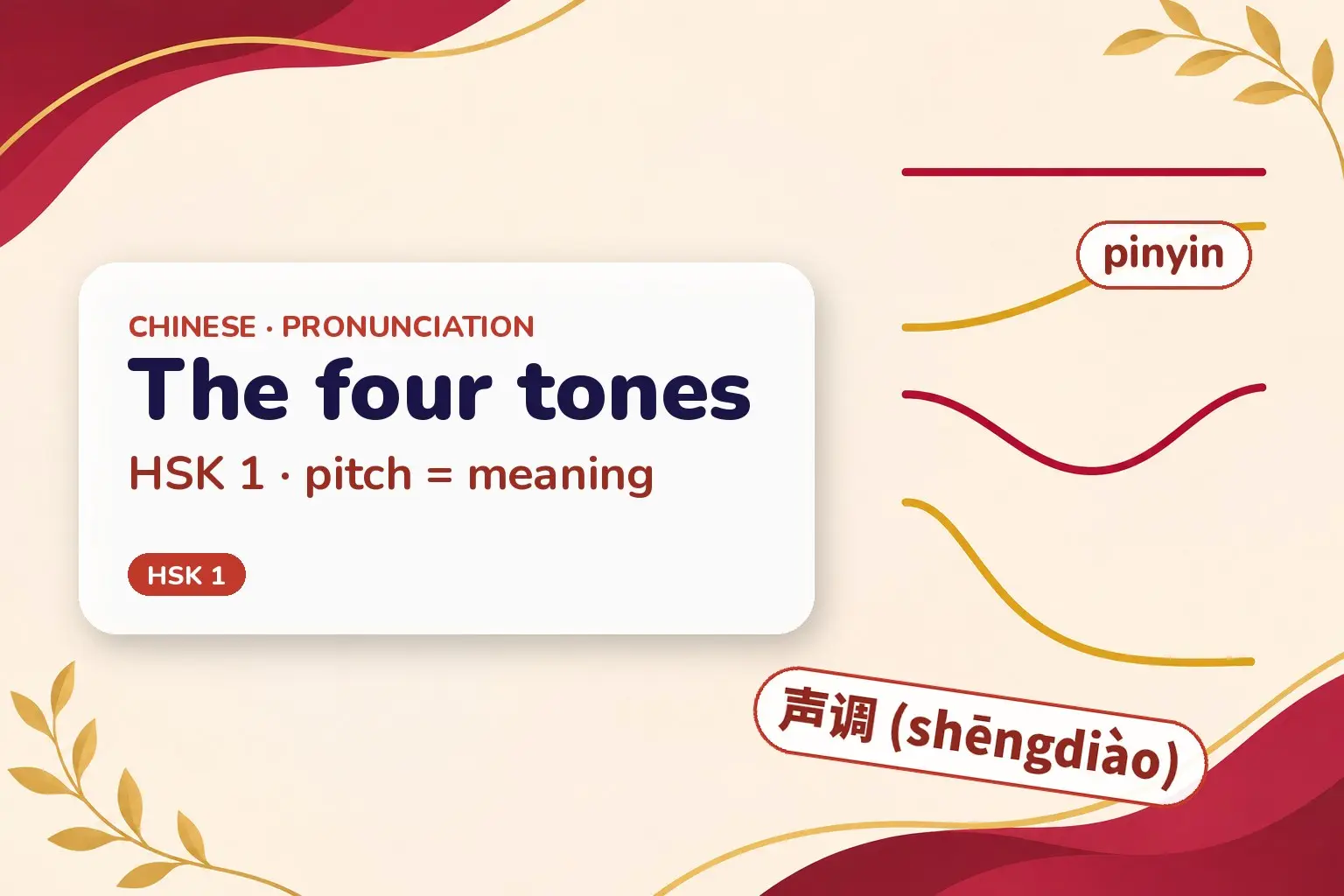
Mandarin has four tones — high and flat (mā), rising (má), low-dipping (mǎ) and sharply falling (mà) — plus a light neutral tone. The same syllable with a different tone is a different word, so tone is part of the word, not an accent.
Level: HSK 1. Mandarin is a tonal language: the pitch you say a syllable on is part of the word, not just emotion or emphasis. Change the tone and you change the meaning. There are four tones plus a light neutral tone, and the most famous example shows all four on one sound: 妈 (mā), 麻 (má), 马 (mǎ), 骂 (mà) — four completely different words.
What a tone is
A tone is the pitch pattern of a syllable — whether your voice stays level, rises, dips, or falls. In pinyin (the romanisation system) each tone has its own mark written over the main vowel. Think of the marks as little pictures of your pitch:
- First tone (ˉ): high and flat, like holding a note — 妈 (mā, mother).
- Second tone (ˊ): rising, like the end of an English question — 麻 (má, hemp).
- Third tone (ˇ): dips low then rises a little — 马 (mǎ, horse).
- Fourth tone (ˋ): sharp and falling, like a firm command — 骂 (mà, to scold).
The neutral tone has no mark at all. It is short, light and quick, and it takes its pitch from whatever comes before it: the second syllable in 妈妈 (māma, mum) is neutral.
The four tones at a glance
| Tone | Mark | Pinyin | Character | Meaning |
|---|---|---|---|---|
| 1st (high, flat) | ˉ | mā | 妈 | mother |
| 2nd (rising) | ˊ | má | 麻 | hemp |
| 3rd (dipping) | ˇ | mǎ | 马 | horse |
| 4th (falling) | ˋ | mà | 骂 | to scold |
| neutral (light) | — | ma | 吗 | question particle |
Where the tone mark goes
Each pinyin syllable gets exactly one tone mark, and it sits on the main vowel. The simple order of priority is:
- If there is an a, mark the a: hǎo, xiào.
- Otherwise mark o or e: duō, xiě.
- In iu or ui, mark the second vowel: liù, guì.
So 好 (hǎo) takes its mark on the a, and 六 (liù) marks the u, the second letter of iu.
Third-tone sandhi
When two third-tone syllables come together, the first one changes to a second tone. This is called tone sandhi. So 你好 (nǐ hǎo, hello) is actually pronounced ní hǎo, even though it is written with two third-tone marks. The spelling keeps the original tones; only the sound changes. A lone third tone before a pause often shortens to just its low dip, without the final rise.
Hear the tones
- 妈māmother — first tone, high and flat
- 麻máhemp — second tone, rising
- 马mǎhorse — third tone, dipping
- 骂màto scold — fourth tone, falling
- 吗maquestion particle — neutral, no mark
- 买mǎito buy — third tone
- 卖màito sell — fourth tone
- 汤tāngsoup — first tone
- 糖tángsugar — second tone
- 躺tǎngto lie down — third tone
- 烫tàngscalding hot — fourth tone
- 你好nǐ hǎohello — said as ní hǎo (sandhi)two 3rd tones
- 好hǎogood — mark on the a
- 六liùsix — mark on the second vowel of iu
- 妈妈māmamum — second syllable neutral
- 谢谢xièxiethank you — second syllable neutral
Common mistakes
- ❌ saying 买 (mǎi, to buy) with a falling tone, which gives 卖 (mài, to sell) — the opposite meaning. Keep the third tone low and dipping.
- ❌ putting the tone mark on the wrong letter: writing haǒ instead of hǎo. The a always wins the mark.
- ❌ pronouncing both syllables of 你好 (nǐ hǎo) as full third tones. The first shifts to a second tone: ní hǎo.
- ❌ stressing a neutral-tone syllable: 妈妈 (māma) is MA-ma, with the second part light and quick, not ma-MA.
A tiny dialogue
— 你好! — Nǐ hǎo! — Hello! — 你好!你买什么? — Nǐ hǎo! Nǐ mǎi shénme? — Hello! What are you buying? — 我买糖。 — Wǒ mǎi táng. — I am buying sugar.
Notice 买 (mǎi, to buy) stays a clear third tone, while 糖 (táng, sugar) rises.
Practice
Four tones practice
Try each one, then press Check. No sign-up, nothing is sent anywhere — it all runs in your browser.
2 Match each syllable to its tone.
- 妈 (mā)
- 麻 (má)
- 马 (mǎ)
- 骂 (mà)
Show answer
- 妈 (mā) → 1st: high flat
- 麻 (má) → 2nd: rising
- 马 (mǎ) → 3rd: dipping
- 骂 (mà) → 4th: falling
One syllable, four tones, four meanings.
Hint: nǐ hǎo sounds like ní hǎo
Show answer
2 — Third-tone sandhi: the first third tone is said as a second tone.
Where to go next
Put the tones together with the sounds in the pinyin initials and pinyin finals, see the whole system in the pinyin overview, and hear it all in the Chinese pronunciation overview. New here? Begin at Start Learning Chinese Here.
Quiz
Four tones quiz
9 questions · pick an answer and you'll see straight away if it's right.
-
Show answer
four — Four tones, plus a light neutral tone.
-
Show answer
rising — The second tone rises, like 麻 (má).
-
Show answer
their tones — Same syllable, different tones, different words.
-
Show answer
sharply falling — The fourth tone falls sharply, like 骂 (mà).
-
Show answer
short, light and unmarked — It is quick and light, with no tone mark.
-
Show answer
the u — In iu, the mark goes on the second vowel: liù.
-
Show answer
ní hǎo — Third-tone sandhi turns the first into a second tone: ní hǎo.
-
Show answer
tone: third versus fourth — 买 (mǎi, buy) is third tone; 卖 (mài, sell) is fourth.
-
Show answer
on a, then o or e, then the second of iu/ui — Priority: a, then o/e, then the second vowel of iu/ui.
All Chinese pronunciation & writing topics
Vocabulary, pronunciation, phrases, practice and exam help, ordered by level. Pick a topic and go straight to it. New lessons go live every day, so topics marked Coming soon fill in over the next weeks.
Pronunciation & writing
HSK 1 8 topics · 6 ready
- 01 Chinese Pronunciation Overview
- 02 Pinyin: The Romanisation System
- 03 Pinyin Initials (Consonants)
- 04 Pinyin Finals (Vowels & Endings)
- 05 The Four Tones (and Neutral Tone) You are here
- 06 Character Strokes & Stroke Order
- 07 Essential HSK 1 Characters Coming soon
- 08 How to Type Chinese (Pinyin Input) Coming soon
HSK 2 7 topics · 2 ready
- 09 Tone Change Rules (Tone Sandhi)
- 10 Introduction to Chinese Characters (Hanzi)
- 11 Character Radicals (Bushou) Coming soon
- 12 Measure Words (Classifiers) Intro Coming soon
- 13 Chinese Radicals Reference (214 Kangxi) Coming soon
- 14 Essential HSK 2 Characters Coming soon
- 15 Simplified vs Traditional Characters Coming soon
HSK 3 2 topics
- 16 Phonetic & Semantic Components Coming soon
- 17 Essential HSK 3 Characters Coming soon