Character Strokes & Stroke Order
Every Chinese character is made of a small set of basic strokes — 横 (héng, horizontal), 竖 (shù, vertical), 撇 (piě), 捺 (nà), 点 (diǎn, dot) and a few more — drawn in a fixed order: top to bottom, left to right, and horizontal before vertical.
On this page9 sections · tap to jump
Level: HSK 1. A Chinese character can look like a tangle of lines, but it is really a small set of strokes — 笔画 (bǐhuà) — drawn in a fixed order, 笔顺 (bǐshùn). Learn the handful of basic strokes and six ordering rules, and even brand-new characters become something you can write cleanly instead of copy like a drawing.
What a stroke is
A stroke is a single line you draw without lifting the pen. 一 (yī, one) is one stroke; 二 (èr, two) is two; 三 (sān, three) is three. Chinese dictionaries count a character by its number of strokes, so knowing the strokes also helps you look words up.
Characters are built from a few basic strokes. Most of what you write is just these shapes repeated and combined.
The basic strokes
| Stroke | Name | Reading | Looks like | Seen in |
|---|---|---|---|---|
| 一 | 横 | héng | horizontal line | 一 (yī), 三 (sān) |
| 丨 | 竖 | shù | vertical line | 十 (shí), 中 (zhōng) |
| 丿 | 撇 | piě | falls to the left | 人 (rén), 八 (bā) |
| 捺 | 捺 | nà | falls to the right | 人 (rén), 大 (dà) |
| 丶 | 点 | diǎn | a dot | 小 (xiǎo), 六 (liù) |
| 提 | 提 | tí | rises to the right | 冰 (bīng), 打 (dǎ) |
| 乛 | 折 | zhé | a turning bend | 口 (kǒu), 日 (rì) |
| 亅 | 钩 | gōu | a hook at the end | 小 (xiǎo), 了 (le) |
The stroke-order rules
Write the strokes of a character in this order. When two rules apply, the higher one usually wins.
| Rule | Chinese | Reading | Example |
|---|---|---|---|
| Top to bottom | 从上到下 | cóng shàng dào xià | 三 (sān): top, middle, bottom |
| Left to right | 从左到右 | cóng zuǒ dào yòu | 们 (men): left part, then right |
| Horizontal before vertical | 先横后竖 | xiān héng hòu shù | 十 (shí): 一 then 丨 |
| Left-falling before right-falling | 先撇后捺 | xiān piě hòu nà | 人 (rén): 丿 then 捺 |
| Outside before inside | 先外后内 | xiān wài hòu nèi | 月 (yuè): frame, then inside |
| Close the box last | 后封口 | hòu fēng kǒu | 口 (kǒu), 国 (guó): seal the bottom last |
A seventh habit helps with symmetrical characters: middle before the two sides, as in 小 (xiǎo), where the centre hook comes before the two dots.
Worked examples
- 一yīone — 1 stroke: a single 横 (héng)horizontal
- 二èrtwo — 2 strokes, top 横 then bottom 横 (héng)
- 三sānthree — 3 strokes, top to bottom
- 十shíten — 2 strokes: 横 (héng) first, then 竖 (shù)horizontal before vertical
- 人rénperson — 2 strokes: 撇 (piě) then 捺 (nà)left-falling before right-falling
- 大dàbig — 3 strokes: 横 (héng), 撇 (piě), 捺 (nà)
- 口kǒumouth — 3 strokes: left 竖 (shù), top-right bend, bottom 横 closes the box
- 日rìsun / day — 4 strokes, close the box last
- 中zhōngmiddle — 4 strokes: the box, then the 竖 (shù) down the centre
- 小xiǎosmall — 3 strokes: centre hook first, then the two 点 (diǎn)middle before sides
- 木mùtree — 4 strokes: 横, 竖, 撇, 捺
- 月yuèmoon — 4 strokes: outside frame before the inside lines
- 八bāeight — 2 strokes: 撇 (piě) then 捺 (nà)
- 国guócountry — 8 strokes: fill the inside, then close the outer box last
- 好hǎogood — 6 strokes: left part 女 (nǚ) first, then right part 子 (zǐ)left to right
Trace each one in the order given; after a few you will feel the rules becoming automatic.
Common mistakes
- ❌ writing 十 (shí) with the 竖 (shù) first → ✅ 横 (héng) comes first: horizontal before vertical.
- ❌ closing the box of 口 (kǒu) before filling it → ✅ seal the bottom last; the inside and sides come first.
- ❌ drawing 人 (rén) right-falling then left → ✅ 撇 (piě, left) before 捺 (nà, right).
- ❌ starting a left-right character like 好 (hǎo) from the right → ✅ write the left part 女 (nǚ) before the right part 子 (zǐ).
- ❌ treating 钩 (gōu, hook) as a separate first stroke → ✅ the hook is the tail of the stroke it sits on, not a new line.
Usage notes
- Stroke count is a lookup key. Paper dictionaries and many apps let you find a character by its stroke total, so counting accurately is a real skill, not just neatness.
- Radicals follow the rules too. A character’s left-hand radical is written before the rest, which is just the left-to-right rule applied to its parts. See how characters combine in Chinese characters: an introduction.
- Simplified vs traditional. Stroke counts differ between simplified and traditional forms, but the ordering rules are the same. Lingoladder uses simplified characters.
- Pinyin is separate. Stroke order is about writing; the sound of a character is shown by pinyin, which you learn alongside it.
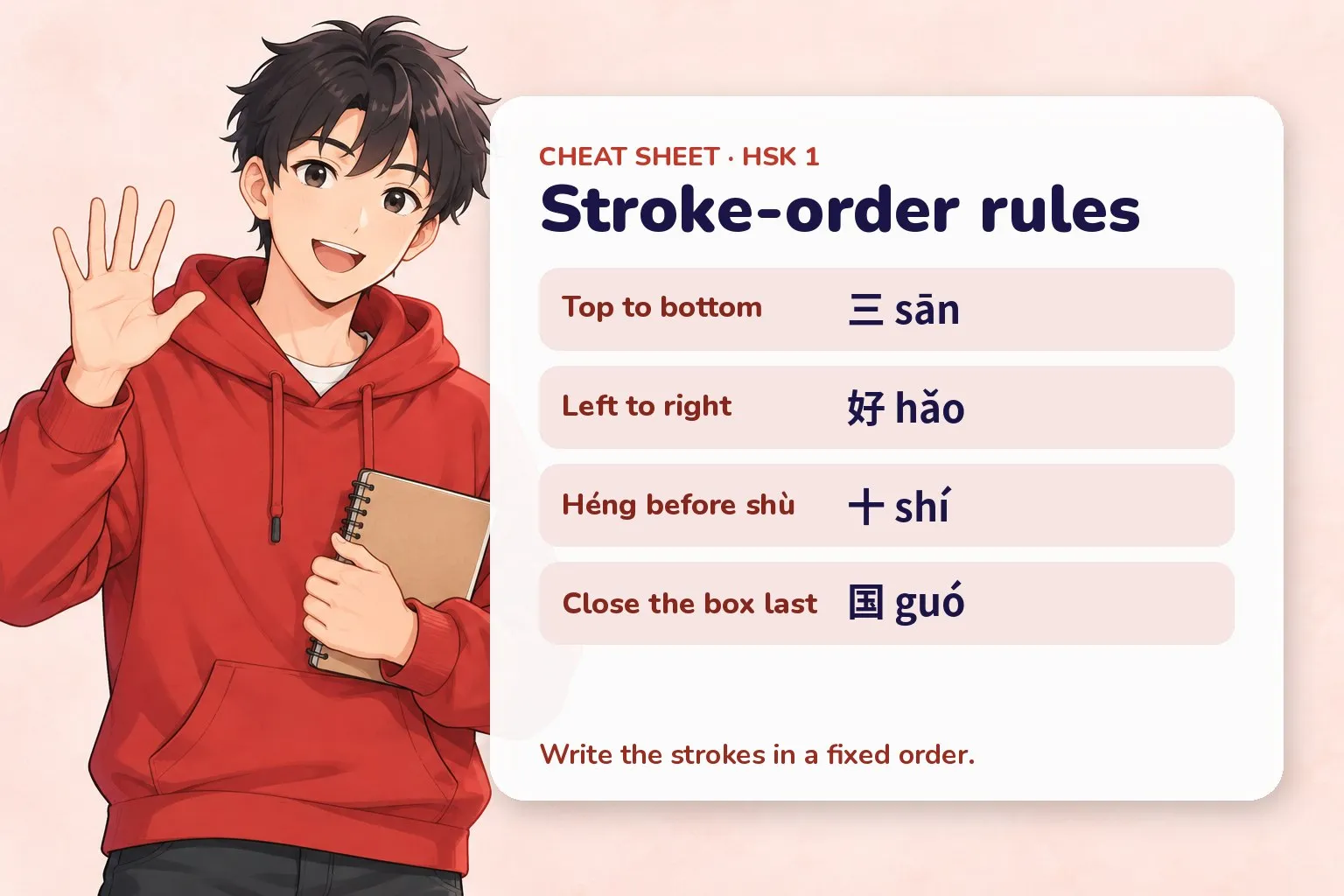
Quick recap before the quiz.
Practice
Strokes and stroke order practice
Try each one, then press Check. No sign-up, nothing is sent anywhere — it all runs in your browser.
Hint: the left-falling one
Show answer
piě — 先撇后捺 (xiān piě hòu nà): 撇 (piě) before 捺 (nà).
4 Match each stroke name to its shape.
- 横 (héng)
- 竖 (shù)
- 点 (diǎn)
- 撇 (piě)
Show answer
- 横 (héng) → horizontal line
- 竖 (shù) → vertical line
- 点 (diǎn) → a dot
- 撇 (piě) → left-falling
横 (héng) is horizontal, 竖 (shù) vertical, 点 (diǎn) a dot, 撇 (piě) left-falling.
Quiz
Strokes and stroke order quiz
10 questions · pick an answer and you'll see straight away if it's right.
-
Show answer
one line drawn without lifting the pen — A stroke — 笔画 (bǐhuà) — is a single unbroken line.
-
Show answer
top to bottom, left to right — 从上到下 (cóng shàng dào xià) and 从左到右 (cóng zuǒ dào yòu): top to bottom, left to right.
-
Show answer
横 (héng) — 先横后竖 (xiān héng hòu shù): horizontal before vertical.
-
Show answer
撇 (piě) — The left-falling stroke is 撇 (piě); the right-falling one is 捺 (nà).
-
Show answer
3 — 口 (kǒu) is three strokes, with the bottom closing the box last.
-
Show answer
fill the inside, then close the box last — 后封口 (hòu fēng kǒu): seal the outer box last.
-
Show answer
点 (diǎn) — 点 (diǎn) is the dot, seen in 小 (xiǎo) and 六 (liù).
-
Show answer
the left part 女 (nǚ) first — 从左到右 (cóng zuǒ dào yòu): the left part 女 (nǚ) before the right part 子 (zǐ).
-
Show answer
look a character up in a dictionary — Stroke total is a standard way to index and look up characters.
-
Show answer
1 — 一 (yī) is a single 横 (héng) — one stroke.
Recap cheat-sheet
| Rule | Reading | Example |
|---|---|---|
| Top to bottom | cóng shàng dào xià | 三 (sān) |
| Left to right | cóng zuǒ dào yòu | 好 (hǎo) |
| Horizontal before vertical | xiān héng hòu shù | 十 (shí) |
| Left-falling before right-falling | xiān piě hòu nà | 人 (rén) |
| Close the box last | hòu fēng kǒu | 国 (guó) |
Next
- See how strokes build up into characters in Chinese characters: an introduction
- Learn the sounds with pinyin: an overview
- New here? Start with Start Learning Chinese Here
All Chinese pronunciation & writing topics
Vocabulary, pronunciation, phrases, practice and exam help, ordered by level. Pick a topic and go straight to it. New lessons go live every day, so topics marked Coming soon fill in over the next weeks.
Pronunciation & writing
HSK 1 8 topics · 6 ready
- 01 Chinese Pronunciation Overview
- 02 Pinyin: The Romanisation System
- 03 Pinyin Initials (Consonants)
- 04 Pinyin Finals (Vowels & Endings)
- 05 The Four Tones (and Neutral Tone)
- 06 Character Strokes & Stroke Order You are here
- 07 Essential HSK 1 Characters Coming soon
- 08 How to Type Chinese (Pinyin Input) Coming soon
HSK 2 7 topics · 2 ready
- 09 Tone Change Rules (Tone Sandhi)
- 10 Introduction to Chinese Characters (Hanzi)
- 11 Character Radicals (Bushou) Coming soon
- 12 Measure Words (Classifiers) Intro Coming soon
- 13 Chinese Radicals Reference (214 Kangxi) Coming soon
- 14 Essential HSK 2 Characters Coming soon
- 15 Simplified vs Traditional Characters Coming soon
HSK 3 2 topics
- 16 Phonetic & Semantic Components Coming soon
- 17 Essential HSK 3 Characters Coming soon