Tone Change Rules in Chinese (Tone Sandhi)
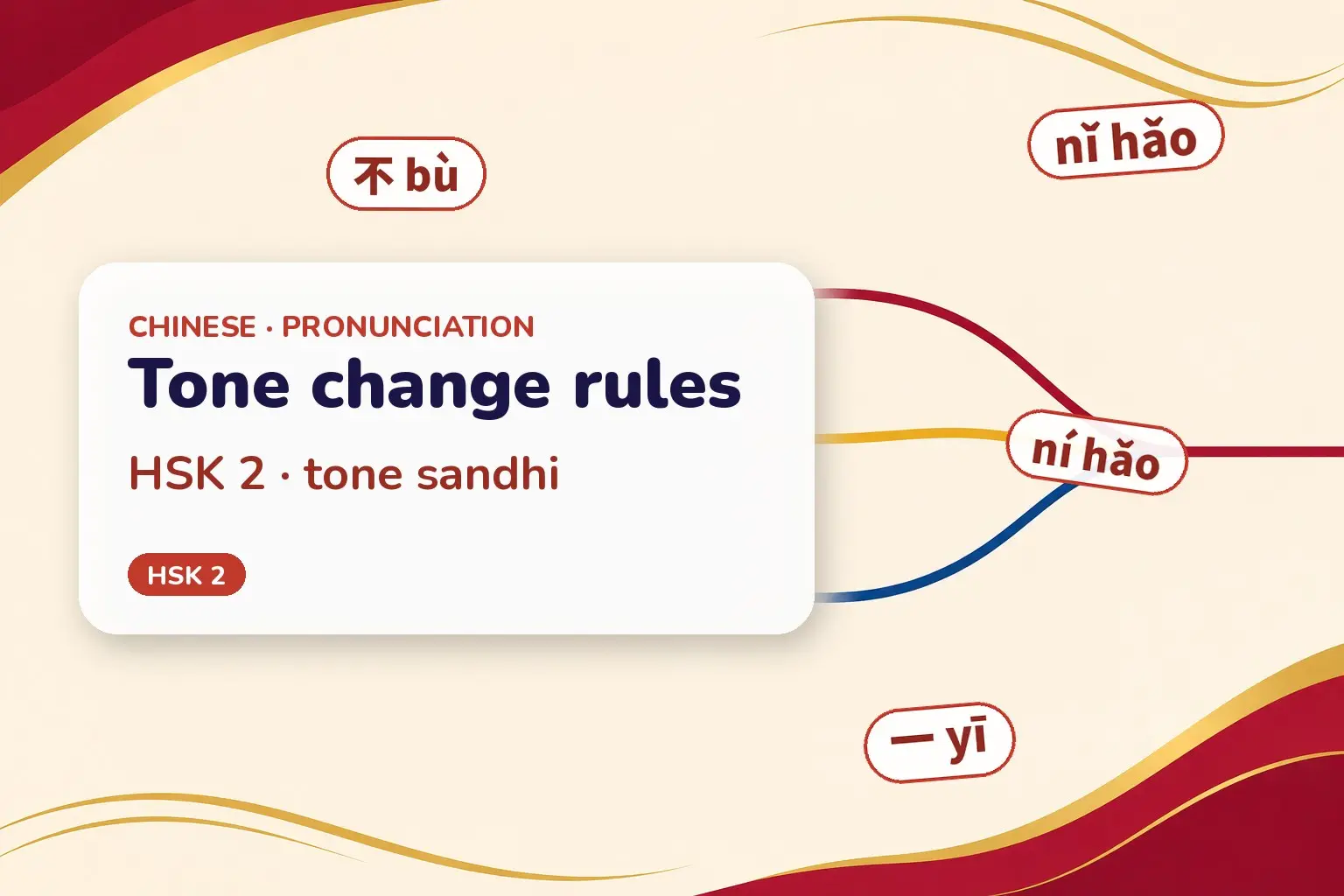
In connected speech some Mandarin tones shift. When two third tones meet, the first becomes a second tone, so 你好 (nǐ hǎo) is said ní hǎo. 一 (yī) and 不 (bù) also change tone before certain syllables. The spelling keeps the original tones.
Level: HSK 2. Once you know the four tones, the next surprise is that a few of them change when syllables run together. This is called tone sandhi (a word borrowed from Sanskrit meaning “joining”). The three you must know early are the third-tone change, and the special behaviour of 一 (yī, one) and 不 (bù, not).
What tone sandhi is
A tone is the pitch pattern of a syllable, and in Mandarin it is part of the word. Sandhi means the automatic sound change that happens when one syllable meets another. The key point: the written pinyin keeps the original tone marks, but your mouth says the changed tone. So you cannot read the change off the page — you learn it as a habit.
There are three changes a beginner meets constantly:
- two third tones in a row,
- the number 一 (yī, one),
- the negative 不 (bù, not).
1. Third-tone sandhi
The third tone is a low, dipping tone. When two third tones come together, the first one is said as a second (rising) tone. The rule is often written 3 + 3 to 2 + 3.
So 你好 (nǐ hǎo) comes out ní hǎo, and 很好 (hěn hǎo, very good) comes out hén hǎo. A third tone before a first, second, fourth or neutral tone is usually said as a half-third: just the low dip, with no final rise. The full dip-and-rise mostly survives at the very end of a phrase or in isolation.
| Where the 3rd tone is | What you say | Example |
|---|---|---|
| before another 3rd tone | rising (2nd) | 你好 (nǐ hǎo) to ní hǎo |
| before 1st, 2nd, 4th, neutral | low half-third | 老师 (lǎoshī) with a low dip |
| alone at the end of a phrase | full dip then rise | 很好 (hěn hǎo), last syllable full |
2. The tone of 一 (yī, one)
一 (yī) is first tone on its own, when counting, or at the end of a word. In front of another syllable it changes:
- before a fourth tone, it becomes yí: 一个 (yí gè, one item), 一下 (yí xià, a moment).
- before a first, second or third tone, it becomes yì: 一天 (yì tiān, one day), 一年 (yì nián, one year), 一起 (yì qǐ, together).
- on its own or as an ordinal, it stays yī: 第一 (dì yī, first), 一 (yī, one).
3. The tone of 不 (bù, not)
不 (bù) is fourth tone by default. The single change: before another fourth tone, it becomes bú.
- 不是 (bú shì, is not) — 是 (shì) is fourth tone, so 不 (bù) rises to bú.
- 不要 (bú yào, do not want) — before fourth-tone 要 (yào), it is bú.
- 不好 (bù hǎo, not good) — before third-tone 好 (hǎo), it stays bù.
- 不多 (bù duō, not much) — before first-tone 多 (duō), it stays bù.
Hear the changes
- 你好nǐ hǎo (said ní hǎo)hello — 3 + 3 becomes 2 + 3third-tone sandhi
- 很好hěn hǎo (said hén hǎo)very good — first third rises
- 我很好wǒ hěn hǎo (said wǒ hén hǎo)I am very good — three thirds
- 老师lǎoshīteacher — low half-third before a first tone
- 可以kěyǐ (said ké yǐ)can, may — 3 + 3 becomes 2 + 3
- 一个yí gèone item — yī becomes yí before a 4th tone
- 一下yí xiàa moment — yí before 4th tone 下
- 一天yì tiānone day — yì before 1st tone 天
- 一起yì qǐtogether — yì before 3rd tone 起
- 第一dì yīfirst — yī stays as an ordinal
- 不是bú shìis not — bù becomes bú before 4th tone 是
- 不要bú yàodo not want — bú before 4th tone 要
- 不好bù hǎonot good — bù stays before 3rd tone 好
- 不多bù duōnot much — bù stays before 1st tone 多
- 一起走yì qǐ zǒuwalk together — yì, then 3 + 3 on qǐ zǒu
Say each one aloud: the written mark is the old tone, your voice uses the new one.
Common mistakes
- ❌ reading 你好 (nǐ hǎo) as two full third tones → ✅ say ní hǎo: the first third rises to a second tone.
- ❌ keeping 一 (yī) as first tone in 一个 (yí gè) → ✅ it drops to yí before the fourth-tone 个 (gè).
- ❌ saying 不 (bù) as fourth tone in 不是 (bú shì) → ✅ it rises to bú before another fourth tone.
- ❌ “correcting” the spelling to match the sound, writing ní hǎo → ✅ keep the pinyin as 你好 (nǐ hǎo); only the sound changes.
- ❌ giving every third tone a big dip-and-rise → ✅ before most tones it is a low half-third; the full shape is mainly phrase-final.
A tiny dialogue
— 你好!你好吗? — Nǐ hǎo! Nǐ hǎo ma? — Hello! How are you? (said ní hǎo) — 我很好!谢谢! — Wǒ hěn hǎo! Xièxie! — I am very good, thanks! (said wǒ hén hǎo) — 我们一起走吧。 — Wǒmen yìqǐ zǒu ba. — Let’s walk together.
Notice 你好 (nǐ hǎo) and 很好 (hěn hǎo) both shift their first tone, and 一起 (yìqǐ) uses yì before the third tone.
Usage notes
- Sandhi is automatic, not optional. Native speech always applies these changes; saying the textbook tones sounds robotic. Train the three rules until they are reflex.
- 半 (bàn) and other words do not change. Only 一 (yī) and 不 (bù) have their own tone rules; ordinary words follow just the third-tone rule.
- Numbers keep 一 (yī) as its first tone when listed. Reciting 一 (yī), 二 (èr), 三 (sān) or a phone number keeps the plain first tone; the change only happens inside a word or measure phrase.
- Learn pinyin with the base tone. Because the page shows the underlying tone, memorise words in their written tones and apply sandhi by ear — see the pinyin overview and the Chinese pronunciation overview.
Practice
Tone sandhi practice
Try each one, then press Check. No sign-up, nothing is sent anywhere — it all runs in your browser.
Hint: nǐ hǎo sounds like ní hǎo
Show answer
2 — Third-tone sandhi: 3 + 3 becomes 2 + 3.
4 Match each phrase to the tone of 一 (yī) / 不 (bù).
- 一天 (one day)
- 一个 (one item)
- 不是 (is not)
- 不好 (not good)
Show answer
- 一天 (one day) → yì (before 1st)
- 一个 (one item) → yí (before 4th)
- 不是 (is not) → bú (before 4th)
- 不好 (not good) → bù (before 3rd)
一 (yī) and 不 (bù) change tone depending on the following tone.
Quiz
Tone sandhi quiz
9 questions · pick an answer and you'll see straight away if it's right.
-
Show answer
tones change automatically when syllables combine — Sandhi is the automatic tone change in connected speech.
-
Show answer
a second (rising) tone — 3 + 3 becomes 2 + 3: 你好 (nǐ hǎo) is said ní hǎo.
-
Show answer
keeps the original tone marks — Spelling keeps the underlying tone; only the sound changes.
-
Show answer
yí — Before a 4th tone it is yí, as in 一个 (yí gè).
-
Show answer
yì — Before 1st/2nd/3rd tones it is yì, as in 一天 (yì tiān).
-
Show answer
fourth tone — 不 rises to bú only before another fourth tone: 不是 (bú shì).
-
Show answer
bù hǎo — 好 (hǎo) is third tone, so 不 stays bù.
-
Show answer
a full dip then rise — At the end of a phrase the full dip-and-rise survives; mid-phrase it is a half-third.
-
Show answer
yī — As an ordinal, 一 (yī) stays first tone: dì yī.
Where to go next
- Revisit the four tones
- See the whole system in the pinyin overview
- New here? Begin at Start Learning Chinese Here
All Chinese pronunciation & writing topics
Vocabulary, pronunciation, phrases, practice and exam help, ordered by level. Pick a topic and go straight to it. New lessons go live every day, so topics marked Coming soon fill in over the next weeks.
Pronunciation & writing
HSK 1 8 topics · 6 ready
- 01 Chinese Pronunciation Overview
- 02 Pinyin: The Romanisation System
- 03 Pinyin Initials (Consonants)
- 04 Pinyin Finals (Vowels & Endings)
- 05 The Four Tones (and Neutral Tone)
- 06 Character Strokes & Stroke Order
- 07 Essential HSK 1 Characters Coming soon
- 08 How to Type Chinese (Pinyin Input) Coming soon
HSK 2 7 topics · 2 ready
- 09 Tone Change Rules (Tone Sandhi) You are here
- 10 Introduction to Chinese Characters (Hanzi)
- 11 Character Radicals (Bushou) Coming soon
- 12 Measure Words (Classifiers) Intro Coming soon
- 13 Chinese Radicals Reference (214 Kangxi) Coming soon
- 14 Essential HSK 2 Characters Coming soon
- 15 Simplified vs Traditional Characters Coming soon
HSK 3 2 topics
- 16 Phonetic & Semantic Components Coming soon
- 17 Essential HSK 3 Characters Coming soon