Chinese Character Radicals (部首 Bushou)
A radical — 部首 (bùshǒu) — is the component a dictionary files a character under. It often hints at meaning: 氵 (shuǐ, water) in 河 (hé, river). Find the radical, count the remaining strokes, and the character is easy to look up.
Level: HSK 2. You do not need to know every character to look one up. Chinese dictionaries group characters under a few hundred radicals, and each radical is a small meaning clue. Learn the twenty or so common ones and an unfamiliar character stops being a shape and becomes a filing address.
What a radical is
A character is built from components — 偏旁 (piānpáng) — and one of them is chosen as the character’s radical, 部首 (bùshǒu). The radical is the heading the character sits under in a dictionary, the way an English dictionary might group words by first letter.
This page is about the radical system itself. For what a character is and how strokes build one, start with the introduction linked at the end.
The set is finite and stable. The dictionary that fixed the modern list was the Kangxi Dictionary of 1716, which worked with 214 radicals; the arrangement goes back to Mei Yingzuo’s Zihui of 1615, which first cut the list to that number and sorted characters under each radical by how many extra strokes they carry. Mainland China later adapted the system to simplified characters: the standard issued in 2009, 汉字部首表 (GF 0011-2009), lists 201 principal components plus 100 associated forms.
That difference in numbers is not a contradiction. The 214 are the classic set; the 201 are the modern mainland index, with variant shapes folded in as associated forms. For a learner the practical list is much shorter: a couple of dozen radicals cover most of what you meet at HSK 2.
The radicals you will meet first
| Radical | Meaning | Pinyin | Usual position | Example |
|---|---|---|---|---|
| 氵 | water | shuǐ | left | 河 (hé) river |
| 亻 | person | rén | left | 你 (nǐ) you |
| 扌 | hand | shǒu | left | 打 (dǎ) hit |
| 讠 | speech | yán | left | 语 (yǔ) language |
| 忄 | heart | xīn | left | 情 (qíng) feeling |
| 女 | woman | nǚ | left | 妈 (mā) mother |
| 口 | mouth | kǒu | left or enclosing | 吃 (chī) eat |
| 艹 | grass, plants | cǎo | top | 花 (huā) flower |
| 宀 | roof | mián | top | 家 (jiā) home |
| 疒 | illness | nì | enclosing left | 病 (bìng) illness |
| 钅 | metal | jīn | left | 银 (yín) silver |
| 纟 | silk, thread | sī | left | 红 (hóng) red |
| 辶 | walking | chuò | bottom left | 这 (zhè) this |
| 足 | foot | zú | left | 跑 (pǎo) run |
| 火 | fire | huǒ | left or bottom | 烧 (shāo) burn |
| 灬 | fire (variant) | huǒ | bottom | 热 (rè) hot |
Two of those are worth staring at. 氵 (shuǐ) is three dots of water, and 灬 (huǒ) is four dots of fire: characters about liquid and characters about heat look nothing alike once you know which is which. The same component can also appear in two positions — 火 (huǒ) sits on the left in 烧 (shāo) and turns into 灬 (huǒ) under 热 (rè).
Where to look for the radical
Position is a habit, not a law, but these patterns hold most of the time:
| Position | Radicals that usually sit there | Reading | Example |
|---|---|---|---|
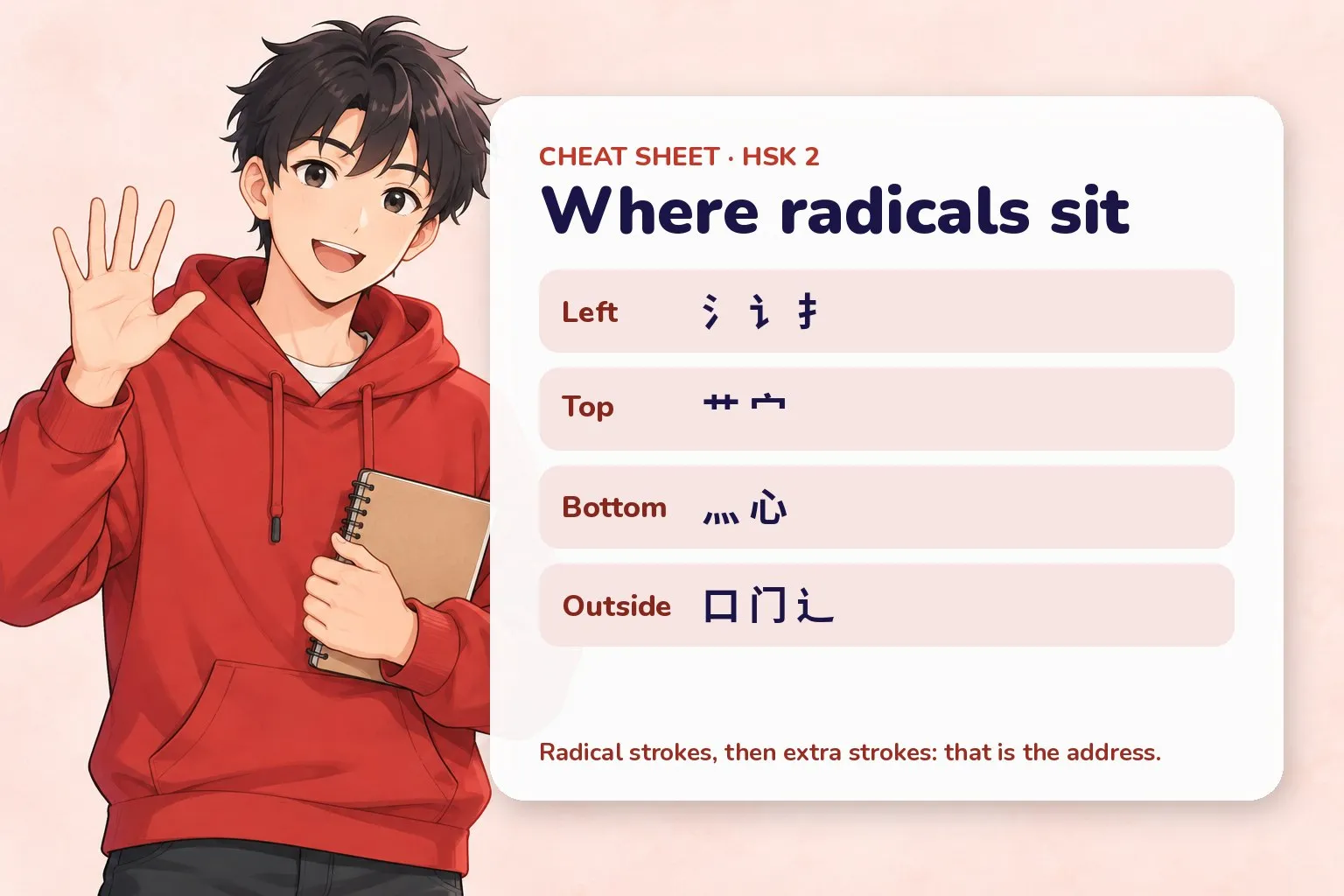
| Left | 氵 亻 扌 讠 忄 女 纟 钅 | shuǐ, rén, shǒu, yán, xīn, nǚ, sī, jīn | 汉 (hàn) Chinese |
| Right | 刂 页 鸟 攵 | dāo, yè, niǎo, pū | 别 (bié) don’t |
| Top | 艹 宀 竹 雨 | cǎo, mián, zhú, yǔ | 茶 (chá) tea |
| Bottom | 灬 心 皿 | huǒ, xīn, mǐn | 想 (xiǎng) think |
| Outside | 口 门 囗 辶 | kǒu, mén, wéi, chuò | 问 (wèn) ask |
When a character offers two candidates, dictionaries follow a fixed priority: top over bottom, left over right, outside over inside. If both halves look equally plausible, try the left one first — it is right more often than not.
Sound clues: the phonetic part
Most characters are phonetic-semantic compounds: one part points to meaning, the other to sound. The 青 (qīng) family shows how far this goes:
| Character | Pinyin | Meaning | Parts |
|---|---|---|---|
| 清 | qīng | clear | 氵 (shuǐ) + 青 (qīng) |
| 请 | qǐng | please, invite | 讠 (yán) + 青 (qīng) |
| 情 | qíng | feeling | 忄 (xīn) + 青 (qīng) |
| 晴 | qíng | sunny | 日 (rì) + 青 (qīng) |
| 睛 | jīng | eye | 目 (mù) + 青 (qīng) |
Every one of those contains 青 (qīng), and every one is pronounced with a q- or j- initial and an -ing rhyme. The meaning radical does the sorting: water for “clear”, speech for “please”, heart for “feeling”, sun for “sunny”, eye for “eye”.
The sound part is a near-miss, not a guarantee. 妈 (mā, mother) is 女 (nǚ) plus 马 (mǎ, horse) — same sound, different tone. Modern pronunciation has drifted far enough that many sound parts are only approximately right, so use them as a memory hook, not as a pronunciation rule.
Looking a character up by radical
- Spot the radical — 部首 (bùshǒu) — using the position patterns above.
- Count the strokes of the radical and turn to that section of the radical index.
- Count the strokes of everything else in the character.
- Within the radical’s section, the entries are ordered by that second number.
- Check the pinyin and meaning in the entry.
Strokes are counted the same way you write them: a single unbroken line is one stroke. 河 (hé) is 氵 (three strokes) plus 可 (five strokes), so it sits under water, five extra strokes.
Example sentences
Each sentence was written for this lesson. The highlighted characters are ones you can now file by radical.
- 我妈妈是老师。Wǒ māma shì lǎoshī.My mother is a teacher.妈 (mā) = 女 (nǚ) + 马 (mǎ)
- 我在学汉语。Wǒ zài xué Hànyǔ.I am learning Chinese.汉 (hàn) and 语 (yǔ) both take the water/speech radical
- 请问洗手间在哪儿?Qǐngwèn, xǐshǒujiān zài nǎr?Excuse me, where is the restroom?请 (qǐng) = 讠 (yán) + 青 (qīng)
- 今天天气很晴朗。Jīntiān tiānqì hěn qínglǎng.The weather is sunny and clear today.晴 (qíng) = 日 (rì) + 青 (qīng)
- 他跑得很快。Tā pǎo de hěn kuài.He runs fast.跑 (pǎo) uses 足 (zú), foot
- 这个字怎么查?Zhège zì zěnme chá?How do I look this character up?查 (chá) also means to check
- 花园里的花很漂亮。Huāyuán lǐ de huā hěn piàoliang.The flowers in the garden are pretty.花 (huā) sits under 艹 (cǎo)
- 我心情很好。Wǒ xīnqíng hěn hǎo.I'm in a good mood.情 (qíng) = 忄 (xīn) + 青 (qīng)
- 他眼睛很大。Tā yǎnjing hěn dà.His eyes are big.睛 (jīng) = 目 (mù) + 青 (qīng)
- 这个问题很难。Zhège wèntí hěn nán.This question is hard.问 (wèn) is filed under 门 (mén)
- 我不舒服,可能病了。Wǒ bù shūfu, kěnéng bìng le.I don't feel well; I may be ill.病 (bìng) takes 疒 (nì)
- 中国有很多银行。Zhōngguó yǒu hěn duō yínháng.China has many banks.银 (yín) = 钅 (jīn) + 艮
- 我想要一杯热茶。Wǒ xiǎng yào yì bēi rè chá.I'd like a cup of hot tea.热 (rè) carries 灬 (huǒ) at the bottom
- 你认识这个汉字吗?Nǐ rènshi zhège Hànzì ma?Do you know this Chinese character?字 (zì) sits under 宀 (mián)
- 红笔在桌子上。Hóng bǐ zài zhuōzi shàng.The red pen is on the table.红 (hóng) uses the silk radical 纟 (sī)
Common mistakes
- ❌ counting the whole character’s strokes when looking it up → ✅ count the extra strokes after the radical. 河 (hé) is five extra under 氵 (shuǐ), not eight.
- ❌ assuming the radical gives the full meaning → ✅ 好 (hǎo, good) is filed under 女 (nǚ, woman) but means “good”; the radical only sorts it.
- ❌ expecting the sound part to give an exact reading → ✅ 妈 (mā) and 马 (mǎ) differ in tone, and many sound parts have drifted further.
- ❌ looking for 金 (jīn) on the left of 银 (yín) → ✅ simplified characters write the metal radical as 钅 (jīn).
- ❌ treating 灬 (huǒ) as a separate radical from 火 (huǒ) → ✅ the four dots are the same fire component in bottom position.
Practice
Character radicals practice
Try each one, then press Check. No sign-up, nothing is sent anywhere — it all runs in your browser.
Hint: the horse character
Show answer
mǎ — 妈 (mā) is 女 (nǚ) plus 马 (mǎ, horse), which carries the sound.
4 Match each radical to its meaning.
- 氵 (shuǐ)
- 艹 (cǎo)
- 疒 (nì)
- 钅 (jīn)
Show answer
- 氵 (shuǐ) → water
- 艹 (cǎo) → plants
- 疒 (nì) → illness
- 钅 (jīn) → metal
Each of these radicals sorts characters by a meaning field.
5 Build the sentence: I am learning Chinese.
Show answer
我 (wǒ) 在 (zài) 学 (xué) 汉语 (Hànyǔ) — Subject, the progressive marker 在 (zài), verb, object.
Quick recap before you practise.
Quiz
Chinese character radicals
10 questions · pick an answer and you'll see straight away if it's right.
-
Show answer
the component a dictionary files the character under — It is an indexing component, used to arrange a dictionary.
-
Show answer
214 — The Kangxi Dictionary of 1716 worked with 214 radicals.
-
Show answer
201 principal and 100 associated components — GF 0011-2009 has 201 principal and 100 associated components.
-
Show answer
water — 氵 (shuǐ) is water, as in 河 (hé, river).
-
Show answer
讠 (yán) — 讠 (yán) is the speech radical; 青 (qīng) supplies the sound.
-
Show answer
晴 (qíng) — 晴 (qíng) pairs 日 (rì, sun) with 青 (qīng).
-
Show answer
left over right — Top over bottom, left over right, outside over inside.
-
Show answer
three for the radical plus five extra — Radical first, then the leftover strokes.
-
Show answer
fire — 灬 (huǒ) is the fire radical in bottom position, as in 热 (rè).
-
Show answer
讠 (yán) — 讠 (yán) is the simplified left-hand form of 言 (yán).
Recap cheat-sheet
| Point | Rule | Pinyin | Example |
|---|---|---|---|
| Radical | a filing component, not a definition | bùshǒu | 好 (hǎo) under 女 (nǚ) |
| Classic set | 214 radicals, Kangxi 1716 | — | 部首 (bùshǒu) |
| Modern set | 201 principal + 100 associated | — | 汉字部首表 |
| Meaning clue | water 氵, speech 讠, heart 忄 | shuǐ, yán, xīn | 河 (hé), 语 (yǔ), 情 (qíng) |
| Sound clue | the phonetic half suggests the reading | shēngpáng | 妈 (mā) from 马 (mǎ) |
| Look-up | radical strokes, then extra strokes | — | 河 (hé) = 3 + 5 |
Next
- How characters are put together: Chinese characters: an introduction
- Writing them in the right order: Character strokes and stroke order
- The sounds behind the parts: Pinyin: an overview
- New here? Start with Start Learning Chinese Here
All Chinese pronunciation & writing topics
Vocabulary, pronunciation, phrases, practice and exam help, ordered by level. Pick a topic and go straight to it. New lessons go live every day, so topics marked Coming soon fill in over the next weeks.
Pronunciation & writing
HSK 1 8 topics · 6 ready
- 01 Chinese Pronunciation Overview
- 02 Pinyin: The Romanisation System
- 03 Pinyin Initials (Consonants)
- 04 Pinyin Finals (Vowels & Endings)
- 05 The Four Tones (and Neutral Tone)
- 06 Character Strokes & Stroke Order
- 07 Essential HSK 1 Characters Coming soon
- 08 How to Type Chinese (Pinyin Input) Coming soon
HSK 2 7 topics · 3 ready
- 09 Tone Change Rules (Tone Sandhi)
- 10 Introduction to Chinese Characters (Hanzi)
- 11 Character Radicals (Bushou) You are here
- 12 Measure Words (Classifiers) Intro Coming soon
- 13 Chinese Radicals Reference (214 Kangxi) Coming soon
- 14 Essential HSK 2 Characters Coming soon
- 15 Simplified vs Traditional Characters Coming soon
HSK 3 2 topics
- 16 Phonetic & Semantic Components Coming soon
- 17 Essential HSK 3 Characters Coming soon