French Intonation & Rhythm
French stress falls on the last syllable of a group of words, not on a stressed syllable inside each word. Statements fall at the end, yes/no questions rise sharply, and an information question starts high and falls away.
On this page9 sections · tap to jump
Level: B1. English speakers carry one habit into French that makes them sound foreign even with perfect grammar: they stress words. French stresses groups. Put the beat on the last syllable of a phrase, let the syllables inside run at an even pace, and the language suddenly sounds like itself.
The rule
French word stress carries no meaning. Two words cannot be told apart by stress alone, and no dictionary marks it. What French does have is a beat at the end of a rhythmic group — a short run of words that belongs together, usually a noun phrase or a clause.
Inside that group the syllables are close to even in length; this is what people mean when they call French syllable-timed. English, by contrast, crushes unstressed syllables and lands hard on the stressed one. The English habit produces the classic error: BEL-leville, A-près, with a punch on the syllable French would leave flat.
So the practical rule is a two-step:
- Cut the sentence into groups. A group is usually “what belongs to one idea”: a subject, a prepositional phrase, a verb with its object.
- Land on the last syllable of each group and let everything before it run flat.
Mon frère | habite | à Bordeaux. — Mon FRÈRE | ha-BITE | à bor-DEAU. — My brother lives in Bordeaux.
The pause marks are not punctuation; they are where the voice lifts or settles.
The four patterns
French intonation follows four recognisable tunes. Each one lives at the end of a group, which is why group boundaries and intonation have to be learned together.
| Pattern | What the voice does | Used for | Example |
|---|---|---|---|
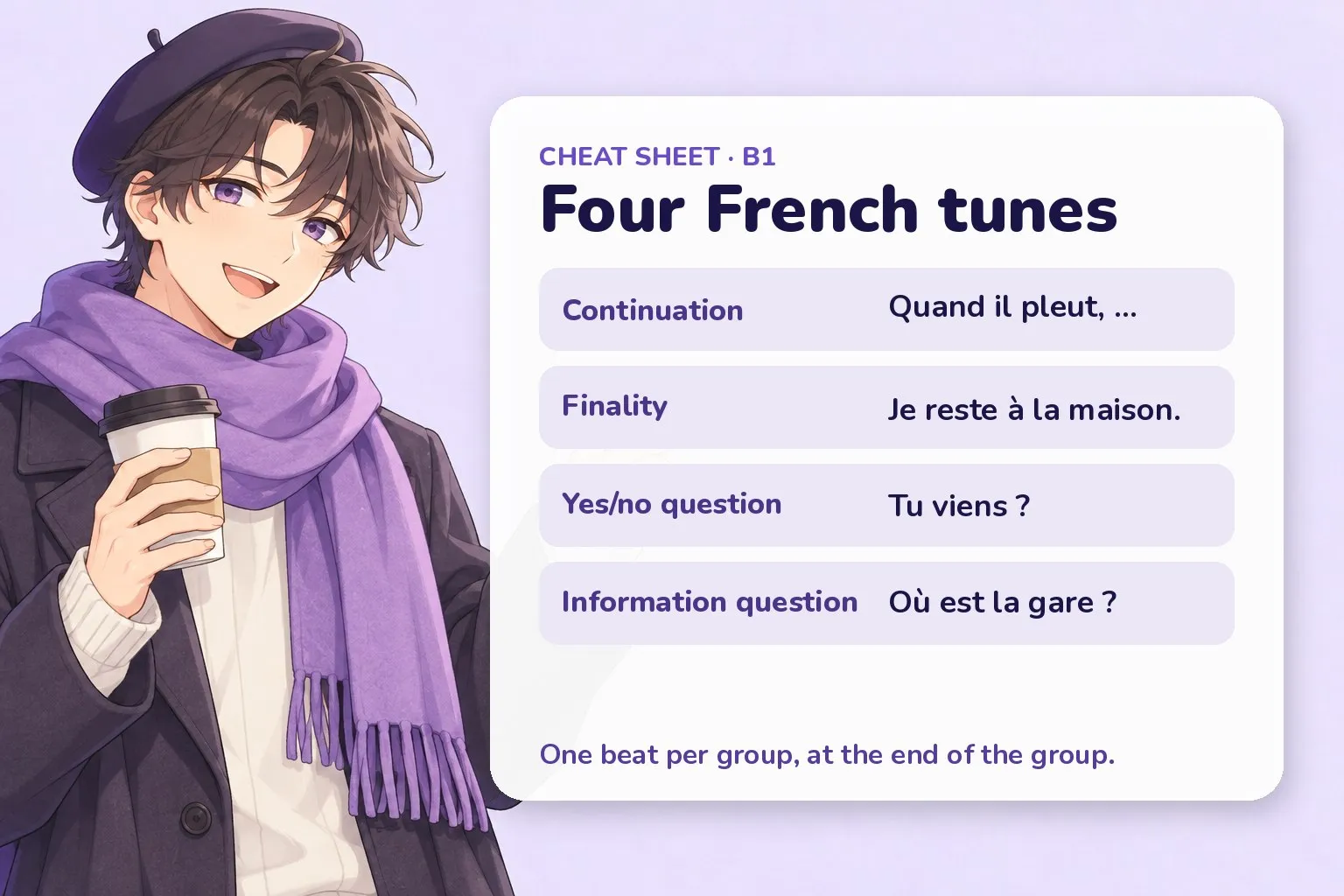
| Continuation | rises on the last syllable of the group | a group that is not the end of the sentence | Quand il pleut, … |
| Finality | falls sharply on the last syllable | the end of a statement | Je reste à la maison. |
| Yes/no question | rises sharply on the last syllable | a question answerable by oui or non | Tu viens ? |
| Information question | starts high on the first word, falls away, often with a small rise at the end | a question with a question word | Où est la gare ? |
A yes/no question can also be built with est-ce que or with inversion (Viens-tu ?). Both keep the rising tune; the grammar changes, the melody does not.
How to say it
Four features of French sound decide whether the rhythm lands. They are worth practising slowly before you speed up.
| Feature | How to say it |
|---|---|
| Silent final letters | Most final consonants are silent: petit = “puh-TEE”, vous = “voo”, grand = “grahn”. A final -e is silent too: petite = “puh-TEET”. |
| Liaison | A normally silent final consonant jumps onto a following vowel: les amis = “lay-za-MEE”, vous avez = “voo-za-VAY”, ont-ils = “on-TEEL”. |
| Nasal vowels | on, an/en, in, un are sounded through the nose with barely any n: maison = “meh-ZOHN”, vin = “van”. |
| r, u and schwa | r comes from the back of the throat (rue, Paris); u is “ee” with rounded lips (tu, rue); schwa e is a light “uh” (le, petit) that can drop: je becomes “sh”. |
Liaison is where rhythm and grammar meet. It fires inside a group (les amis) and normally not across a boundary, so a misplaced liaison both sounds wrong and tells the listener the group ended in the wrong place.
Rhythm in practice
Read these groups aloud, keeping the syllables even and the beat at each bar.
| Sentence | Groups | Beat lands on |
|---|---|---|
| Mon frère habite à Bordeaux. | Mon frère / habite / à Bordeaux | FRÈRE, BITE, DEAU |
| Quand il pleut, je reste à la maison. | Quand il pleut / je reste / à la maison | PLEUT (rise), RESTE, SON |
| Est-ce que tu as faim ? | Est-ce que tu as faim | FAIM (rise) |
| Où est la gare ? | Où / est la gare | OÙ (high), GARE |
| Prenez le train de huit heures. | Prenez / le train / de huit heures | NEZ, TRAIN, HEURES |
The last line is worth a second look: huit heures is one group, said “wee-TUHR”, because the final t of huit sounds before the vowel of heures, and the beat sits on the last syllable of heures.
Example sentences
Each sentence was written for this lesson. Listen for where the voice rises and where it falls.
- Bonjour.Hello.finality fall
- Je m'appelle Marie.My name is Marie.beat on the last syllable
- Vous êtes français ?Are you French?yes/no rise, liaison in vous êtes
- Tu viens ce soir ?Are you coming tonight?yes/no rise
- Tu viens ce soir.You're coming tonight.same words, falling tune
- Où est la gare ?Where is the station?high on Où, then a fall
- Qu'est-ce que vous faites ?What do you do?question word starts high
- Est-ce que tu as faim ?Are you hungry?rise at the end, not on est-ce que
- J'habite à Paris, mais je travaille à Lyon.I live in Paris, but I work in Lyon.continuation rise after Paris
- Quand il pleut, je reste à la maison.When it rains, I stay at home.rise on pleut, fall on maison
- C'est très intéressant.That's very interesting.single group, one fall
- Ce n'est pas possible.That's not possible.beat on the final syllable
- Il est déjà parti.He has already left.no liaison: déjà starts with a consonant
- Les enfants ont mangé.The children have eaten.liaison only in les enfants
- Prenez le train de huit heures.Take the eight o'clock train.huit heures links: wee-TUHR
- Vraiment ?Really?a one-word rise
Common mistakes
- ❌ stressing the first syllable of each word, as in JA-mais → ✅ stress the end of the group: ja-MAIS.
- ❌ letting the voice fall after every group → ✅ non-final groups rise; only the last one falls.
- ❌ pronouncing final consonants, as in petit with a t → ✅ puh-TEE, silent t.
- ❌ flattening yes/no questions into statements → ✅ Tu viens ? rises sharply; Tu viens. falls.
- ❌ skipping liaison inside a group, as in les amis = “lay a-MEE” → ✅ “lay-za-MEE”.
Practice
French intonation practice
Try each one, then press Check. No sign-up, nothing is sent anywhere — it all runs in your browser.
Hint: the liaison consonant is a z sound
Show answer
amis — Liaison gives les amis = lay-za-MEE.
4 Match each pattern to its use.
- continuation
- finality
- yes/no question
- information question
Show answer
- continuation → more is coming
- finality → end of a statement
- yes/no question → answerable by oui or non
- information question → starts high on the question word
Each pattern is tied to a sentence type and to a group boundary.
5 Order the words: My brother lives in Bordeaux.
Show answer
Mon frère habite à Bordeaux — Subject, verb, place phrase — three groups, three beats.
Quick recap before you practise.
Quiz
French intonation and rhythm
10 questions · pick an answer and you'll see straight away if it's right.
-
Show answer
is not distinctive — Stress alone cannot distinguish two French words.
-
Show answer
its last syllable — The final full syllable of the group takes the stress.
-
Show answer
a fall — The finality pattern is a sharp fall on the last syllable.
-
Show answer
high on the question word, then falls — The question word carries high pitch, then the voice falls away.
-
Show answer
Tu viens. / Tu viens ? — Same words, falling versus rising tune.
-
Show answer
lay-za-MEE — The silent s of les links onto the vowel as a z sound.
-
Show answer
the first consonant-initial syllable of the word — For emphasis French stresses the start of the word instead of the end.
-
Show answer
a rise — It is a yes/no question, so the final syllable rises.
-
Show answer
the t of petit — The t of petit is silent; the s of les is silent too, but it links on.
-
Show answer
group — Rhythmic groups, not words, carry the stress.
Recap cheat-sheet
| Point | Rule | Example |
|---|---|---|
| Stress | one beat per group, on the last syllable | ja-MAIS |
| Rhythm | syllables inside a group are even | Mon frère / habite |
| Continuation | rise on a non-final group | Quand il pleut, … |
| Finality | fall on the last group | … je reste à la maison. |
| Yes/no question | sharp rise | Tu viens ? |
| Information question | high start, falling away | Où est la gare ? |
| Liaison | inside groups | les amis = lay-za-MEE |
Next
- The sounds behind the rhythm: French vowel sounds
- When letters link: liaison in French
- The grammar side of questions: asking questions in French
- Letters that vanish: silent letters in French
- New here? Start with Start Learning French Here
All French pronunciation & writing topics
Vocabulary, pronunciation, phrases, practice and exam help, ordered by level. Pick a topic and go straight to it. New lessons go live every day, so topics marked Coming soon fill in over the next weeks.
Pronunciation & writing
A1 5 topics · 5 ready
A2 3 topics · 3 ready
B1 2 topics · 2 ready
- 09 French Liaison
- 10 French Intonation & Rhythm You are here