French Nasal Vowels: on, an, in Explained
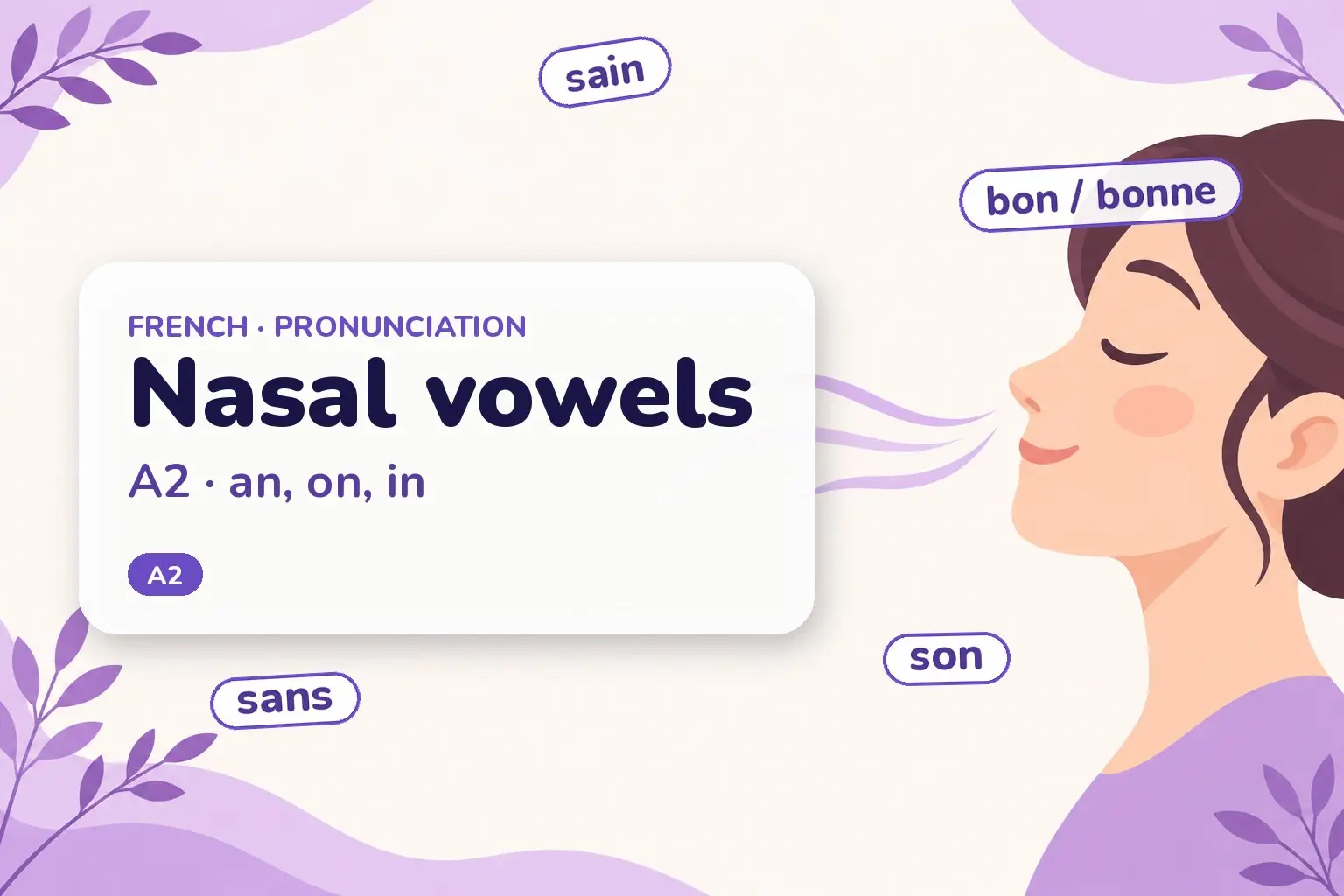
French has three main nasal vowels: an/en as in sans, on as in son, and in/ain/un as in sain. A vowel followed by n or m turns nasal, and the n or m itself is not pronounced — unless it is doubled or a vowel follows.
Level: A2. Nasal vowels are one of the sounds that make French sound French — and one English speakers most often miss. A nasal vowel is a vowel you say with air flowing through the nose as well as the mouth. French writes them as a vowel plus n or m, but here is the key: you do not pronounce that n or m. It is just a flag telling you the vowel is nasal. Master three of them and your accent takes a big step forward.
What a nasal vowel is
Say “ah” normally: all the air leaves through your mouth. Now let some air come down your nose at the same time — the vowel takes on a hum. That is a nasal vowel. French has three you must learn, plus a fourth that most speakers merge with one of them:
- an / en → the sound in sans (“without”)
- on / om → the sound in son (“his/her” or “sound”)
- in / ain / ein → the sound in sain (“healthy”)
- un / um → historically a fourth sound, in brun (“brown”), now said like in by most people.
In every case the written n or m is silent as a consonant; it only marks the vowel as nasal.
When the vowel is nasal — and when it is not
The vowel nasalises only when the n or m closes the syllable. Two situations keep the vowel oral (ordinary) instead:
- A doubled n or m: bon is nasal, but bonne (“good,” feminine) is oral — you say a clear “o” and then an “n.”
- An n or m before a vowel: un is nasal, but une (“a,” feminine) is oral, and bonheur (“happiness”) has an oral “o.”
So the same letters behave differently depending on what follows. This is why an (nasal) and Anne (oral, a name) do not rhyme.
How to say it
These are the sounds English lacks, so drill them slowly:
| Nasal vowel | Common spellings | Example | How to aim for it |
|---|---|---|---|
| “an” [ɑ̃] | an, am, en, em | sans, champ, vent | open “ah” sent through the nose |
| “on” [ɔ̃] | on, om | son, nom, bon | rounded “oh” through the nose |
| “in” [ɛ̃] | in, im, ain, ein, un | vin, pain, brun | bright “a” of “cat” through the nose |
The trap for English speakers is adding an actual “n” or “ng” at the end. Keep the tongue away from the roof of the mouth: let the vowel itself carry the nasal hum and stop.
Hear the contrasts
- sanswithout — the 'an' nasal[ɑ̃]
- sonhis/her; sound — the 'on' nasal[ɔ̃]
- sainhealthy — the 'in' nasal[ɛ̃]
- vinwine — in = nasal, no 'n' said
- painbread — ain = the 'in' sound
- bongood (m) — nasal o
- bonnegood (f) — oral o, then a clear ndouble n keeps it oral
- anyear — nasalvs the name Anne, which is oral
- annéeyear (span) — oral a, double n
- ventwind — en = the 'an' sound
- bienwell — -ien = the 'in' sound[jɛ̃]
- chiendog — -ien = 'in'
- nomname — om = the 'on' sound
- champfield — am before p = 'an'
- brunbrown — un, now usually said like 'in'
- unea (f) — oral u, because a vowel follows the n
Minimal pairs to drill
Say each set, keeping the three nasals distinct and the oral ones clean:
- sans [ɑ̃] vs son [ɔ̃] vs sain [ɛ̃] — the three nasal vowels in one frame.
- an (nasal) vs Anne (oral) — one n nasalises, two do not.
- bon (nasal) vs bonne (oral) — the feminine opens the syllable.
- vin (nasal) vs vigne (oral “ee”) — don’t add a real “n.”
A note on -en
The spelling -en usually gives the “an” sound: vent (“wind”), souvent (“often”), comment (“how”). But after i, in the ending -ien, it flips to the “in” sound: bien (“well”), chien (“dog”), italien (“Italian”). Let the whole ending, not just the letters, tell you the vowel.
Practice
French nasal vowels practice
Try each one, then press Check. No sign-up, nothing is sent anywhere — it all runs in your browser.
3 Match each word to its nasal sound.
- sans
- son
- sain
- bonne
Show answer
- sans → an [ɑ̃]
- son → on [ɔ̃]
- sain → in [ɛ̃]
- bonne → oral — no nasal
sans = an, son = on, sain = in; bonne is oral because of the double n.
Hint: like the vowel in sain
Show answer
in — -ien gives the 'in' sound: chien, bien.
Where to go next
Fit these into the full vowel system with the French vowel sounds page, review the letters and accents in the French alphabet, and hear the whole sound inventory in the French pronunciation overview. New here? Begin at Start Learning French Here.
Quiz
French nasal vowels quiz
10 questions · pick an answer and you'll see straight away if it's right.
-
Show answer
nose as well as the mouth — Some air escapes through the nose, giving the vowel its hum.
-
Show answer
silent — just a marker — The n/m only signals nasality; it is not pronounced as a separate sound.
-
Show answer
vin — vin is nasal; the others are oral (double n/m or a following vowel).
-
Show answer
an [ɑ̃] — sans is the 'an' nasal [ɑ̃].
-
Show answer
on [ɔ̃] — son is the 'on' nasal [ɔ̃].
-
Show answer
a doubled n/m or a following vowel — bonne (double n) and une (vowel after n) are oral.
-
Show answer
the in nasal — -ien gives the 'in' sound [jɛ̃]: bien, chien.
-
Show answer
the an nasal — -en is usually the 'an' sound: vent, souvent.
-
Show answer
in — Most speakers merge un with the 'in' sound today.
-
Show answer
you must not add an actual n at the end — vin is a single nasal vowel; pronouncing the n breaks it.
All French pronunciation & writing topics
Vocabulary, pronunciation, phrases, practice and exam help, ordered by level. Pick a topic and go straight to it. New lessons go live every day, so topics marked Coming soon fill in over the next weeks.
Pronunciation & writing
A1 5 topics · 5 ready
A2 3 topics · 3 ready
- 06 French Vowel Sounds
- 07 French Nasal Vowels You are here
- 08 French H: Mute vs Aspirate
B1 2 topics · 1 ready
- 09 French Liaison
- 10 French Intonation & Rhythm Coming soon