French Accents & Diacritics Explained
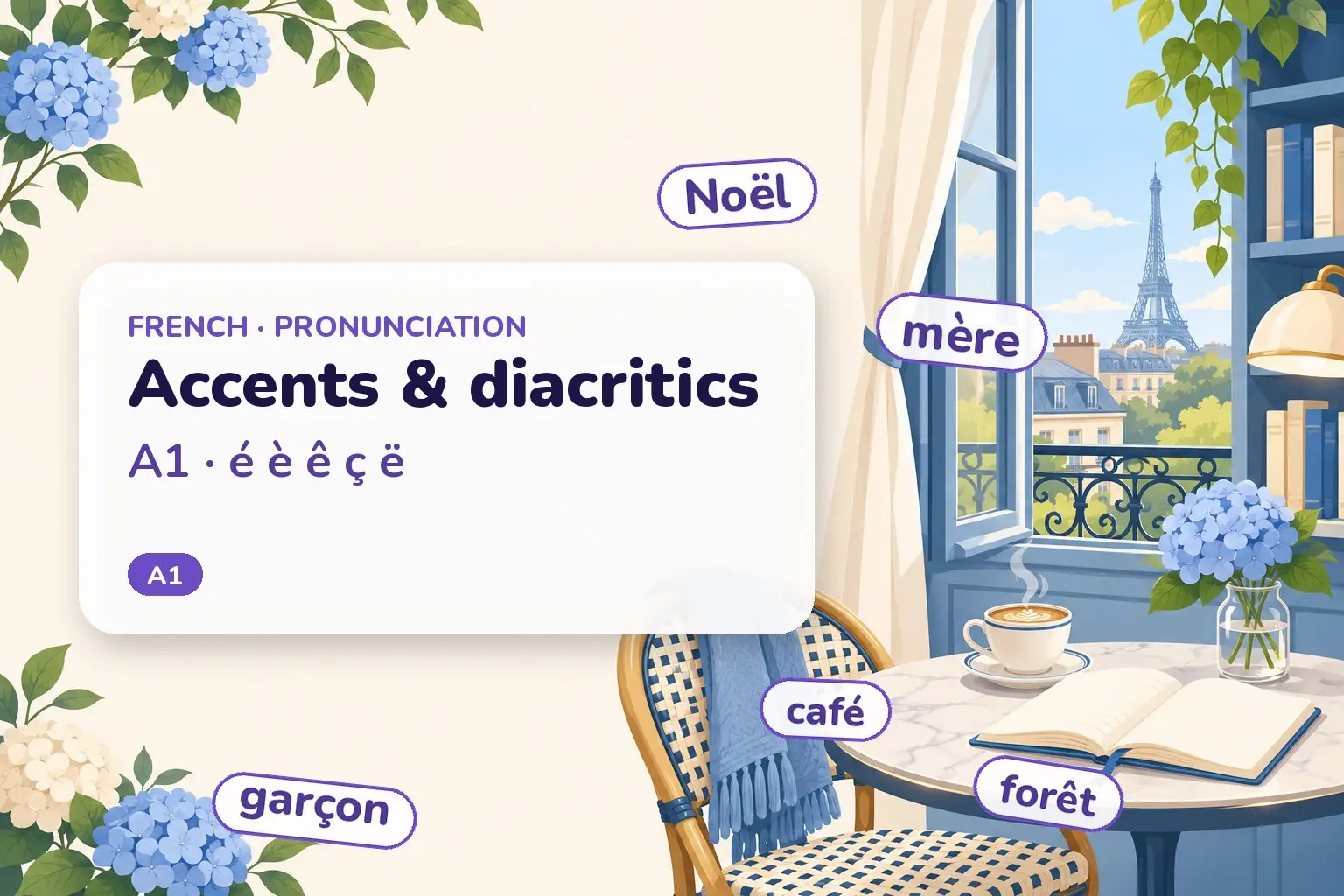
French has five diacritics: the acute (é), grave (è, à), circumflex (ê), cédille (ç) and tréma (ë, ï). Some change a sound — é is a closed 'ay', è an open 'eh', ç turns c into 's' — and some only tell two words apart, like a and à.
On this page13 sections · tap to jump
Level: A1. The little marks over French letters are not decoration — they are diacritics, and each one does a job. Some tell you how to say a vowel, one changes a consonant, and a few only exist to keep two identical-looking words apart. Learn the five and French spelling starts to make sense.
The five diacritics
French uses five accent marks. Here is what each is called and where it appears:
| Mark | Name | Appears on | Example |
|---|---|---|---|
| ´ | accent aigu (acute) | é only | café |
| ` | accent grave (grave) | è, à, ù | mère, à, où |
| ^ | accent circonflexe (circumflex) | ê, â, î, ô, û | forêt |
| ¸ | cédille (cedilla) | ç only | français |
| ¨ | tréma (diaeresis) | ë, ï, ü | Noël, naïf |
The acute and grave are the ones you will use constantly; the cédille and tréma are rarer but important when they appear.
The acute and grave: two kinds of e
The biggest payoff is learning what the two accents do to the letter e:
- é (acute) is a closed sound, like a short, bright English “ay” without the glide: été (summer), café (coffee), parlé (spoken).
- è (grave) is an open sound, like the “e” in English “bet”: mère (mother), très (very), près (near).
So the accent is not random: é points the mouth one way and è the other. A plain e with no accent is usually the soft “uh” sound (le, je) or silent at the end of a word.
The grave also sits on a and u — in à (to/at), où (where), là (there) — but there it changes no sound at all. Its only job is to separate words that would otherwise look identical (see below).
The circumflex: a little hat
The circumflex (^) often marks a letter, usually an s, that French used to write and later dropped. That is why so many circumflex words have an English cousin with the s still in it:
- forêt — forest
- hôpital — hospital
- château — castle
- île — isle, island
On ê the circumflex also makes the open sound, exactly like è: forêt, fête (party), tête (head). On the other vowels (â, î, ô, û) it changes little or nothing in everyday speech; on û it is purely a spelling mark, as in sûr (sure).
The cédille: keeping c soft
The letter c is hard (a “k” sound) before a, o, u — café, comme, cuisine — and soft (an “s” sound) before e and i — ce, ici. The cédille (¸) forces that soft “s” sound even before a, o, u:
- français (French) — “fran-SAY”, not “fran-KAY”
- garçon (boy / waiter) — “gar-SON”
- ça (that) — “sa”
- leçon (lesson) — “luh-SON”
You will never see a cédille before e or i, because c is already soft there.
The tréma: two vowels, said apart
The tréma (¨) sits on the second of two vowels to say “pronounce me separately — do not blend us into one sound”:
- Noël (Christmas) — “no-EL”, not “neul”
- naïf (naive) — “na-EEF”, in three clear sounds
- maïs (sweetcorn) — “ma-EESS”, which keeps it apart from mais (but), said “meh”
Without the tréma, ai and oe would normally fuse into a single vowel; the two dots break them up.
How to say it
A few habits lock these in for an English speaker:
- é = a tight “ay”. Say café as “ka-FAY”, with no English “y”-glide at the end.
- è and ê = an open “eh”. Say mère as “mehr” and forêt as “foh-REH”.
- ç = a plain “s”. Say garçon as “gar-SON”; never let it slip to a “k”.
- Split a tréma. Say Noël in two beats, “no-EL”, and naïf in three, “na-EEF”.
- Ignore a silent-change accent. The à of voilà and the û of sûr sound like plain a and u; the mark is only for the eye.
Hear it
- cafécoffee — é is a closed 'ay'
- étésummer — two closed é sounds
- parléspoken — past participle, closed é
- mèremother — è is an open 'eh'
- trèsvery — open è
- prèsnear — open è
- forêtforest — ê, open, marks a lost s
- fêteparty, celebration — ê open 'eh'
- hôpitalhospital — ô marks a lost s
- françaisFrench — the cédille keeps c soft (s)
- garçonboy, waiter — ç as 's'
- çathat — ç as 's'
- leçonlesson — ç as 's'
- NoëlChristmas — tréma splits it: no-EL
- naïfnaive — tréma: na-EEF, said apart
- maïssweetcorn — ma-EESS, not like mais (but)
- oùwhere — grave on u, no sound change
- àto, at — grave on a, only separates it from a (has)
Common mistakes
- ❌ saying é and è the same way → ✅ é is closed (“ay”, été) and è is open (“eh”, mère); the accent tells you which.
- ❌ reading ç as a “k”: garçon as “gar-kon” → ✅ the cédille makes it “s”: “gar-SON”.
- ❌ blending Noël into “neul” → ✅ the tréma splits it: “no-EL”.
- ❌ thinking every circumflex changes the sound → ✅ on û and often â/î it is only a spelling mark: sûr sounds like sur.
- ❌ dropping the grave on à or où in writing → ✅ it is required: à (to) and a (has), où (where) and ou (or), are different words.
A tiny dialogue
— Tu préfères le café ou le thé ? — Do you prefer coffee or tea? — Un café, s’il te plaît. Où est la cuisine ? — A coffee, please. Where is the kitchen? — Là, à côté de la fenêtre. — There, next to the window.
Listen for the closed é in préfères and café, the grave où and à, and the circumflex ê in fenêtre.
Practice
French accents practice
Try each one, then press Check. No sign-up, nothing is sent anywhere — it all runs in your browser.
2 Match each mark to its job.
- é
- è / ê
- ç
- ë / ï (tréma)
Show answer
- é → closed 'ay' sound
- è / ê → open 'eh' sound
- ç → keeps c soft (s)
- ë / ï (tréma) → split two vowels apart
Acute = closed e, grave/circumflex on e = open e, cédille = soft c, tréma = separate vowels.
Hint: no-EL, not 'neul'
Show answer
separate — The tréma says to pronounce the vowels separately: no-EL.
Quiz
French accents and diacritics quiz
10 questions · pick an answer and you'll see straight away if it's right.
-
Show answer
five — Acute, grave, circumflex, cédille and tréma — five.
-
Show answer
closed 'ay' — The acute é is a closed sound, like a tight 'ay'.
-
Show answer
open 'eh' — The grave è is open, like the e in 'bet'.
-
Show answer
only e — The accent aigu appears on é only.
-
Show answer
keeps it soft (s) — ç gives a soft 's': français, garçon, ça.
-
Show answer
e or i — Before e and i the c is already soft, so no cédille is needed.
-
Show answer
pronounced separately — The tréma splits them: na-EEF.
-
Show answer
a / à — a (has) and à (to) sound the same; the grave only separates them.
-
Show answer
open 'eh', like è — On ê the circumflex gives the open sound, like è: fo-REH.
-
Show answer
a tréma — The tréma on ï makes maïs 'ma-EESS', unlike mais 'meh'.
Where to go next
Fit the accents into the whole sound system with the French alphabet and the French vowel sounds, see which letters stay silent in French silent letters, and hear it all in the French pronunciation overview. New here? Begin at Start Learning French Here.
Recap cheat-sheet
| Mark | On | Does | Example |
|---|---|---|---|
| é (acute) | e | closed ‘ay’ | café |
| è / ê (grave / circumflex) | e | open ‘eh’ | mère, forêt |
| ç (cédille) | c | soft ‘s’ before a/o/u | garçon |
| ¨ (tréma) | e, i, u | split vowels apart | Noël |
| à, où, û | a, u | no sound; separate words | à vs a |
All French pronunciation & writing topics
Vocabulary, pronunciation, phrases, practice and exam help, ordered by level. Pick a topic and go straight to it. New lessons go live every day, so topics marked Coming soon fill in over the next weeks.
Pronunciation & writing
A1 5 topics · 5 ready
- 01 French Pronunciation Overview
- 02 The French Alphabet
- 03 French Silent Letters
- 04 French Accents & Diacritics You are here
- 05 French Elision (l', j', d')
A2 3 topics · 3 ready
B1 2 topics · 1 ready
- 09 French Liaison
- 10 French Intonation & Rhythm Coming soon