French Elision (l', j', d')
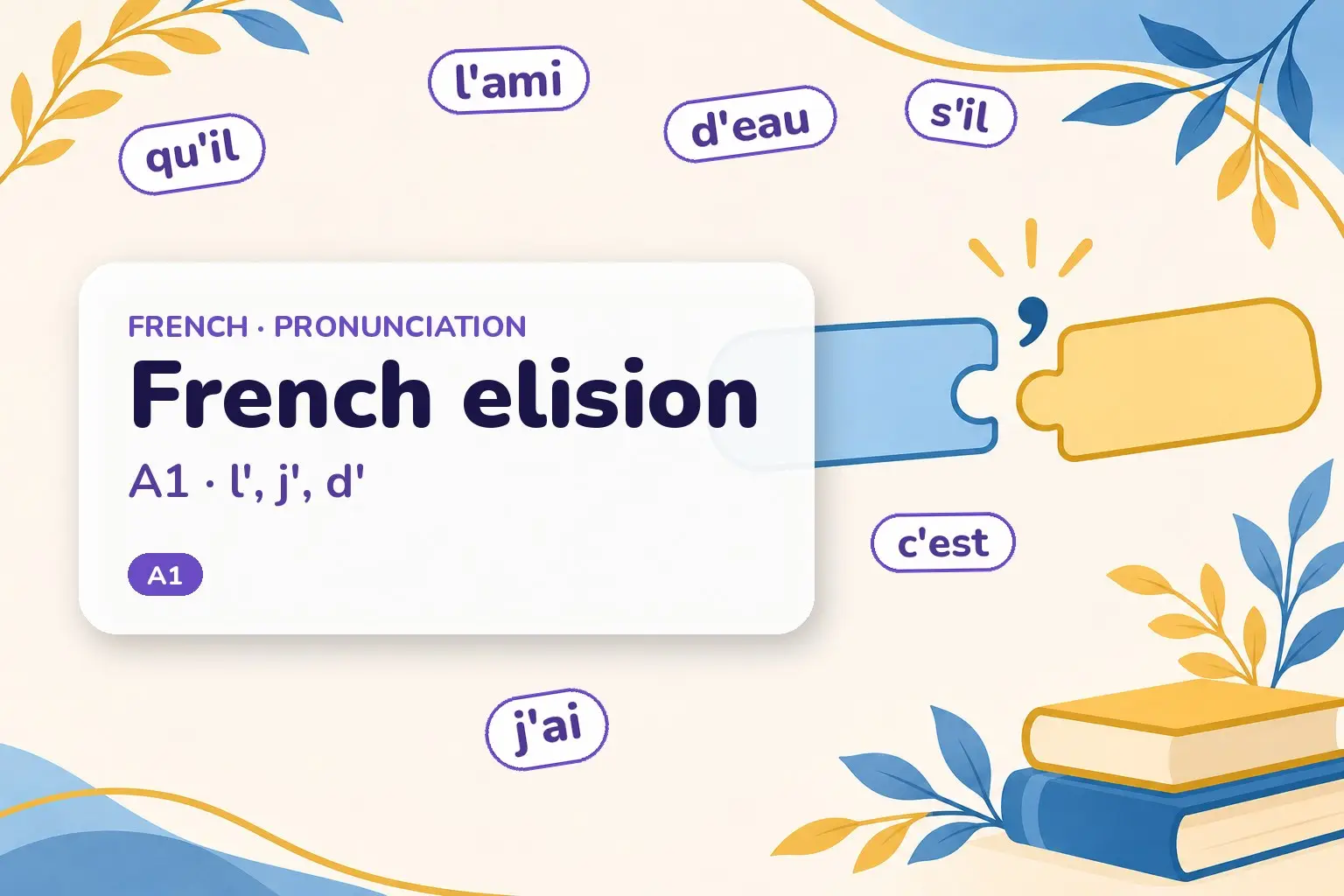
Elision drops the final vowel of a short word before a vowel sound and replaces it with an apostrophe: le + ami becomes l'ami, je + ai becomes j'ai, de + eau becomes d'eau.
Level: A1. French dislikes two vowel sounds crashing together, so when a short word ends in a vowel and the next word starts with one, the first vowel is dropped and an apostrophe takes its place. Le ami is never said — it becomes l’ami. This squeezing-out is called elision (l’élision), and once you know which words do it, French spelling and rhythm make much more sense.
What elision is
Elision is the loss of a final vowel before a vowel sound, marked by an apostrophe. Only a short, fixed list of words elide; they are everyday words you meet from day one:
- le / la → l’ : l’ami (the friend), l’école (the school)
- je → j’ : j’ai (I have), j’aime (I like)
- me, te, se → m’, t’, s’ : il s’appelle (he is called)
- ce → c’ : c’est (it is), c’était (it was)
- ne → n’ : je n’ai pas (I don’t have)
- de → d’ : d’eau (of water), d’accord (agreed)
- que → qu’ : qu’il (that he), qu’une (than a/only a)
- si → s’ : only before il/ils — s’il (if he), s’ils (if they)
When a word elides, it attaches to the next word and is said as one block: l’ami is “lah-mee”, not two separate words.
Elision before a vowel — or a mute h
Elision happens before a word that begins with a vowel (a, e, i, o, u) or a silent “mute” h, because a mute h is pronounced as if it were not there:
- vowel start: l’arbre (the tree), j’étudie (I study), d’Italie (from Italy).
- mute h: l’homme (the man), l’heure (the hour), l’hôtel (the hotel).
A capital letter does not stop elision: l’Europe, l’Afrique, j’adore Anne.
When elision is blocked: the aspirate h
A small group of words start with an aspirate h (h aspiré). It is still silent, but it behaves like a consonant and blocks elision (and liaison). You keep the full word and no apostrophe:
- le héros (the hero), not l’héros.
- la honte (the shame), le hibou (the owl), le haricot (the bean).
There is no sound to tell a mute h from an aspirate h — only a dictionary knows. Le Robert and other dictionaries mark the aspirate h, often with a small sign before the word.
The conjunctions that elide
A few linking words also elide, which is worth knowing early:
- jusque → jusqu’ : jusqu’à demain (until tomorrow).
- lorsque, puisque, quoique → lorsqu’, puisqu’, quoiqu’ before a vowel: lorsqu’il arrive (when he arrives).
- quelque → quelqu’ in quelqu’un (someone).
- presque keeps its e except in presqu’île (peninsula).
How to say it
- l’, j’, d’, c’, n’, m’, t’, s’ are all one sound joined to the next word: j’ai = “zhay”, d’eau = “doh”, c’est = “say”, n’est = “neh”.
- The apostrophe is not a pause — do not stop on it. l’ami flows straight through: “lah-mee”.
- A mute-h word sounds vowel-first: l’heure = “lur”, l’homme = “lom”.
- An aspirate-h word keeps a tiny break and the full article: le héros = “luh ay-ro”, with no linking z or apostrophe.
Elision in action
- l'amithe friend — le + amile → l' before a vowel
- l'écolethe school — la + école
- j'ai faim.I'm hungry. — je + aije → j'
- j'aime le café.I like coffee. — je + aime
- c'est vrai.it's true. — ce + estce → c'
- je n'ai pas le temps.I don't have time. — ne + aine → n'
- un verre d'eaua glass of water — de + eaude → d'
- je suis d'accord.I agree. — de + accord
- s'il te plaîtplease — si + ilsi → s' only before il/ils
- il s'appelle Paul.his name is Paul. — se + appellese → s'
- l'homme est grand.the man is tall. — mute helision before a mute h
- à l'heureon time — mute h in heure
- le héros du filmthe film's hero — aspirate hno elision: le héros, not l'héros
- la hontethe shame — aspirate h blocks elision
- jusqu'à demainuntil tomorrow — jusque + à
- quelqu'unsomeone — quelque + un
Common mistakes
- ❌ le ami → ✅ l’ami. Le and la must elide to l’ before a vowel sound.
- ❌ je ai → ✅ j’ai. Je always becomes j’ before a vowel: j’ai, j’aime, j’habite.
- ❌ l’héros → ✅ le héros. Héros has an aspirate h, which blocks elision.
- ❌ si il → ✅ s’il. Si elides only before il/ils: s’il, s’ils — but si elle stays si elle.
- ❌ que il → ✅ qu’il. Que becomes qu’ before a vowel: qu’il, qu’une, qu’elle.
A short exchange
— Tu veux un verre d’eau ? — Oui, s’il te plaît. — C’est pour l’ami de Léa ? — Non, c’est pour moi. J’ai soif.
Here d’eau, s’il, c’est, l’ami and j’ai all show elision; each apostrophe glues two words into one smooth sound.
Usage notes
- Elision is compulsory, not optional. Unlike some liaisons, writing le ami or je ai is simply wrong; the apostrophe form is the only correct spelling.
- It is about sound, not letters. The next word’s first sound decides: l’hôtel elides (mute h = vowel sound), le hamac does not (aspirate h).
- Elision and liaison are cousins. Both smooth a vowel clash. Elision drops a vowel and adds an apostrophe; liaison instead wakes a silent final consonant before a vowel.
- Check new h-words in a dictionary. Because nothing in the sound tells you, note whether each h-word is mute or aspirate when you learn it.
Practice
French elision practice
Try each one, then press Check. No sign-up, nothing is sent anywhere — it all runs in your browser.
Hint: je loses its e
Show answer
j'ai — je becomes j' before a vowel: j'ai.
4 Match each word to its elided form.
- je
- de
- ce
- ne
Show answer
- je → j'
- de → d'
- ce → c'
- ne → n'
These short words drop their vowel before a vowel sound and take an apostrophe.
Where to go next
Elision keeps vowels from clashing; its partner, liaison, links a silent consonant before a vowel, and together they explain why spoken French flows. The same silent-letter logic appears in French silent letters. New here? Start with Start Learning French Here.
Quiz
French elision quiz
10 questions · pick an answer and you'll see straight away if it's right.
-
Show answer
dropping a final vowel before a vowel sound and adding an apostrophe — A final vowel is dropped before a vowel sound and replaced by an apostrophe: l'ami.
-
Show answer
l' — Both become l': l'ami, l'école.
-
Show answer
j'aime — je elides to j': j'aime.
-
Show answer
a mute h — A mute h counts as a vowel sound: l'homme, l'heure.
-
Show answer
an aspirate h (héros) — An aspirate h behaves like a consonant: le héros, not l'héros.
-
Show answer
il / ils — s'il, s'ils — but si elle, si on keep the i.
-
Show answer
d'eau — de becomes d' before a vowel: d'eau.
-
Show answer
does not block elision — Elision still applies: l'Europe, j'adore Anne.
-
Show answer
qu'il — que elides to qu': qu'il.
-
Show answer
no, the apostrophe form is the only correct spelling — Elision is compulsory: le ami and je ai are simply wrong.
All French pronunciation & writing topics
Vocabulary, pronunciation, phrases, practice and exam help, ordered by level. Pick a topic and go straight to it. New lessons go live every day, so topics marked Coming soon fill in over the next weeks.
Pronunciation & writing
A1 5 topics · 5 ready
- 01 French Pronunciation Overview
- 02 The French Alphabet
- 03 French Silent Letters
- 04 French Accents & Diacritics
- 05 French Elision (l', j', d') You are here
A2 3 topics · 3 ready
B1 2 topics · 1 ready
- 09 French Liaison
- 10 French Intonation & Rhythm Coming soon