French Silent Letters: Which Ones to Skip
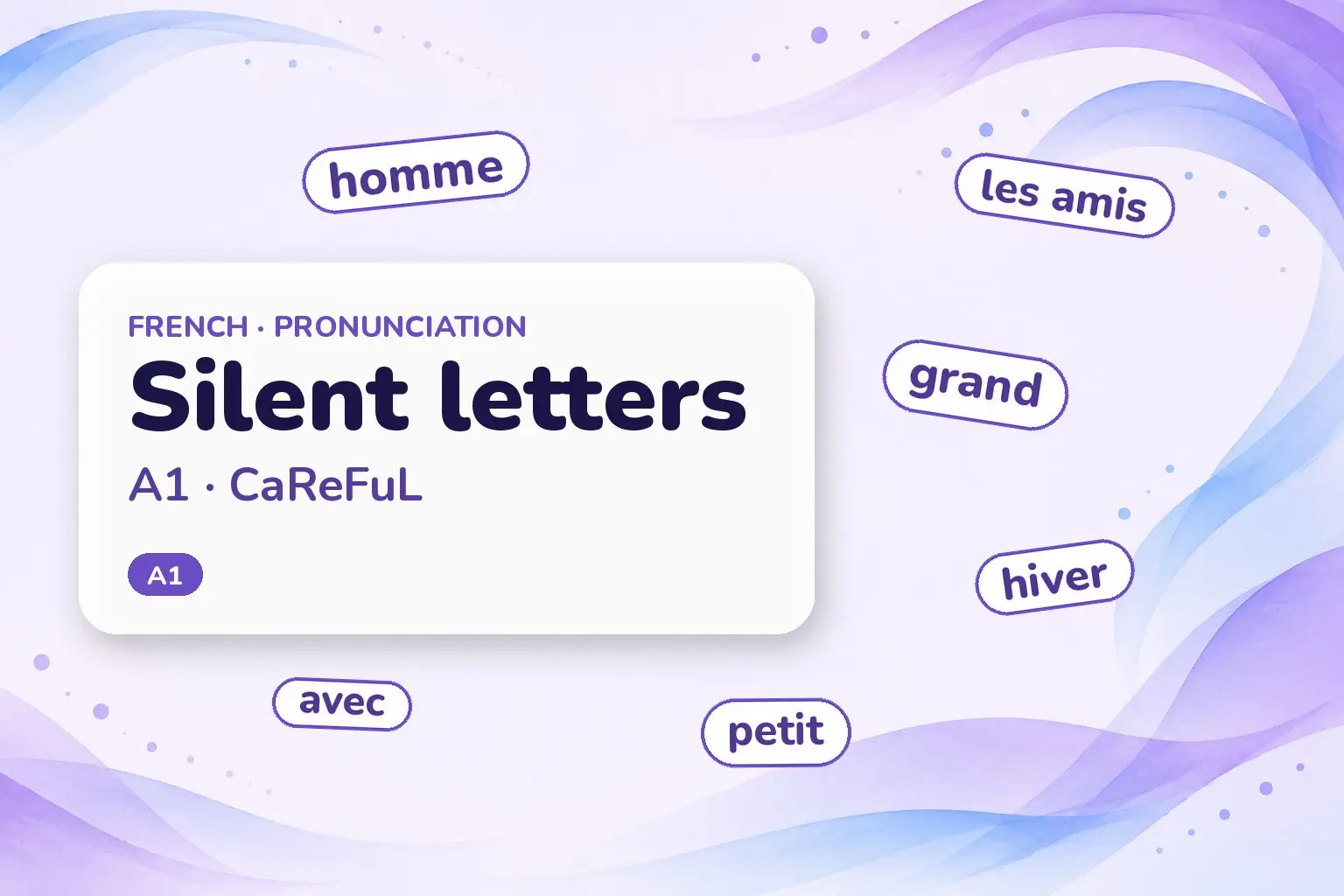
French often writes letters it does not say. Most final consonants are silent (petit, grand, trois), the final -e is silent, and h is never pronounced. The exceptions are the final letters c, r, f and l, kept in the word CaReFuL.
Level: A1. One of the first shocks in French is how many letters you simply do not say. Petit ends in a silent t; grand in a silent d; the h in homme is never heard. The good news is that the silence follows patterns. Learn which final letters drop and which stay, and French spelling stops looking random.
The main rule: final consonants are often silent
As a rule of thumb, a consonant at the end of a word is silent in French. You write it, but you do not pronounce it:
- petit — the t is silent (“puh-TEE”)
- grand — the d is silent (“grahn”)
- trois — the s is silent (“trwah”)
- nez — the z is silent (“nay”)
- tabac — even the… no: here the c is silent too, an exception we meet below.
The final -e is also silent — it is the famous e muet (mute e). Table, une and grande all end in a soft, unspoken e. That silent -e does, however, make the consonant before it sound: grand (“grahn”) versus grande (“grahnd”).
The exception: CaReFuL
Four final consonants usually are pronounced. The classic memory aid spells the English word CaReFuL — the capital letters C, R, F, L:
- C — avec (with), sac (bag)
- R — hiver (winter), bonjour (hello)
- F — neuf (nine), chef (chef)
- L — journal (newspaper), avril (April)
So be careful: these four tend to stay. There are still exceptions even here — the r of an -er ending is silent (see below), and tabac keeps a silent c — but CaReFuL is the right default.
Silent h, -er and -ent
Three more patterns catch beginners:
- H is always silent. Homme (“om”), heure (“err”), hôtel (“oh-tel”). French has no h sound at all.
- -er and -ez are silent after the vowel. The infinitive parler (“par-LAY”) and chez (“shay”) end in a plain vowel; the r and z are not heard.
- -ent on a verb is silent. The ils/elles ending -ent is mute: ils parlent sounds exactly like il parle. Beware — on an adverb like vraiment (really), -ent is pronounced.
How to say it
A few habits fix most of these sounds for an English speaker:
- Chop the final consonant. Say petit as “puh-TEE” and grand as “grahn” — no t, no d.
- Keep CaReFuL. Let c, r, f, l ring out: avec, bonjour, neuf, journal.
- Swallow the final -e. Table is “TAHBL”, not “tah-bluh”; the -e is a silent cushion.
- Never breathe the h. Start homme on the vowel: “om”, not “hom”.
- Link before a vowel. In les amis (the friends) the silent s comes alive as a z: “lay-za-mee”. This is liaison.
Hear it
- petitsmall — silent final t
- grandbig — silent final d
- troisthree — silent final s
- neznose — silent final z
- tabletable — silent final e
- avecwith — CaReFuL: the c is said
- hiverwinter — CaReFuL: the r is said
- neufnine — CaReFuL: the f is said
- journalnewspaper — CaReFuL: the l is said
- parlerto speak — the -er is silent
- chezat the place of — the -ez is silent
- hommeman — silent h and silent final e
- heurehour — silent h
- ils parlentthey speak — the -ent is silent
- les amisthe friends — liaison: the s is said as z
- vous avezyou have — liaison across the words
Common mistakes
- ❌ saying the t in petit (“puh-TEET”) → ✅ “puh-TEE”; the final t is silent in the masculine.
- ❌ breathing the h in homme → ✅ start on the vowel: “om”. French has no h sound.
- ❌ pronouncing the r in parler (“par-LAIR”) → ✅ “par-LAY”; the -er ending drops the r.
- ❌ sounding the -ent in ils parlent → ✅ it is silent, so it matches il parle.
- ❌ dropping the liaison in les amis → ✅ link them: “lay-za-mee”, with the s said as a z before the vowel.
A tiny dialogue
— Vous parlez français ? — Do you speak French? — Un petit peu. — A little bit. — Vous êtes ici chez des amis ? — Are you here at friends’ place?
Listen for the silent -ez in parlez, the silent t in petit, and the liaison in des amis.
Practice
Silent letters practice
Try each one, then press Check. No sign-up, nothing is sent anywhere — it all runs in your browser.
2 Match each word to the letter you DO pronounce.
- avec
- hiver
- neuf
- journal
Show answer
- avec → c
- hiver → r
- neuf → f
- journal → l
The CaReFuL letters c, r, f, l are usually sounded.
Hint: spell the word CaReFuL
Show answer
c r f l — C, R, F and L are the final consonants usually pronounced.
Where to go next
Fit silent letters into the whole sound system with the French vowel sounds and the nasal vowels, review the letters and accents in the French alphabet, and hear the full inventory in the French pronunciation overview. New here? Begin at Start Learning French Here.
Quiz
French silent letters quiz
9 questions · pick an answer and you'll see straight away if it's right.
-
Show answer
usually silent — Most final consonants are silent: petit, grand, trois.
-
Show answer
silent (e muet) — The final -e is mute, though it wakes the consonant before it.
-
Show answer
avec — Avec ends in c, one of the CaReFuL letters, so the c is said.
-
Show answer
c, r, f, l — The final consonants c, r, f and l are usually sounded.
-
Show answer
silent — French has no h sound; heure starts on the vowel.
-
Show answer
silent, giving 'par-LAY' — The infinitive -er ending drops the r: par-LAY.
-
Show answer
il parle — The verb ending -ent is silent, so it matches il parle.
-
Show answer
sounding a final consonant before a following vowel — In les amis the silent s is sounded as z before the vowel.
-
Show answer
the final -e lets the t be heard in petite — The silent -e wakes the t: petite is puh-TEET, petit is puh-TEE.
All French pronunciation & writing topics
Vocabulary, pronunciation, phrases, practice and exam help, ordered by level. Pick a topic and go straight to it. New lessons go live every day, so topics marked Coming soon fill in over the next weeks.
Pronunciation & writing
A1 5 topics · 5 ready
- 01 French Pronunciation Overview
- 02 The French Alphabet
- 03 French Silent Letters You are here
- 04 French Accents & Diacritics
- 05 French Elision (l', j', d')
A2 3 topics · 3 ready
B1 2 topics · 1 ready
- 09 French Liaison
- 10 French Intonation & Rhythm Coming soon