The French Alphabet: Letters & Spelling
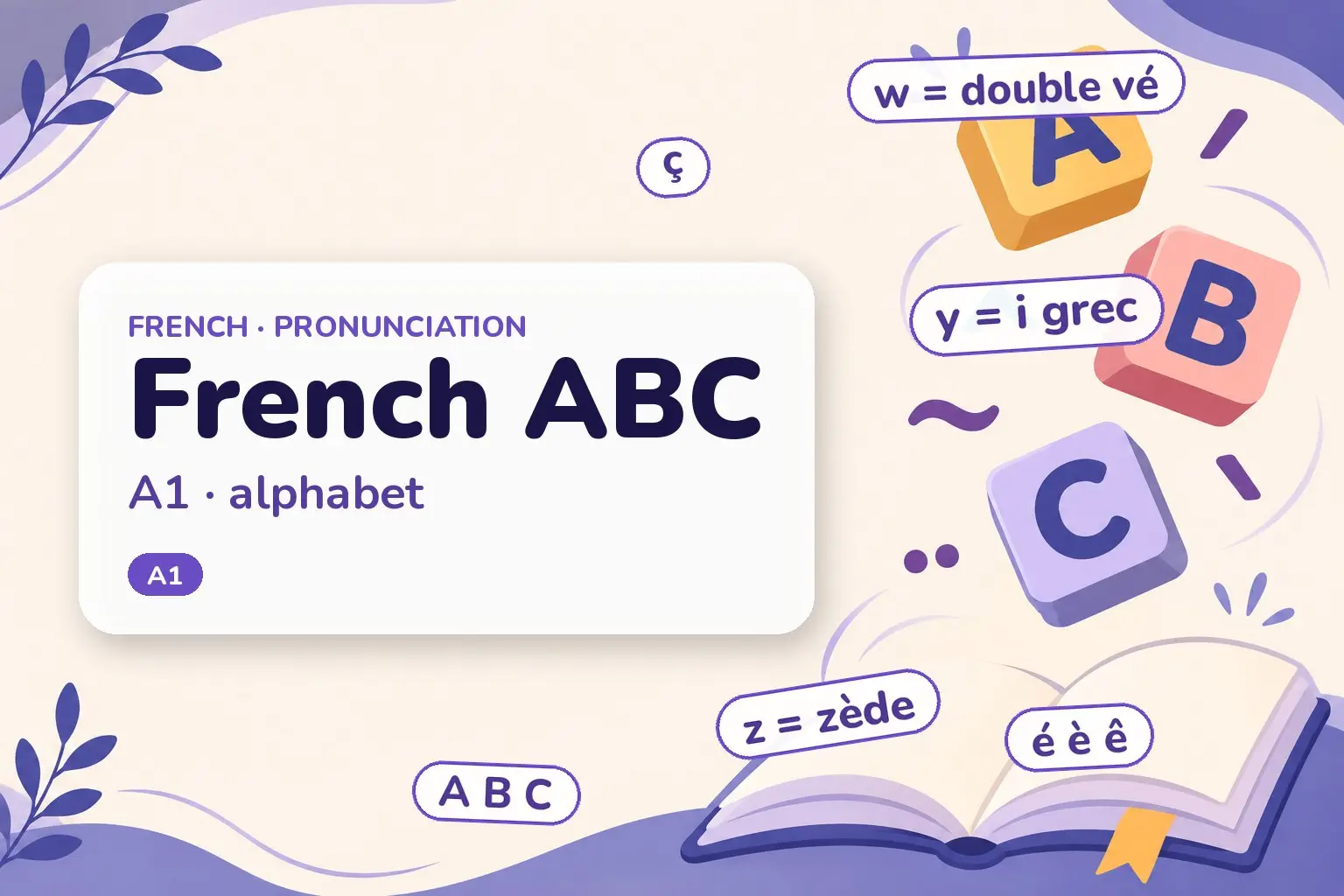
The French alphabet uses the same 26 Latin letters as English, but the names sound different — b is 'bé', g is 'gé', j is 'ji', w is 'double vé'. Five accent marks (é è ê ë, ç) change how a letter sounds, not the number of letters.
Level: A1. Good news first: French and English share the same 26 letters. What changes is how you name each letter when you say it aloud, plus a handful of accent marks that sit on top of some vowels and under the letter c. Learn the names once and you can spell your own name, read out an email address, and sound out new words.
The same 26 letters, new names
French writes with the Latin alphabet, exactly the 26 letters you already know, A to Z. There are no extra letters — the accented forms like é and à are not counted as separate letters in the alphabet. The job of this page is the names: when you say the alphabet or spell a word out loud, the sounds are different from English.
A few letters cause most of the confusion for English speakers, because the names clash with English:
- g is “gé” (like the start of “Gérard”), while j is “ji” — the two are almost swapped compared with English.
- i is “ee” and e is “euh”, so they do not sound like their English names.
- w is “double vé” (literally “double v”), not “double u”.
- y is “i grec”, meaning “Greek i”.
The letter names
| Letter | French name (say it like) |
|---|---|
| A a | ah |
| B b | bé |
| C c | cé |
| D d | dé |
| E e | euh |
| F f | effe |
| G g | gé |
| H h | ache (silent letter, but still named) |
| I i | ee |
| J j | ji |
| K k | ka |
| L l | elle |
| M m | emme |
| N n | enne |
| O o | oh |
| P p | pé |
| Q q | ku |
| R r | erre |
| S s | esse |
| T t | té |
| U u | ew (lips rounded) |
| V v | vé |
| W w | double vé |
| X x | ixe |
| Y y | i grec |
| Z z | zède |
The accent marks
Accents are not decoration — they tell you how to read a letter, and sometimes change the word’s meaning. Five marks matter:
- accent aigu (´) only on e: é, a closed “ay” sound, as in café.
- accent grave (`) on e, a, u: è (open “eh”, as in mère), and on à and où mainly to separate meanings.
- accent circonflexe (ˆ) on any vowel: â ê î ô û, as in hôpital — often where an old s was dropped.
- tréma (¨) on e, i, u: it means “say this vowel separately”, as in Noël (no-EL).
- cédille (¸) only under c: ç makes a soft “s” sound before a, o, u, as in français.
How to say it
A few sounds in the letter names have no exact English match:
- u / “ew” — round your lips as if to whistle, then say “ee”. This is the vowel in tu and the letter name for u.
- e / “euh” — a soft, neutral sound like the “u” in “fur” without the r.
- r / “erre” — the French r is made at the back of the throat, a light gargle, not the English rolling or hard r.
- é versus è — é is tight and bright (“ay”), è is open and relaxed (“eh”); compare été (summer) with mère (mother).
Spelling and letters in action
- A, B, C, Dah, bé, cé, dé — the start of the alphabet
- G comme GérardG as in Gérard — 'gé', like the soft French g
- J comme JulieJ as in Julie — 'ji', easy to confuse with English g
- cafécoffee — the é is 'accent aigu', an 'ay' sound
- mèremother — the è is 'accent grave', an open 'eh'
- hôpitalhospital — ô is 'accent circonflexe'; the h is silent
- françaisFrench — the ç (cédille) gives a soft 's'
- NoëlChristmas — the tréma means say o and e separately
- y = i grecthe letter y is named 'i grec', Greek i
- w = double véthe letter w is named 'double vé'
- deux L'two Ls' — how you say a doubled letter when spelling aloud
- elle s'appelle Anneher name is Anne — A, deux N, E when spelled out
- kilokilo — one of the few common words with k
- wagontrain car — a borrowed word that keeps w
Practice
French alphabet practice
Try each one, then press Check. No sign-up, nothing is sent anywhere — it all runs in your browser.
3 Match each letter to its French name.
- g
- w
- i
- z
Show answer
- g → gé
- w → double vé
- i → ee
- z → zède
g = gé, w = double vé, i = ee, z = zède.
Hint: it makes c sound like s
Show answer
cédille — The cédille (ç) softens c to an 's' sound before a, o, u.
Where to go next
Once you can name the letters, build real sounds in the French pronunciation overview, then start forming sentences with the verb être and browse the French grammar section. New to the course? Begin at Start Learning French Here.
Quiz
The French alphabet
8 questions · pick an answer and you'll see straight away if it's right.
-
Show answer
26 — The same 26 Latin letters as English; accented forms are not extra letters.
-
Show answer
gé — g is 'gé'; j is 'ji'.
-
Show answer
double vé — w is 'double vé' in French.
-
Show answer
accent aigu — é carries the accent aigu, a bright 'ay' sound.
-
Show answer
cédille — ç is the cédille; it makes a soft 's' before a, o, u.
-
Show answer
say the two vowels separately — A tréma means pronounce that vowel on its own: No-ël.
-
Show answer
k and w — K and W appear mostly in borrowed words such as kilo and wagon.
-
Show answer
deux L — Say 'deux L' (two Ls) when spelling aloud.
All French pronunciation & writing topics
Vocabulary, pronunciation, phrases, practice and exam help, ordered by level. Pick a topic and go straight to it. New lessons go live every day, so topics marked Coming soon fill in over the next weeks.
Pronunciation & writing
A1 5 topics · 2 ready
- 01 French Pronunciation Overview
- 02 The French Alphabet You are here
- 03 French Silent Letters Coming soon
- 04 French Accents & Diacritics Coming soon
- 05 French Elision (l', j', d') Coming soon
A2 3 topics
- 06 French Vowel Sounds Coming soon
- 07 French Nasal Vowels Coming soon
- 08 French H: Mute vs Aspirate Coming soon
B1 2 topics
- 09 French Liaison Coming soon
- 10 French Intonation & Rhythm Coming soon