How to Practise Spanish Writing
To practise Spanish writing, climb in steps: copy and adapt correct model sentences, join them into short paragraphs, then run a feedback loop — compare your text with a model, mark the gaps (especially accents, ñ and ser vs estar), and rewrite. Short, finished pieces beat long abandoned ones.
Level: B1. Writing is the skill learners avoid longest, because it exposes every gap at once: grammar, accents, agreement and word choice. The cure is not talent but a routine — small, finished pieces you correct and rewrite. This page gives you one.
By the end of this page you can…
…build Spanish writing up from sentences to paragraphs, run a feedback loop that fixes your real mistakes, handle accents and punctuation, and keep a routine you can sustain.
Writing is an output skill
Reading and listening are input; writing is output, and output shows what you can actually produce, not just recognise. That is why it feels hard — and why it is the fastest way to find your real gaps. Each time you cannot write a word you thought you knew, you have found something worth studying.
Spanish spelling is largely regular, so if you can say a word you can usually spell it. The traps are the written accents, the ñ, and grammar choices such as ser vs estar and gender agreement.
Build up in steps
Do not jump straight to free writing. Climb a ladder:
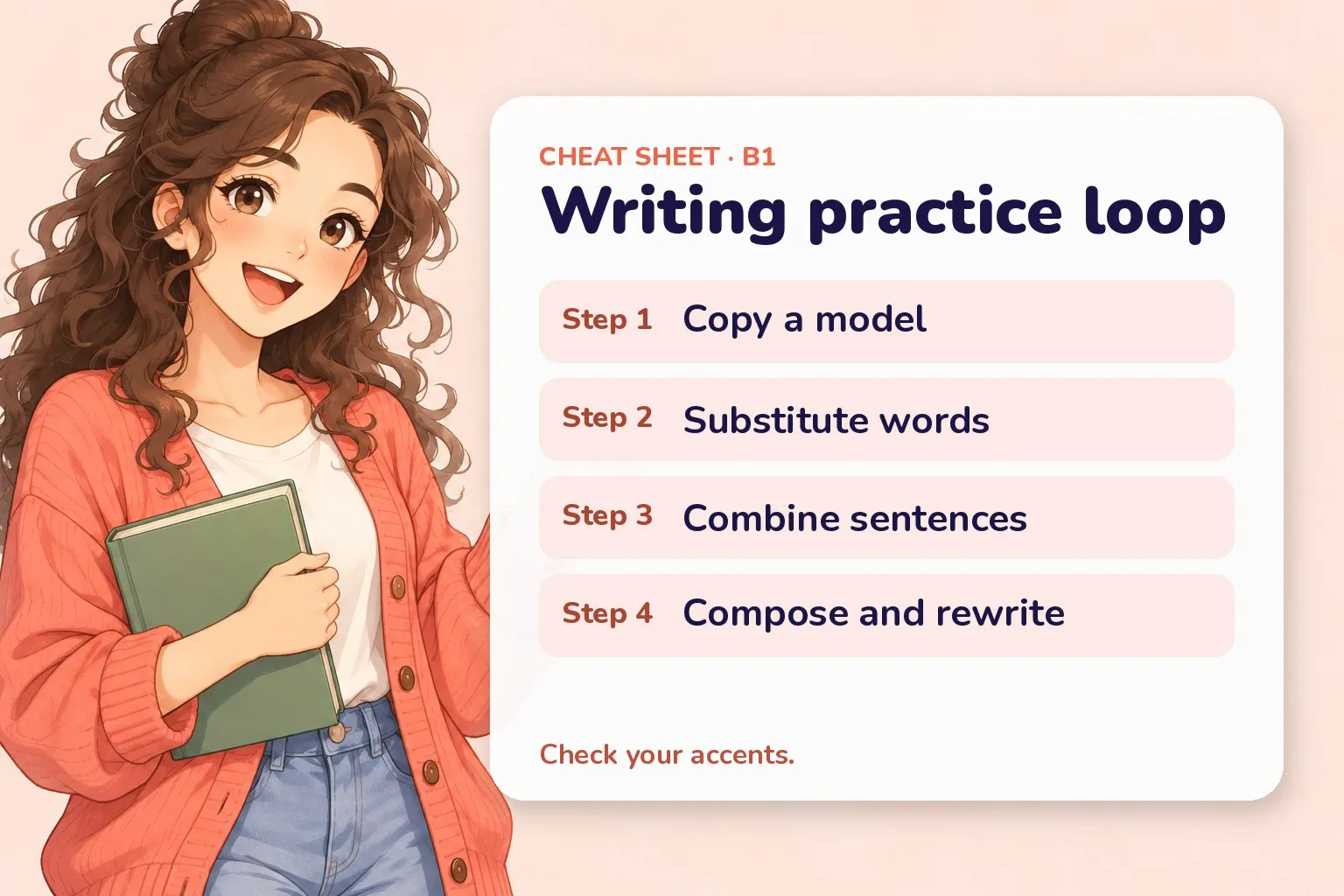
- Copy a correct model sentence exactly, accents included.
- Substitute — swap one word for another you know: change the place, the time, the object.
- Combine two short sentences with a connector such as pero (“but”) or porque (“because”).
- Compose a short paragraph of four to six sentences on a familiar topic: your day, your town, your weekend.
Each rung reuses the grammar you are studying now, so writing doubles as review.
The feedback loop
Writing without correction just drills your mistakes. After each piece:
- Write your short text.
- Compare it line by line with a correct model or a corrected version.
- Mark every difference — a missing accent, a wrong ser/estar, an adjective that does not agree — not only outright errors.
- Rewrite the whole piece correctly. The rewrite is where the learning lands.
Learn from model answers
Imitation is not cheating — it is how you absorb natural phrasing. Keep a small bank of correct model texts at your level (a diary entry, a self-introduction, an email) and reuse their patterns with your own content. The example sentences below are model lines you can copy and adapt; play each one to hear it as you write it.
- Hoy hace buen tiempo.The weather is nice today.a simple opening line
- Me levanté a las siete de la mañana.I got up at seven in the morning.
- Estudié en la biblioteca con un amigo.I studied at the library with a friend.
- Comí una ensalada al mediodía.I had a salad at midday.
- Estaba un poco cansado, pero fue divertido.I was a little tired, but it was fun.pero = but
- Mañana es fiesta, así que voy a descansar.Tomorrow is a holiday, so I'm going to rest.así que = so
- Mi ciudad es pequeña, pero tranquila.My city is small, but quiet.
- El fin de semana quiero ver una película.At the weekend I want to watch a film.
- Últimamente estoy estudiando español.Lately I have been studying Spanish.
- Practico la escritura un poco cada día.I practise writing a little every day.
How to say it
Playing your sentences aloud helps you catch spelling: in Spanish, sound and spelling line up closely.
- ñ — a “ny” sound as in “canyon”: año (“year”) is “AH-nyoh”, quite unlike ano.
- accented vowels (á, é, í, ó, ú) — the accent does not change the vowel’s sound; it marks which syllable is stressed: practico (I practise) vs practicó (he practised).
- h — always silent: hoy (“today”) is “oy”, hace is “AH-seh”.
- v and b — sound almost the same, so you must learn which word takes which letter; saying it will not tell you.
A weekly writing routine
- Three short pieces a week, five to six sentences each, beat one long piece.
- Reuse this week’s grammar. If you are studying a tense or ser vs estar, build your sentences around it.
- Mine a frequency list. The high-frequency words (for example the FrequencyWords lists) tell you which vocabulary to drill into your writing first.
- Keep a correction log. Write each mistake and its fix in one place and review it before the next piece, so the same error does not return.
Common writing mistakes
- Dropping written accents. Tildes carry meaning: tú (“you”) vs tu (“your”), él (“he”) vs el (“the”). Proof-read every accent before you finish.
- Forgetting the opening ¿ and ¡. Spanish opens questions and exclamations with inverted marks: ¿Cómo estás?, not Cómo estás?
- Confusing ser and estar. Both mean “to be”; a wrong choice changes the meaning. Check each one against what it describes.
- Agreement slips. Articles and adjectives must match the noun in gender and number: las casas blancas, not los casa blanco.
Practice
Spanish writing-strategy practice
Try each one, then press Check. No sign-up, nothing is sent anywhere — it all runs in your browser.
2 Put the build-up ladder in order.
Show answer
copy a model sentence substitute a word combine two sentences compose a paragraph — Copy, substitute, combine, then compose.
Hint: it goes at the start
Show answer
¿ — Questions begin with ¿ and end with ?
5 Match each writing habit to its benefit.
- checking accents
- feedback loop
- model texts
- correction log
Show answer
- checking accents → keeps words distinct
- feedback loop → fixes mistakes instead of drilling them
- model texts → teach natural phrasing
- correction log → stops errors from returning
Each habit targets a different part of better writing.
Quick recap before you practise.
Quiz
Spanish writing quiz
8 questions · pick an answer and you'll see straight away if it's right.
-
Show answer
output skill — Writing is output: it shows what you can actively produce.
-
Show answer
copy a correct model sentence — Copying correct models teaches natural structure before you compose.
-
Show answer
write, compare, mark, rewrite — Compare your text with a model, mark the gaps, and rewrite.
-
Show answer
it makes a different word with the ñ sound — año (year) and ano are different words; the ñ is essential.
-
Show answer
start with ¿ and end with ? — Spanish opens questions with the inverted ¿.
-
Show answer
a finished five to six sentences — Short, finished, corrected pieces teach the most.
-
Show answer
las casas blancas — Article and adjective agree in gender and number: las casas blancas.
-
Show answer
to review past mistakes so they do not return — Reviewing logged mistakes stops the same error coming back.
Next
- Pair it with input: how to practise Spanish reading
- Train your ear too: how to practise Spanish listening
- Sharpen output aloud with shadowing
- Build the grammar you will write with in the Spanish grammar section
- New here? Start with Start Learning Spanish Here
All Spanish practice topics
Vocabulary, pronunciation, phrases, practice and exam help, ordered by level. Pick a topic and go straight to it. New lessons go live every day, so topics marked Coming soon fill in over the next weeks.
Practice
A1 1 topics · 1 ready
A2 5 topics · 2 ready
- 02 How to Practise Spanish Listening
- 03 Spanish Reading Practice: Elementary
- 04 Ser vs Estar Practice Set Coming soon
- 05 Spanish Accent (Tilde) Practice Coming soon
- 06 Gustar-Type Verbs Practice Coming soon
B1 6 topics · 3 ready
- 07 Shadowing to Improve Spanish Speaking
- 08 Spanish Reading Practice: Intermediate
- 09 How to Practise Spanish Writing You are here
- 10 Por vs Para Practice Set Coming soon
- 11 Preterite vs Imperfect Practice Coming soon
- 12 Spanish Commands Practice (tu/usted) Coming soon
B2 2 topics · 1 ready
- 13 Spanish Reading Practice: Upper-Intermediate
- 14 Spanish Subjunctive Practice Set Coming soon