Spanish Reading Practice: Intermediate
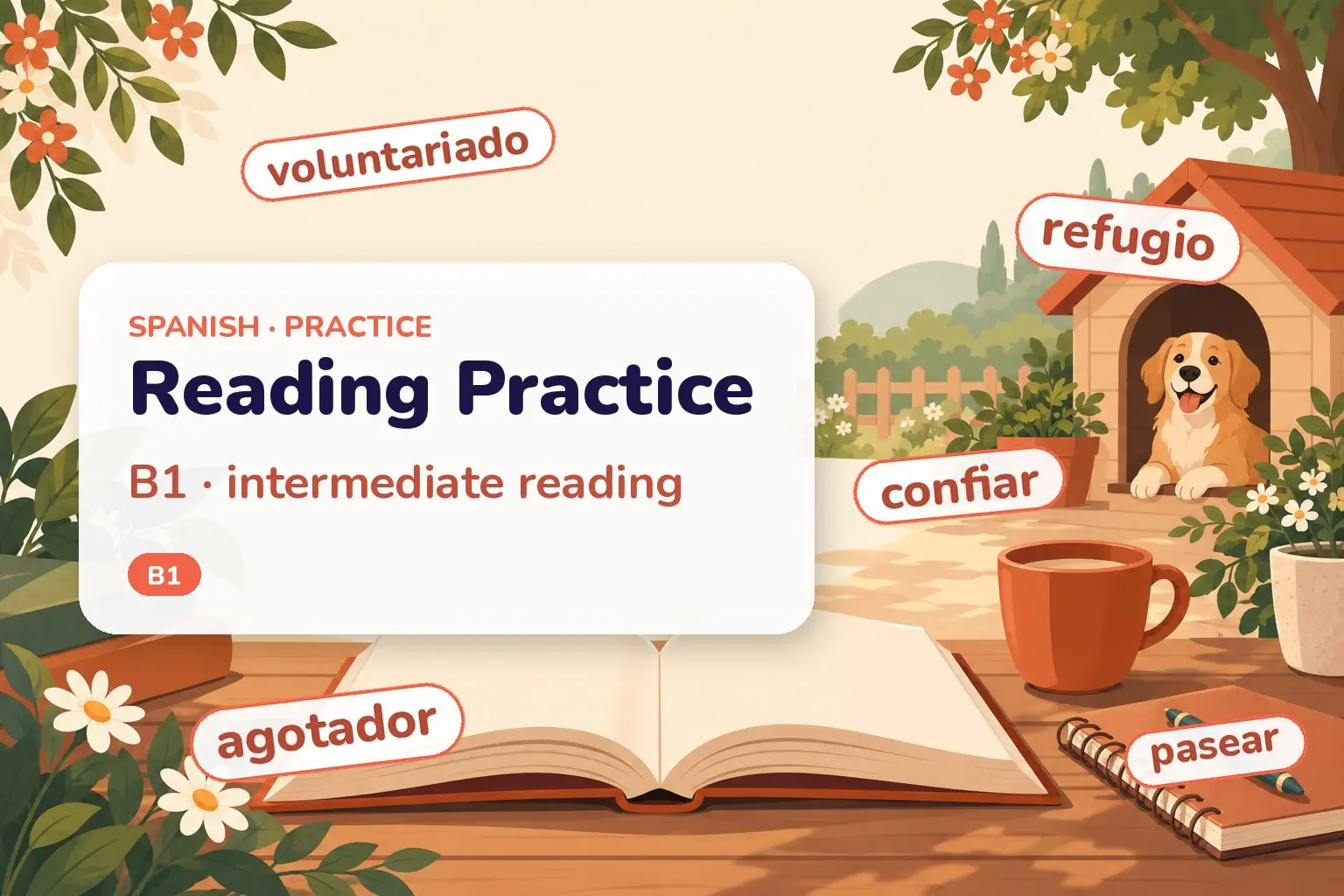
Intermediate Spanish reading (B1) means longer passages that mix the preterite and the imperfect and link ideas with connectors like aunque ('although'), mientras ('while') and por eso ('that's why'). Read for the gist first, then reread to track who did what and when.
Level: B1. Intermediate reading is a real step up from elementary: the passages are longer, and the past is told with two tenses at once. The skill now is to follow who did what, when, and how each clause links to the next.
By the end of this page you can…
…read a short B1 story about volunteering at an animal shelter, tell the preterite apart from the imperfect, and answer questions about it.
How to read an intermediate text
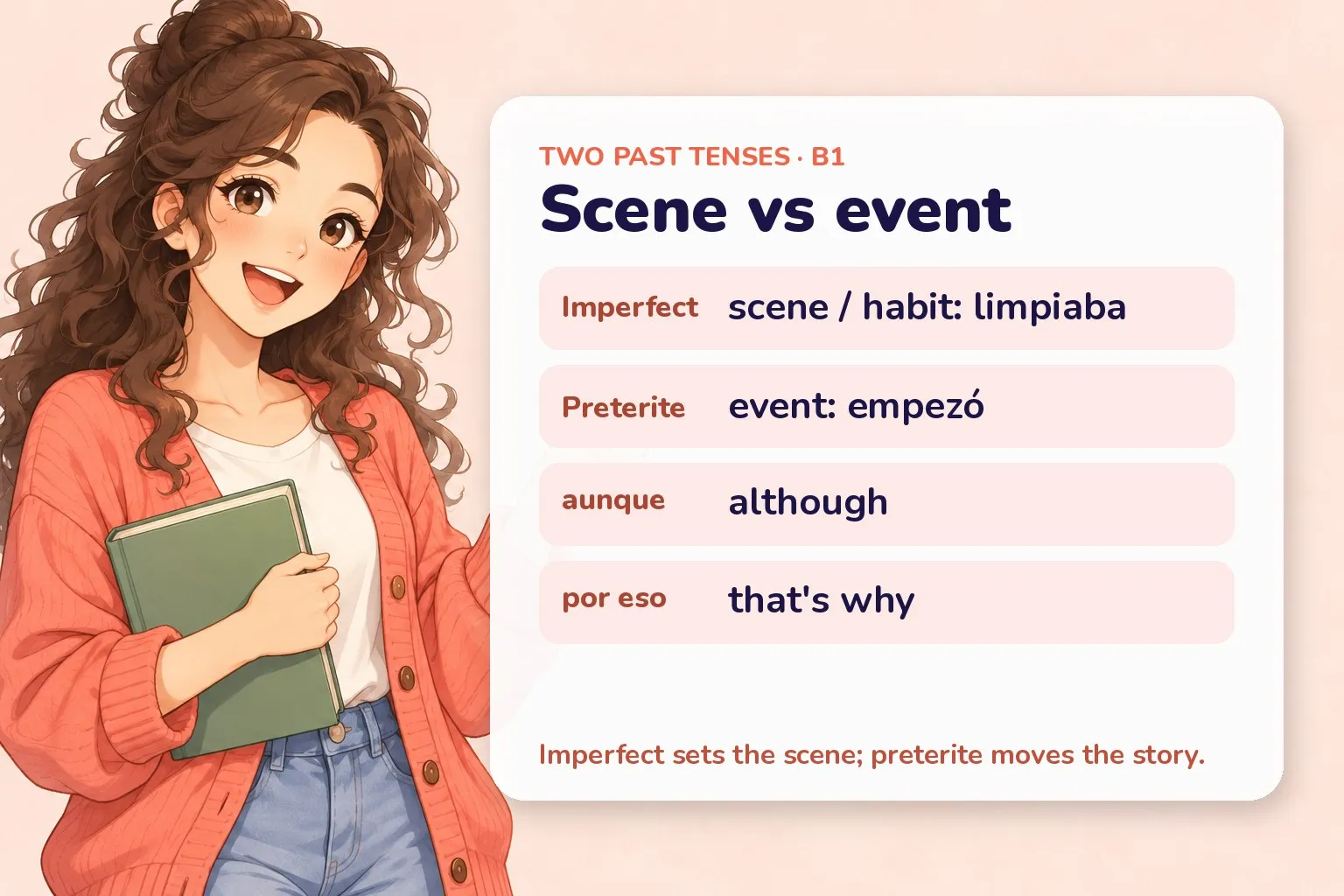
At this level, past-tense stories run on two tenses. The imperfect (limpiaba, llovía, estaba) paints the background — habits, ongoing actions, descriptions — while the preterite (empezó, adoptó, aprendí) marks the single, finished events that move the story forward. Spotting which is which tells you what is scene and what is action. Connectors do the rest: aunque (“although”) and sin embargo (“however”) signal contrast, mientras (“while”) sets two things side by side, and por eso (“that’s why”) marks a result.
The graded text
Read this short story one line at a time. Each line shows the Spanish and the English; tap play to hear it.
- El año pasado decidí hacer un voluntariado en un refugio de animales.Last year I decided to volunteer at an animal shelter.preterite: decidí = 'I decided'
- Nunca había trabajado con animales, así que al principio estaba nervioso.I had never worked with animals, so at first I was nervous.había trabajado = past perfect; estaba = imperfect
- Cada sábado por la mañana limpiaba las jaulas y daba de comer a los perros.Every Saturday morning I cleaned the cages and fed the dogs.imperfect for a repeated habit
- Un día, mientras paseaba a un perro, empezó a llover muy fuerte.One day, while I was walking a dog, it started to rain hard.paseaba (ongoing) + empezó (event)
- Volvimos corriendo al refugio y nos secamos como pudimos.We ran back to the shelter and dried off as best we could.
- Aunque fue agotador, aprendí mucho sobre la responsabilidad.Although it was exhausting, I learned a lot about responsibility.aunque = 'although'
- Lo que más me gustó fue ver cómo los animales confiaban en mí poco a poco.What I liked most was seeing how the animals gradually trusted me.lo que = 'what / the thing that'
- Al final del verano, una familia adoptó al perro que yo cuidaba.At the end of summer, a family adopted the dog I was taking care of.adoptó (event) vs cuidaba (ongoing)
- Me puse triste, pero también me alegré por él.I became sad, but I was also glad for him.ponerse/alegrarse = change of feeling
- Por eso, este año pienso volver como voluntario.That's why, this year I plan to go back as a volunteer.por eso = 'that's why'
- Si tienes tiempo libre, te recomiendo una experiencia así.If you have free time, I recommend an experience like this.
- Vale la pena, aunque a veces es difícil.It's worth it, although it's sometimes hard.vale la pena = 'it's worth it'
Key vocabulary
These are some of the most useful intermediate words in the text.
| Word | English |
|---|---|
| voluntariado | volunteer work |
| refugio | shelter |
| jaula | cage |
| pasear | to walk (a dog), to stroll |
| agotador | exhausting |
| responsabilidad | responsibility |
| confiar | to trust |
| adoptar | to adopt |
| cuidar | to take care of |
| valer la pena | to be worth it |
How to say it
Spanish spelling is regular; mind these few sounds from the story:
| Word | How to say it |
|---|---|
| jaula | the j is a strong, breathy h: “HOW-la”. |
| refugio | g before i sounds like that same h: “re-FOO-hee-o”. |
| llover | ll like English y, v like a soft b: “yo-BEHR”. |
| agotador | stress the last syllable: “a-go-ta-DOR”. |
Check you understood
- What did the writer decide to do last year? (Volunteer at an animal shelter.)
- How did they feel at first, and why? (Nervous, because they had never worked with animals.)
- What happened one day while walking a dog? (It started to rain hard.)
- Who adopted the dog the writer cared for? (A family, at the end of summer.)
- What does the writer plan to do this year? (Go back as a volunteer.)
Extension: read a little more every day
Once this story feels easy, change the goal rather than the text at first: read it aloud for smooth rhythm, then cover the English and translate each line yourself, then retell the story from memory in your own words. When you are ready for new material, choose B1 graded readers or simple blog-style diaries, and keep each session short. If you want to warm up on something gentler first, revisit the elementary reading passage.
Practice
Intermediate reading practice
Try each one, then press Check. No sign-up, nothing is sent anywhere — it all runs in your browser.
Hint: a…
Show answer
aunque — aunque means 'although' and marks the contrast.
3 Match each verb with its job in the story.
- limpiaba
- empezó
- adoptó
- estaba
Show answer
- limpiaba → imperfect: a habit
- empezó → preterite: single event
- adoptó → preterite: single event
- estaba → imperfect: background state
Imperfect = scene/habit; preterite = the completed events that move the story.
Quick recap before you practise.
Quiz
Intermediate reading quiz
7 questions · pick an answer and you'll see straight away if it's right.
-
Show answer
reread a short passage with a new goal each pass — Reread a connected passage with a purpose each pass: gist, tenses, aloud.
-
Show answer
nervous — al principio estaba nervioso = 'at first I was nervous'.
-
Show answer
the imperfect — The imperfect (limpiaba, estaba, llovía) paints the background.
-
Show answer
it started to rain hard — empezó a llover muy fuerte = 'it started to rain very hard'.
-
Show answer
that's why — por eso marks a result: 'that's why / for that reason'.
-
Show answer
a family — una familia adoptó al perro que yo cuidaba = 'a family adopted the dog I was caring for'.
-
Show answer
it tells you what is scene and what is a completed event — The imperfect is background; the preterite is the finished events that move the story forward.
Next
- Build the grammar behind the sentences in the Spanish grammar section
- Warm up with the elementary text first: Spanish Reading Practice: Elementary
- New here? Start with Start Learning Spanish Here
All Spanish practice topics
Vocabulary, pronunciation, phrases, practice and exam help, ordered by level. Pick a topic and go straight to it. New lessons go live every day, so topics marked Coming soon fill in over the next weeks.
Practice
A1 1 topics · 1 ready
A2 5 topics · 2 ready
- 02 How to Practise Spanish Listening
- 03 Spanish Reading Practice: Elementary
- 04 Ser vs Estar Practice Set Coming soon
- 05 Spanish Accent (Tilde) Practice Coming soon
- 06 Gustar-Type Verbs Practice Coming soon
B1 6 topics · 2 ready
- 07 Shadowing to Improve Spanish Speaking
- 08 Spanish Reading Practice: Intermediate You are here
- 09 How to Practise Spanish Writing Coming soon
- 10 Por vs Para Practice Set Coming soon
- 11 Preterite vs Imperfect Practice Coming soon
- 12 Spanish Commands Practice (tu/usted) Coming soon
B2 2 topics · 1 ready
- 13 Spanish Reading Practice: Upper-Intermediate
- 14 Spanish Subjunctive Practice Set Coming soon