Spanish Reading Practice: Beginner
Beginner Spanish reading means working through short texts built from the most common A1 words. Read for the gist first, then reread for details, checking any new word and saying it aloud before you move on.
Level: A1. Reading at the beginner stage is not about speed or long texts. It is about short passages you can almost fully understand, read slowly and more than once. Spanish spelling is regular, so once you know a handful of sound rules you can read almost any new word aloud on sight — which makes reading and pronunciation practice the same activity.
By the end of this page you can…
…read a short A1 self-introduction, say each word, and answer simple questions about it.
How to read a beginner text
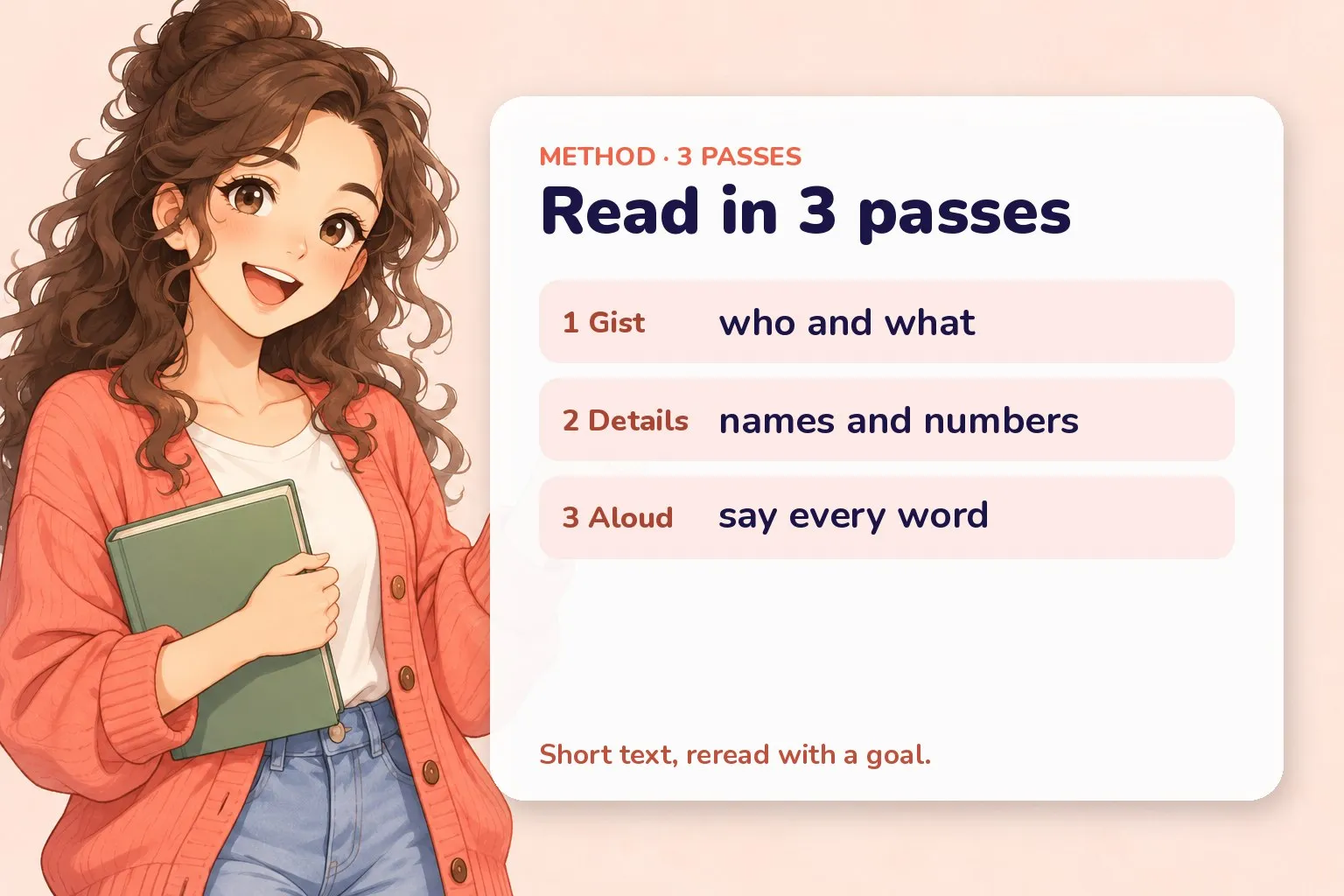
Three habits make beginner reading work. Keep the text short (a few sentences), reread it with a new purpose each time, and read aloud so you connect the spelling to the sound.
The graded text
Read this short self-introduction one line at a time. Each line shows the Spanish and the English; tap play to hear it.
- Hola. Me llamo Ana.Hello. My name is Ana.greeting and name
- Soy estudiante.I am a student.role
- Soy de México.I am from Mexico.origin
- Vivo en Madrid.I live in Madrid.
- Todos los días voy a la escuela.Every day I go to school.
- Como con una amiga.I eat with a friend.
- Por la noche leo un libro en casa.At night I read a book at home.
- Mucho gusto.Pleased to meet you (closing).
Key vocabulary
These are some of the most common beginner words in the text.
| Word | English |
|---|---|
| soy | I am |
| estudiante | student |
| de | from, of |
| vivo | I live |
| escuela | school |
| amiga | friend (female) |
| libro | book |
| leo | I read |
| casa | house, home |
| noche | night |
How to say it
Spanish spelling is regular; mind these few sounds in the text:
| Word | How to say it |
|---|---|
| llamo | the ll sounds like English y: “YA-mo”. |
| escuela | the c before u is a hard k: “es-KWE-la”. |
| amiga | the g before a is a hard g: “a-MEE-ga”. |
| noche | the ch is like English “ch”: “NO-che”. |
| libro | roll the single r as a light tap: “LEE-bro”. |
Check you understood
- Who is speaking, and what do they do? (A student named Ana.)
- Where is she from, and where does she live? (From Mexico; she lives in Madrid.)
- How often does she go to school? (Every day.)
- What does she do at night? (Read a book at home.)
Extension: read a little more every day
Once this text feels easy, change the goal rather than the text at first: read it aloud for smooth rhythm, then cover the English and translate each line yourself. When you are ready for new material, choose graded readers or simple dialogues at the same level, and keep each session short.
Quick recap before you practise.
Practice
Reading practice
Try each one, then press Check. No sign-up, nothing is sent anywhere — it all runs in your browser.
Hint: the speaker's role
Show answer
estudiante — estudiante means student.
3 Match each word with its meaning.
- escuela
- amiga
- libro
- casa
Show answer
- escuela → school
- amiga → friend (female)
- libro → book
- casa → home
These are common A1 words from the text.
Quiz
Beginner reading quiz
7 questions · pick an answer and you'll see straight away if it's right.
-
Show answer
reread a short text with a new goal each pass — Short texts, reread with a purpose, build beginner reading best.
-
Show answer
Madrid — Vivo en Madrid = 'I live in Madrid.'
-
Show answer
student — estudiante means student.
-
Show answer
read a book — Por la noche leo un libro = 'At night I read a book.'
-
Show answer
like English y — In most of the Spanish-speaking world, ll sounds like English y: 'YA-mo'.
-
Show answer
book — libro means book.
-
Show answer
spelling is regular, so reading teaches pronunciation too — Because Spanish spelling is regular, reading aloud trains pronunciation at the same time.
Next
- Build the grammar behind the sentences in the Spanish grammar section
- Train your ear with How to Practise Spanish Listening
- New here? Start with Start Learning Spanish Here
All Spanish practice topics
Vocabulary, pronunciation, phrases, practice and exam help, ordered by level. Pick a topic and go straight to it. New lessons go live every day, so topics marked Coming soon fill in over the next weeks.
Practice
A1 1 topics · 1 ready
- 01 Spanish Reading Practice: Beginner You are here
A2 5 topics · 2 ready
- 02 How to Practise Spanish Listening
- 03 Spanish Reading Practice: Elementary
- 04 Ser vs Estar Practice Set Coming soon
- 05 Spanish Accent (Tilde) Practice Coming soon
- 06 Gustar-Type Verbs Practice Coming soon
B1 6 topics · 2 ready
- 07 Shadowing to Improve Spanish Speaking
- 08 Spanish Reading Practice: Intermediate
- 09 How to Practise Spanish Writing Coming soon
- 10 Por vs Para Practice Set Coming soon
- 11 Preterite vs Imperfect Practice Coming soon
- 12 Spanish Commands Practice (tu/usted) Coming soon
B2 2 topics · 1 ready
- 13 Spanish Reading Practice: Upper-Intermediate
- 14 Spanish Subjunctive Practice Set Coming soon