How to Practise Spanish Listening
Good Spanish listening practice means choosing short audio you mostly understand, then replaying it with a new goal each pass: first for the gist, then for details, then for the exact words. Mix guessing from context with catching the sounds that link and weaken in fast speech.
Level: A2. Listening often feels like the hardest Spanish skill, because you cannot slow real speech down. The fix is not “listen to more Spanish” in general — it is listening to the right audio in the right way, a few focused minutes at a time.
By the end of this page you can…
…choose Spanish listening material at your level and practise it with a clear goal for each replay.
What good listening practice looks like
Playing Spanish in the background while you do something else barely helps. Useful practice has three features: the audio is at your level (you understand most of it), it is short, and you listen with a purpose — a question you are trying to answer. Then you listen again with a new purpose.
Two ways your brain listens
You understand speech using two skills at once:
- Top-down: using what you already know — the topic, the situation, the speaker’s tone — to predict. If you know two people are meeting, you expect greetings, names and ¿cómo estás?
- Bottom-up: catching the actual sounds, words and grammar as they go past.
Weak listeners lean on only one. If you guess everything from context you miss details; if you hunt for every single word you lose the thread. Good practice trains both: predict first, then check what you really heard.
Graded listening: start where you understand most
“Graded” means matched to your level. Start with audio where you catch most of the message — a slow news clip, a simple dialogue, or the example sentences on this site. If you understand less than about half, the clip is too hard: switch to something slower or simpler rather than struggling. As it becomes easy, step up.
A simple listening routine
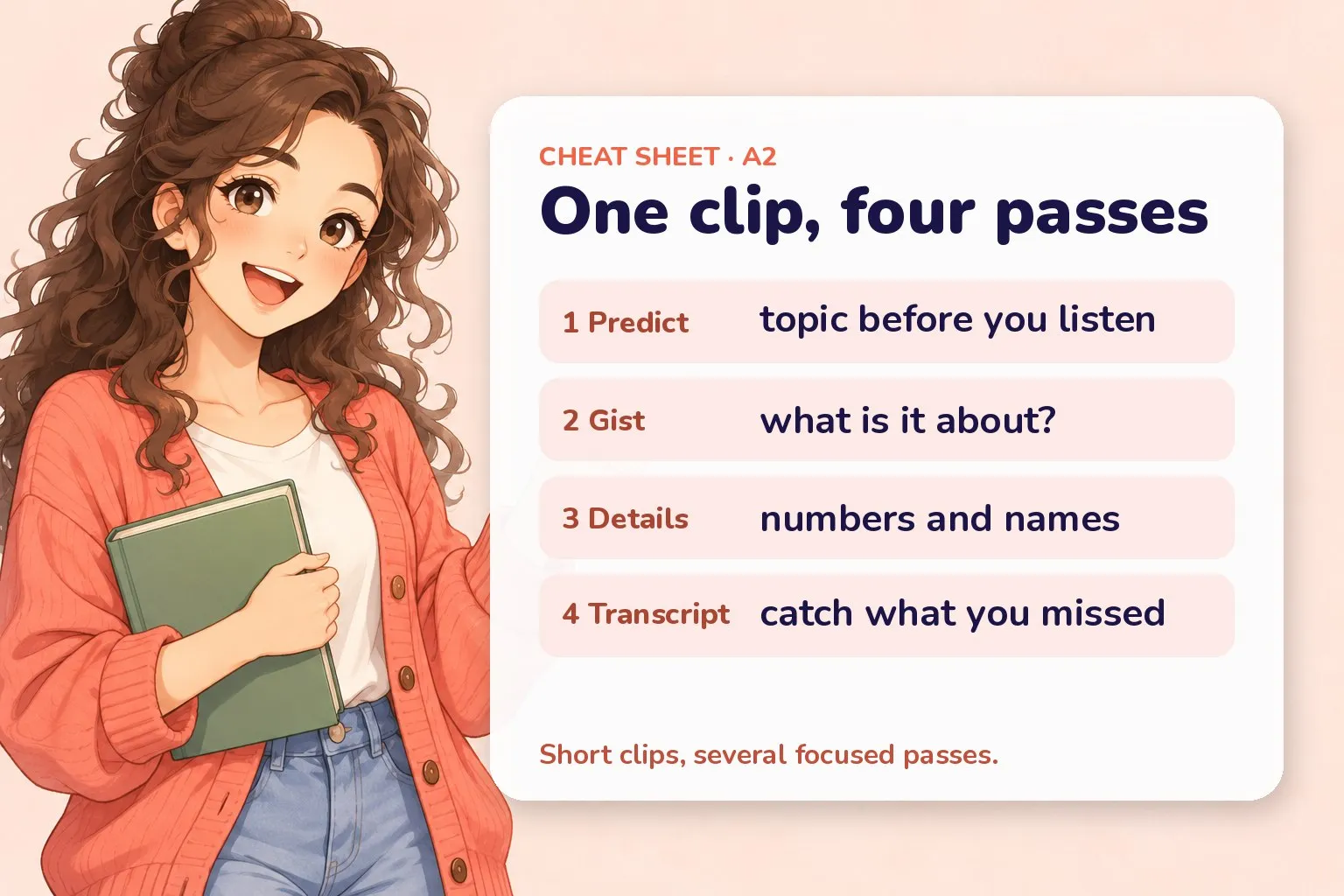
- Before you listen, read the title or look at the picture and predict what you will hear.
- First listen — gist. Answer one big question: what is it about? Who is talking?
- Second listen — details. Answer two or three small questions: numbers, names, what someone wants.
- Third listen — exact words. Read the transcript while you listen and mark the parts your ear missed.
- Listen once more with the transcript closed to enjoy how much more you now catch.
Sample listening tasks
- Gist task: listen to a short café dialogue and decide — did the customer order a hot drink or a cold one?
- Detail task: listen again and write the price and the number of items.
- Gap task: cover the transcript, listen, and fill one missing word in each line.
- Dictation: play one short sentence, pause, and write exactly what you heard; then check.
How to say it
Most “I can’t follow fast Spanish” problems are connected-speech problems — the words are familiar, but they join and soften:
- Vowel linking (sinalefa): when one word ends in a vowel and the next starts with one, they run together: mi amigo sounds like “mia-migo”; la hora like “la-hora”.
- Soft d between vowels: cansado is often heard as “cansao”; nada as “na-a”. The d almost vanishes.
- Pure, short vowels: a e i o u never glide the way English vowels do, so no is “noh”, not “no-oo”. Listen for clean, even vowels.
- rr, j and ll: the rolled rr (perro), the throaty j (jamón, like a strong “h”) and ll/y (lluvia, “YOO-vya”) hide words if your ear expects English sounds.
When you know these patterns, fast speech stops sounding like a blur.
Example sentences
Listen to each line, then read how it sounds in natural, fast speech. The words are easy — the joining is the challenge.
- Hola, ¿cómo estás?Hello, how are you? — estás links into one smooth phrase.gist: a greeting
- Me llamo Ana.My name is Ana. — catch the name in the reply.detail task
- ¿De dónde eres?Where are you from? — dónde eres links the vowels.
- Soy de México.I'm from Mexico. — the place is the detail to catch.detail: the place
- ¿Qué hora es?What time is it? — qué-hora runs together.listen for a number
- Son las tres.It's three o'clock.
- ¿Cuánto cuesta?How much is it? — listen for the price.
- Cuesta dos euros.It costs two euros.detail: the price
- Más despacio, por favor.Slower, please. — a phrase worth knowing by ear.
- ¿Puedes repetir?Can you repeat? — useful when the audio feels fast.
Quick recap before you practise.
Practice
Listening method practice
Try each one, then press Check. No sign-up, nothing is sent anywhere — it all runs in your browser.
Hint: the overall meaning, not small facts
Show answer
gist — First pass for gist, then later passes for details and exact words.
4 Order the passes of a good listening routine.
Show answer
predict before listening gist: what is it about details: numbers and names exact words with transcript — Predict, then gist, then details, then the exact words.
5 Match each Spanish listening challenge to what it is.
- sinalefa
- soft d
- pure vowels
- graded audio
Show answer
- sinalefa → vowels link across words
- soft d → cansado sounds like cansao
- pure vowels → a e i o u do not glide
- graded audio → material at your level
Knowing these patterns stops fast Spanish sounding like a blur.
Quiz
Spanish listening practice quiz
8 questions · pick an answer and you'll see straight away if it's right.
-
Show answer
at your level, mostly understandable — Graded audio you mostly follow is where real practice happens.
-
Show answer
switch to slower or simpler audio — Too-hard audio is not practice; step down a level.
-
Show answer
several times, with a new goal each pass — The gains are in focused replays with different purposes.
-
Show answer
catching the actual sounds, words and grammar — Bottom-up is catching the sounds; top-down is predicting from context.
-
Show answer
on a later pass, to catch what you missed — Reading first turns listening into reading; save the transcript for later passes.
-
Show answer
the vowels link across the two words (sinalefa) — Sinalefa joins a word-final vowel to a word-initial vowel in natural speech.
-
Show answer
cansao — The d between vowels softens almost to nothing: cansao.
-
Show answer
short and frequent, with focus — Ten focused minutes a day beats a rare long session.
Next
- Turn listening into speaking with Shadowing to Improve Spanish Speaking
- Build the grammar behind what you hear in the Spanish grammar section
- New here? Start with Start Learning Spanish Here
All Spanish practice topics
Vocabulary, pronunciation, phrases, practice and exam help, ordered by level. Pick a topic and go straight to it. New lessons go live every day, so topics marked Coming soon fill in over the next weeks.
Practice
A1 1 topics · 1 ready
A2 5 topics · 2 ready
- 02 How to Practise Spanish Listening You are here
- 03 Spanish Reading Practice: Elementary
- 04 Ser vs Estar Practice Set Coming soon
- 05 Spanish Accent (Tilde) Practice Coming soon
- 06 Gustar-Type Verbs Practice Coming soon
B1 6 topics · 2 ready
- 07 Shadowing to Improve Spanish Speaking
- 08 Spanish Reading Practice: Intermediate
- 09 How to Practise Spanish Writing Coming soon
- 10 Por vs Para Practice Set Coming soon
- 11 Preterite vs Imperfect Practice Coming soon
- 12 Spanish Commands Practice (tu/usted) Coming soon
B2 2 topics · 1 ready
- 13 Spanish Reading Practice: Upper-Intermediate
- 14 Spanish Subjunctive Practice Set Coming soon