Spanish Reading Practice: Elementary
Elementary Spanish reading means short connected passages a step above beginner, built from common words and past-tense verbs. Read for the gist, then reread for the connectors that show the order of events.
Level: A2. Elementary reading is one step past the beginner self-introduction. The sentences are still short, but now they connect: things happen in order, mostly in the past, and the connectors tell you what came first.
By the end of this page you can…
…read a short A2 account of someone’s weekend, follow the order of events, and answer questions about it.
How to read an elementary text
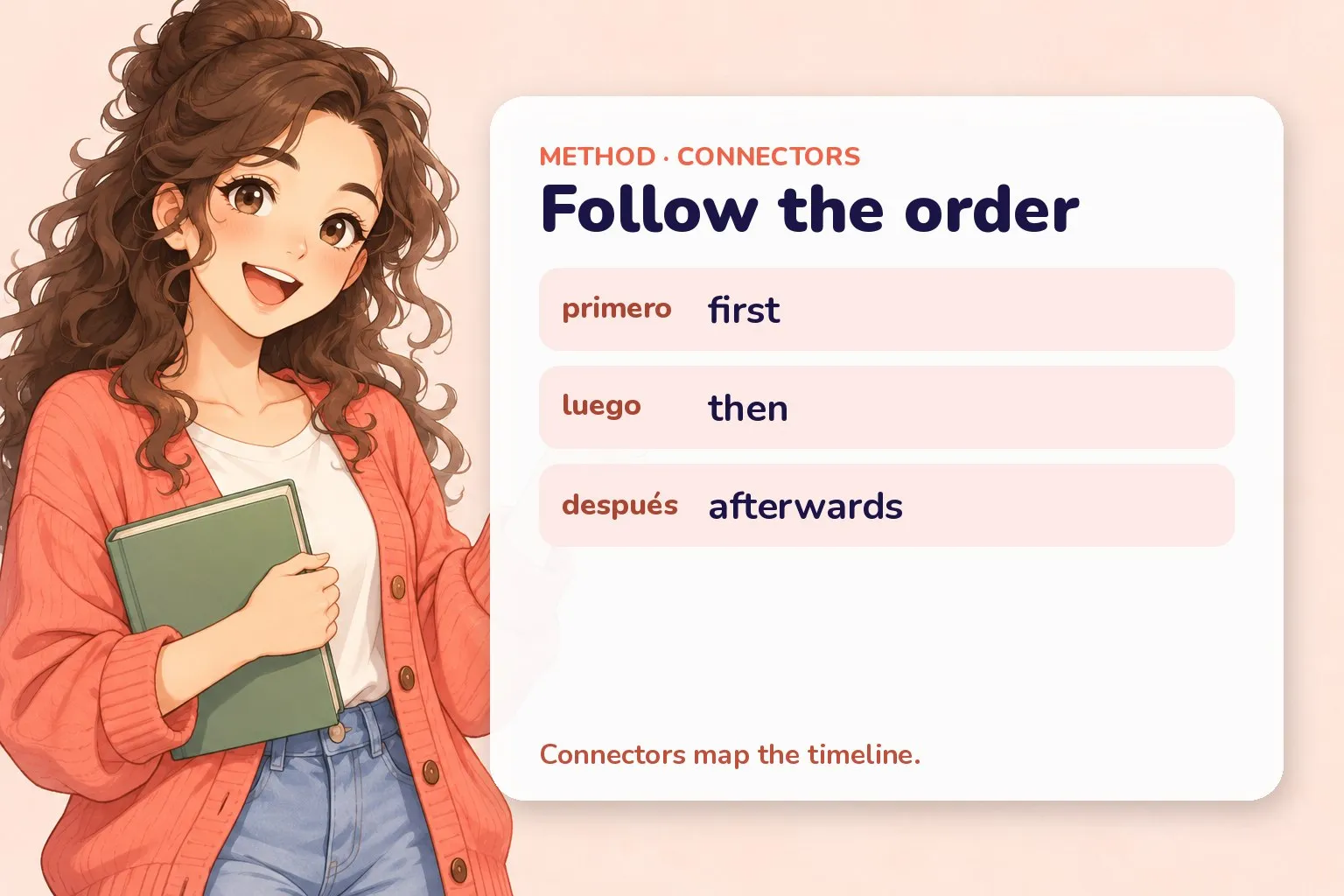
Keep the same three habits as at beginner level, with one addition: track the connectors. Words like primero (first), luego (then) and después (afterwards) carry the timeline, so spotting them tells you the sequence even before you know every word. The verbs here are mostly in the simple past (preterite), which at A2 you can recognise from endings like -é and -ó.
The graded text
Read this short account of a weekend one line at a time. Each line shows the Spanish and the English; tap play to hear it.
- El sábado pasado fui a la playa con mi hermana.Last Saturday I went to the beach with my sister.preterite: fui = 'I went'
- Salimos de casa muy temprano.We left home very early.
- Primero tomamos el autobús.First we took the bus.primero = 'first'
- Luego caminamos por la arena.Then we walked along the sand.luego = 'then'
- Hacía mucho sol, así que nadamos un rato.It was very sunny, so we swam for a while.
- Después comimos un bocadillo cerca del mar.Afterwards we ate a sandwich near the sea.después = 'afterwards'
- Mi hermana compró un helado de fresa.My sister bought a strawberry ice cream.
- Por la tarde volvimos a casa en tren.In the afternoon we went back home by train.
- Estábamos un poco cansados, pero muy contentos.We were a little tired, but very happy.pero = 'but'
- Quiero volver a la playa el próximo verano.I want to go back to the beach next summer.
Key vocabulary
These are some of the most common elementary words in the text.
| Word | English |
|---|---|
| sábado | Saturday |
| playa | beach |
| temprano | early |
| autobús | bus |
| arena | sand |
| sol | sun |
| bocadillo | sandwich |
| helado | ice cream |
| tren | train |
| cansados | tired |
How to say it
Spanish spelling is regular; mind these few sounds in the text:
| Word | How to say it |
|---|---|
| playa | the ll/y sound: “PLA-ya”; the y like English y. |
| arena | tap the single r lightly: “a-RE-na”. |
| hacía | the h is silent: “a-THEE-a” (Spain) or “a-SEE-a” (Latin America). |
| bocadillo | c before a is a hard k; ll like y: “bo-ka-DEE-yo”. |
| helado | silent h, light tap on the l: “e-LA-do”. |
Check you understood
- Where did the writer go, and with whom? (To the beach, with their sister.)
- What did they do first? (Took the bus.)
- What did they eat near the sea? (A sandwich.)
- What did the sister buy? (A strawberry ice cream.)
- How did they feel on the way home? (A little tired, but very happy.)
Extension: read a little more every day
Once this passage feels easy, change the goal rather than the text at first: read it aloud for smooth rhythm, then cover the English and translate each line yourself, then retell the weekend from memory in your own short sentences. When you are ready for new material, choose A2 graded readers or simple blog-style diaries, and keep each session short.
Practice
Elementary reading practice
Try each one, then press Check. No sign-up, nothing is sent anywhere — it all runs in your browser.
Hint: p…
Show answer
primero — primero means 'first' and marks the first event.
3 Match each word with its meaning.
- playa
- autobús
- bocadillo
- helado
Show answer
- playa → beach
- autobús → bus
- bocadillo → sandwich
- helado → ice cream
These are common A2 words from the text.
Quick recap before you practise.
Quiz
Elementary reading quiz
7 questions · pick an answer and you'll see straight away if it's right.
-
Show answer
reread a short passage with a new goal each pass — Short connected texts, reread with a purpose, build elementary reading best.
-
Show answer
their sister — con mi hermana = 'with my sister'.
-
Show answer
then — luego means 'then', marking the next event.
-
Show answer
took the bus — Primero tomamos el autobús = 'first we took the bus'.
-
Show answer
sandwich — bocadillo means sandwich.
-
Show answer
a strawberry ice cream — compró un helado de fresa = 'bought a strawberry ice cream'.
-
Show answer
spelling is regular, so reading teaches pronunciation too — Because Spanish spelling is regular, reading aloud trains pronunciation at the same time.
Next
- Build the grammar behind the sentences in the Spanish grammar section
- Warm up with the beginner text first: Spanish Reading Practice: Beginner
- New here? Start with Start Learning Spanish Here
All Spanish practice topics
Vocabulary, pronunciation, phrases, practice and exam help, ordered by level. Pick a topic and go straight to it. New lessons go live every day, so topics marked Coming soon fill in over the next weeks.
Practice
A1 1 topics · 1 ready
A2 5 topics · 2 ready
- 02 How to Practise Spanish Listening
- 03 Spanish Reading Practice: Elementary You are here
- 04 Ser vs Estar Practice Set Coming soon
- 05 Spanish Accent (Tilde) Practice Coming soon
- 06 Gustar-Type Verbs Practice Coming soon
B1 6 topics · 2 ready
- 07 Shadowing to Improve Spanish Speaking
- 08 Spanish Reading Practice: Intermediate
- 09 How to Practise Spanish Writing Coming soon
- 10 Por vs Para Practice Set Coming soon
- 11 Preterite vs Imperfect Practice Coming soon
- 12 Spanish Commands Practice (tu/usted) Coming soon
B2 2 topics · 1 ready
- 13 Spanish Reading Practice: Upper-Intermediate
- 14 Spanish Subjunctive Practice Set Coming soon