Shadowing to Improve Spanish Speaking
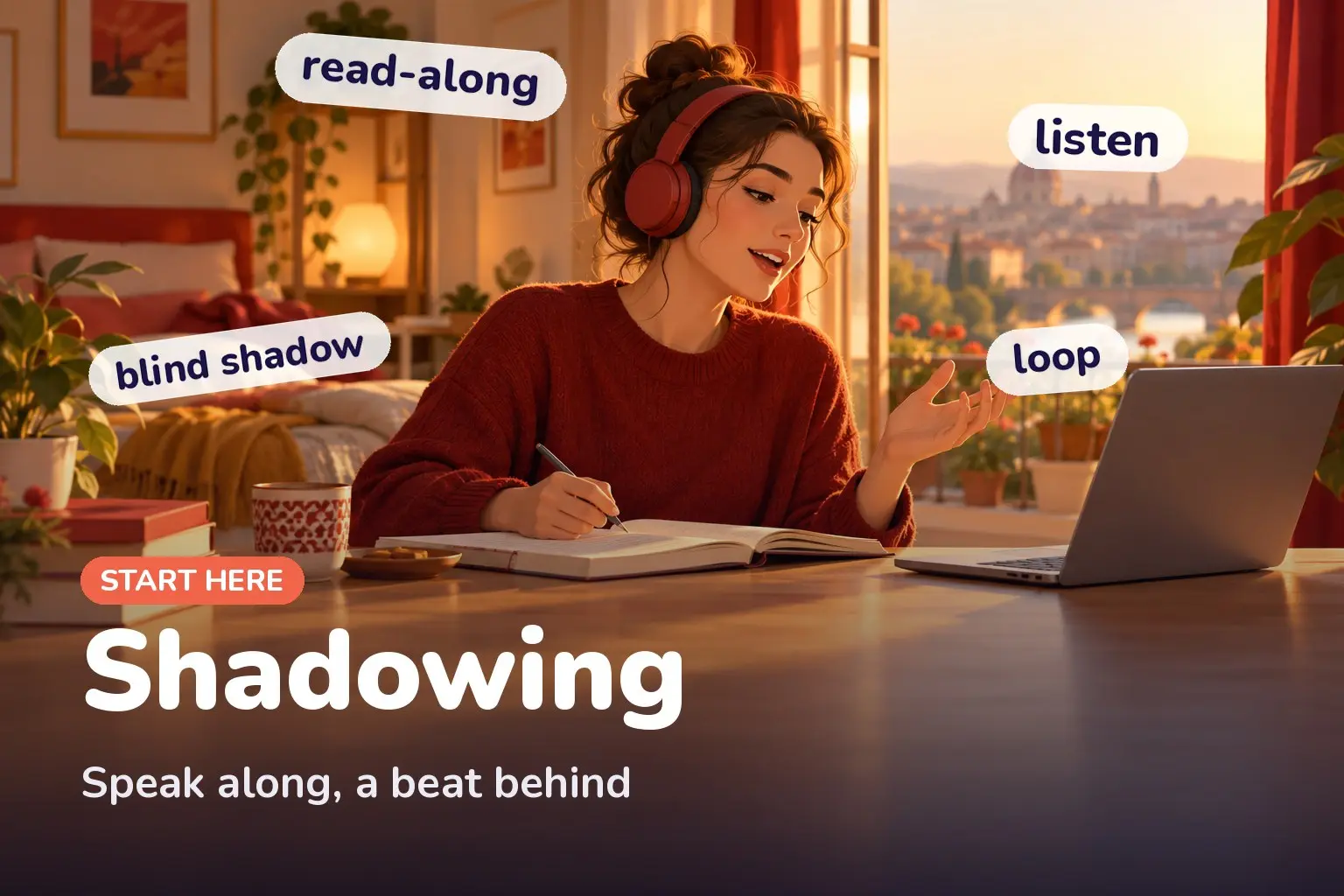
Shadowing means playing a short Spanish clip and speaking along almost in sync, copying its rhythm, stress and sounds. Done daily with material you already understand, it builds speed, clear pronunciation and natural phrasing.
Level: B1 (intermediate). Shadowing is one of the most efficient ways to turn the Spanish you understand into Spanish you can say quickly and clearly.
By the end of this page you can…
…run a short shadowing session on your own, pick good material, and avoid the three mistakes that make shadowing feel useless.
What shadowing is
Shadowing means listening to a short recording and speaking along at almost the same time — a beat behind the voice — copying its rhythm, stress and sounds as closely as you can. You are not repeating after a pause; you are tracking the voice live, like an echo.
It works because speaking fluently is a physical skill. You already know far more Spanish than you can say smoothly; shadowing trains your ears and mouth to produce it at natural speed, so grammar you “know” becomes grammar you can actually use in conversation.
Spanish rewards this especially well because it is syllable-timed — each syllable takes roughly the same length — and vowels link across word boundaries: su hermano flows as one smooth “su-ermano”, and la amiga becomes “lamiga”. Reading alone never teaches this flow; your ear and mouth have to.
How to shadow — step by step
- Pick a short clip (10–30 seconds) of clear, standard Spanish at a level you mostly understand. One paragraph of a lesson dialogue is plenty.
- Listen once without speaking. Make sure you understand every line.
- Read-along shadow. Play it again and speak along while reading the text, matching the timing. Do this three or four times.
- Blind shadow. Hide the text and shadow by ear, copying the melody of the voice, not just the words.
- Record yourself once and compare. Listen for where your rhythm or linking drifts from the model.
- Loop the hard spot. Pull out the one phrase that trips you and repeat just that until it is smooth.
Use the “Listen” button on the lines below (your device’s built-in voice) to try each step.
How to say it
A few sounds trip up English speakers in these sample lines:
| Sound | How to say it |
|---|---|
| rr / initial r | A rolled, trilled r: perro, río. A single r between vowels is a quick tap: pero. |
| j and g before e/i | A raspy “h” from the throat: trabajo = “tra-BA-ho”, gente = “HEN-teh”. |
| ll and y | Like the English y in yes: llamo = “YAH-mo”. |
| Linked vowels | Run vowels together across words: ¿cómo estás? = “CO-mwes-TAS”. |
Sample lines to shadow
Start slow, then build up speed. Each line was written for this lesson.
- Buenos días.Good morning.
- Hoy hace muy buen tiempo.The weather is really nice today.
- Perdone, ¿dónde está la estación?Excuse me, where is the station?link perdone-dónde smoothly
- ¿Puede hablar más despacio, por favor?Can you speak more slowly, please?
- Me llevo este, gracias.I'll take this one, thanks.
- ¿Lo puede repetir, por favor?Can you repeat that, please?
- ¿Qué haces el fin de semana?What do you do on the weekend?
- Fui al cine con unos amigos.I went to the cinema with some friends.con-unos-amigos links together
- Estaba un poco cansado, pero lo pasé genial.I was a little tired, but I had a great time.
- Nos vemos mañana.See you tomorrow.
Common pitfalls
- Shadowing material that is too hard. If you are decoding meaning while you speak, slow down or switch to easier audio.
- Repeating, not tracking. Waiting for a gap and then parroting is not shadowing. Speak while the voice speaks, a beat behind.
- Stressing like English. English stretches stressed syllables and swallows the rest; Spanish keeps syllables even. Copy the steady beat.
- Going too long. Attention fades fast. Several short reps on one passage beat one long, sloppy run.
A simple weekly routine
- Most days, 5–10 minutes: one short passage, steps 3–6 above.
- Twice a week: record and compare, then loop two problem phrases.
- Reuse, then refresh: keep a passage for several days until it is effortless, then swap in a new one from a finished lesson.
Pair this with high-frequency vocabulary so the sentences you shadow are also the ones you will reuse in conversation.
Practice
Shadowing practice check
Try each one, then press Check. No sign-up, nothing is sent anywhere — it all runs in your browser.
Hint: Not after a pause.
Show answer
along — You speak along with the voice in near real time, not after a pause.
3 Put the first steps in order.
Show answer
listen once read-along shadow blind shadow — Listen first, then shadow with the text, then shadow by ear.
4 Match each term with its meaning.
- syllable-timed
- vowel linking
- blind shadow
- loop
Show answer
- syllable-timed → each syllable takes similar length
- vowel linking → vowels join across words
- blind shadow → shadow without the text
- loop → repeat one hard phrase
These are the core ideas behind a Spanish shadowing session.
Quiz
Shadowing quiz
8 questions · pick an answer and you'll see straight away if it's right.
-
Show answer
Speaking along with a clip, a beat behind — You track the voice live, copying its rhythm and stress.
-
Show answer
10–30 seconds — Short clips keep your attention and let you loop the hard parts.
-
Show answer
So you drill real language, not noise — If you do not understand it, you are just drilling sounds without meaning.
-
Show answer
Spanish is syllable-timed and links vowels across words — Spanish keeps syllables even and links vowels (su hermano → su-ermano).
-
Show answer
Shadowing without reading the text — You drop the text and track the voice by ear.
-
Show answer
Mouthing along silently with no sound — Speaking out loud is what trains production; silent mouthing trains only listening.
-
Show answer
Short daily sessions — Short and daily beats long and rare for a physical skill.
-
Show answer
syllable — Spanish is syllable-timed, unlike stress-timed English.
Next
- Grammar backbone: the Spanish grammar section
- New here? Start with Start Learning Spanish Here
All Spanish practice topics
Vocabulary, pronunciation, phrases, practice and exam help, ordered by level. Pick a topic and go straight to it. New lessons go live every day, so topics marked Coming soon fill in over the next weeks.
Practice
A1 1 topics · 1 ready
A2 5 topics · 2 ready
- 02 How to Practise Spanish Listening
- 03 Spanish Reading Practice: Elementary
- 04 Ser vs Estar Practice Set Coming soon
- 05 Spanish Accent (Tilde) Practice Coming soon
- 06 Gustar-Type Verbs Practice Coming soon
B1 6 topics · 2 ready
- 07 Shadowing to Improve Spanish Speaking You are here
- 08 Spanish Reading Practice: Intermediate
- 09 How to Practise Spanish Writing Coming soon
- 10 Por vs Para Practice Set Coming soon
- 11 Preterite vs Imperfect Practice Coming soon
- 12 Spanish Commands Practice (tu/usted) Coming soon
B2 2 topics · 1 ready
- 13 Spanish Reading Practice: Upper-Intermediate
- 14 Spanish Subjunctive Practice Set Coming soon