Spanish Reading Practice: Upper-Intermediate
Upper-intermediate Spanish reading (B2) means short opinion essays that argue a case. The new skill is reading the subjunctive and advanced connectors: no creo que sea, aunque intenten, sin embargo and por lo tanto all shape the writer's stance.
Level: B2. Upper-intermediate reading is a real step up from intermediate: the text is now a short opinion essay, and the writer argues a case. The skill now is to follow the argument — and the subjunctive that colours it.
By the end of this page you can…
…read a short B2 opinion essay about mass tourism, recognise the subjunctive after doubt, necessity and concession, and answer questions about the writer’s position.
How to read an upper-intermediate text
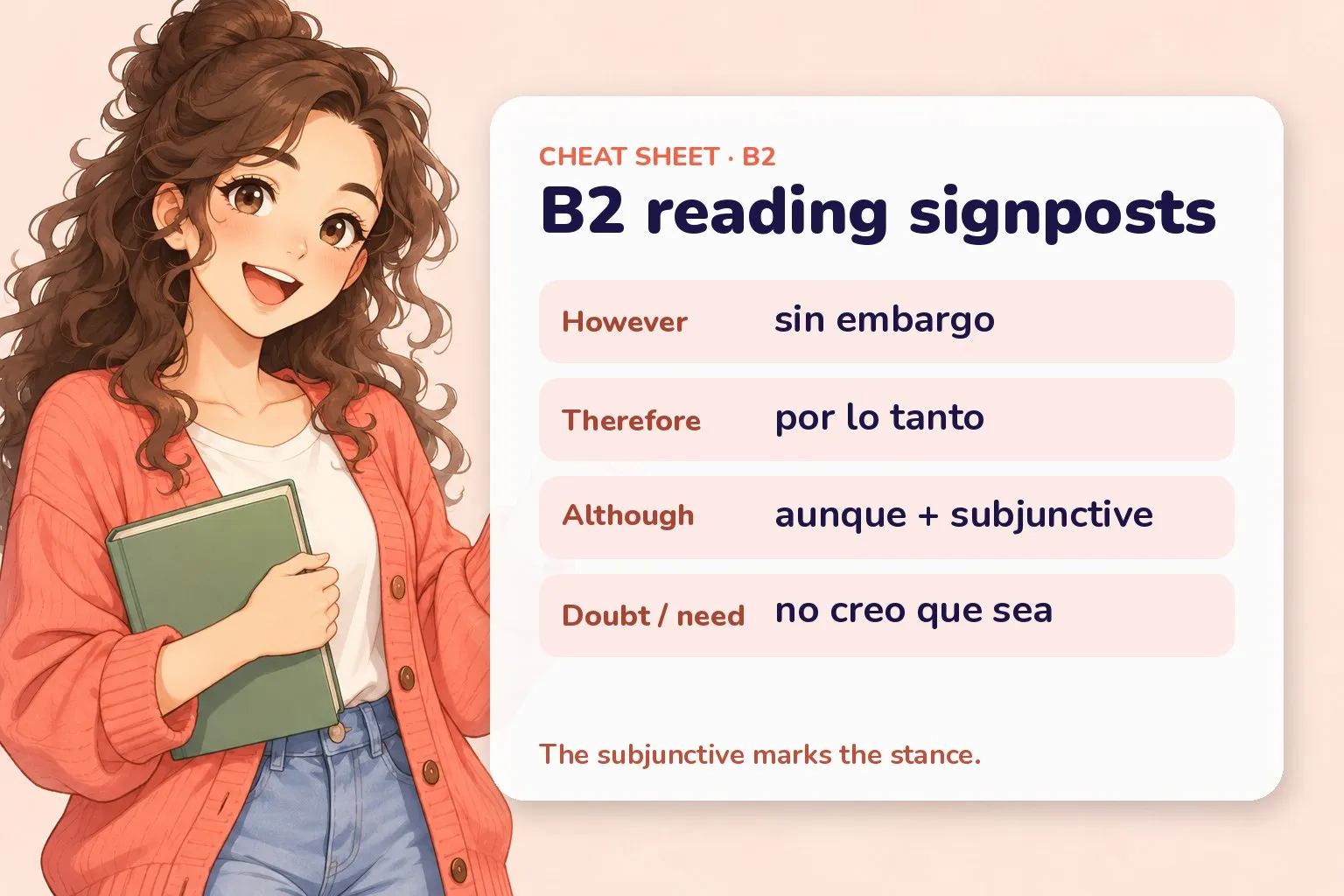
At this level, the argument runs on connectors and the subjunctive. Learn the signposts and a dense paragraph opens up: por un lado (“on the one hand”) and sin embargo (“however”) pivot between sides, por lo tanto (“therefore”) marks a conclusion, a pesar de (“despite”) concedes a point, and en definitiva (“in short”) sums up. The subjunctive appears after doubt, necessity and concession — no creo que sea (“I don’t think it is”), es necesario que exista (“it is necessary that there be”), aunque intenten (“although they try”) — so a verb like sea or exista is a signal, not a mistake. Watch, too, for the conditional pattern si + imperfect subjunctive … conditional: si respetara … mejoraría (“if it respected … it would improve”).
The graded text
Read this short essay one line at a time. Each line shows the Spanish and the English; tap play to hear it.
- En los últimos años, el turismo masivo se ha convertido en un tema polémico.In recent years, mass tourism has become a controversial topic.
- Por un lado, genera empleo y aporta ingresos importantes a muchas ciudades.On the one hand, it generates jobs and brings important income to many cities.por un lado = 'on the one hand'
- Sin embargo, no todo el mundo cree que sus efectos sean positivos.However, not everyone believes that its effects are positive.sean = subjunctive after no creer que
- En algunos barrios, los alquileres han subido tanto que los vecinos se ven obligados a marcharse.In some neighbourhoods, rents have risen so much that residents are forced to leave.
- Aunque las autoridades intenten regular el número de visitantes, el problema persiste.Although the authorities try to regulate the number of visitors, the problem persists.intenten = subjunctive after aunque
- Por lo tanto, es necesario que exista un equilibrio entre el turismo y la vida local.Therefore, it is necessary that there be a balance between tourism and local life.exista = subjunctive after es necesario que
- A pesar de los inconvenientes, sería injusto culpar únicamente a los turistas.Despite the drawbacks, it would be unfair to blame only the tourists.a pesar de = 'despite'; sería = conditional
- Muchos de ellos desconocen el impacto que su visita tiene en la comunidad.Many of them are unaware of the impact their visit has on the community.
- Quizás la solución pase por un turismo más responsable y sostenible.Perhaps the solution lies in more responsible and sustainable tourism.pase = subjunctive after quizás
- Si cada viajero respetara las costumbres locales, el ambiente mejoraría.If every traveller respected local customs, the atmosphere would improve.si + imperfect subjunctive … conditional
- En definitiva, el reto consiste en disfrutar del viaje sin perjudicar a quienes viven allí.In short, the challenge is to enjoy the trip without harming those who live there.en definitiva = 'in short'
Key vocabulary
These are some of the most useful upper-intermediate words in the essay.
| Word | English |
|---|---|
| turismo masivo | mass tourism |
| polémico | controversial |
| ingresos | income |
| alquiler | rent |
| vecino | resident, neighbour |
| autoridades | authorities |
| equilibrio | balance |
| sostenible | sustainable |
| reto | challenge |
| perjudicar | to harm |
How to say it
Spanish spelling is regular; mind these few sounds from the essay:
| Word | How to say it |
|---|---|
| polémico | stress the é: “po-LEH-mee-ko”. |
| alquiler | qu is a hard k: “al-kee-LEHR”. |
| vecino | v is a soft b, c before i is s/th: “be-SEE-no”. |
| quizás | qu is k, stress the á: “kee-SAHS”. |
Check you understood
- What has become a controversial topic? (Mass tourism, el turismo masivo.)
- What benefit of tourism does the writer admit? (It generates jobs and brings income.)
- What problem does the writer raise about some neighbourhoods? (Rents rise so much that residents must leave.)
- Does the writer blame the tourists alone? (No — many are unaware of their impact; it would be unfair.)
- What does the writer propose? (More responsible, sustainable tourism, and a balance.)
Extension: read a little more every day
Once this essay feels easy, change the goal rather than the text at first: read it aloud for smooth rhythm, then cover the English and translate each line, then summarise the writer’s argument in one sentence of your own. When you are ready for new material, choose B2 graded readers, newspaper opinion columns (artículos de opinión) or essay blogs, and keep each session short. If you want to warm up on something gentler first, revisit the intermediate reading passage.
Practice
Upper-intermediate reading practice
Try each one, then press Check. No sign-up, nothing is sent anywhere — it all runs in your browser.
Hint: sin e…
Show answer
sin embargo — sin embargo = 'however', pivoting to the opposing view.
3 Match each word with its meaning.
- ingresos
- alquiler
- sostenible
- reto
Show answer
- ingresos → income
- alquiler → rent
- sostenible → sustainable
- reto → challenge
These are common B2 words from the essay.
Quick recap before you practise.
Quiz
Upper-intermediate reading quiz
7 questions · pick an answer and you'll see straight away if it's right.
-
Show answer
reread a short essay with a new goal each pass — Reread a short argument with a purpose each pass: gist, the subjunctive, then the writer's stance.
-
Show answer
it generates jobs and income — genera empleo y aporta ingresos importantes = 'it generates jobs and brings important income'.
-
Show answer
however — sin embargo = 'however', a pivot to a contrasting idea.
-
Show answer
rents rise so much that residents must leave — los alquileres han subido tanto que los vecinos se ven obligados a marcharse.
-
Show answer
the subjunctive follows 'es necesario que' (necessity) — Necessity (es necesario que) triggers the subjunctive: exista.
-
Show answer
no — many are unaware, and it would be unfair — sería injusto culpar únicamente a los turistas; muchos desconocen el impacto.
-
Show answer
more responsible, sustainable tourism and a balance — un turismo más responsable y sostenible, y un equilibrio con la vida local.
Next
- Build the grammar behind the sentences in the Spanish grammar section
- Warm up with the intermediate text first: Spanish Reading Practice: Intermediate
- New here? Start with Start Learning Spanish Here
All Spanish practice topics
Vocabulary, pronunciation, phrases, practice and exam help, ordered by level. Pick a topic and go straight to it. New lessons go live every day, so topics marked Coming soon fill in over the next weeks.
Practice
A1 1 topics · 1 ready
A2 5 topics · 2 ready
- 02 How to Practise Spanish Listening
- 03 Spanish Reading Practice: Elementary
- 04 Ser vs Estar Practice Set Coming soon
- 05 Spanish Accent (Tilde) Practice Coming soon
- 06 Gustar-Type Verbs Practice Coming soon
B1 6 topics · 2 ready
- 07 Shadowing to Improve Spanish Speaking
- 08 Spanish Reading Practice: Intermediate
- 09 How to Practise Spanish Writing Coming soon
- 10 Por vs Para Practice Set Coming soon
- 11 Preterite vs Imperfect Practice Coming soon
- 12 Spanish Commands Practice (tu/usted) Coming soon
B2 2 topics · 1 ready
- 13 Spanish Reading Practice: Upper-Intermediate You are here
- 14 Spanish Subjunctive Practice Set Coming soon