Katakana Reading & Writing Practice
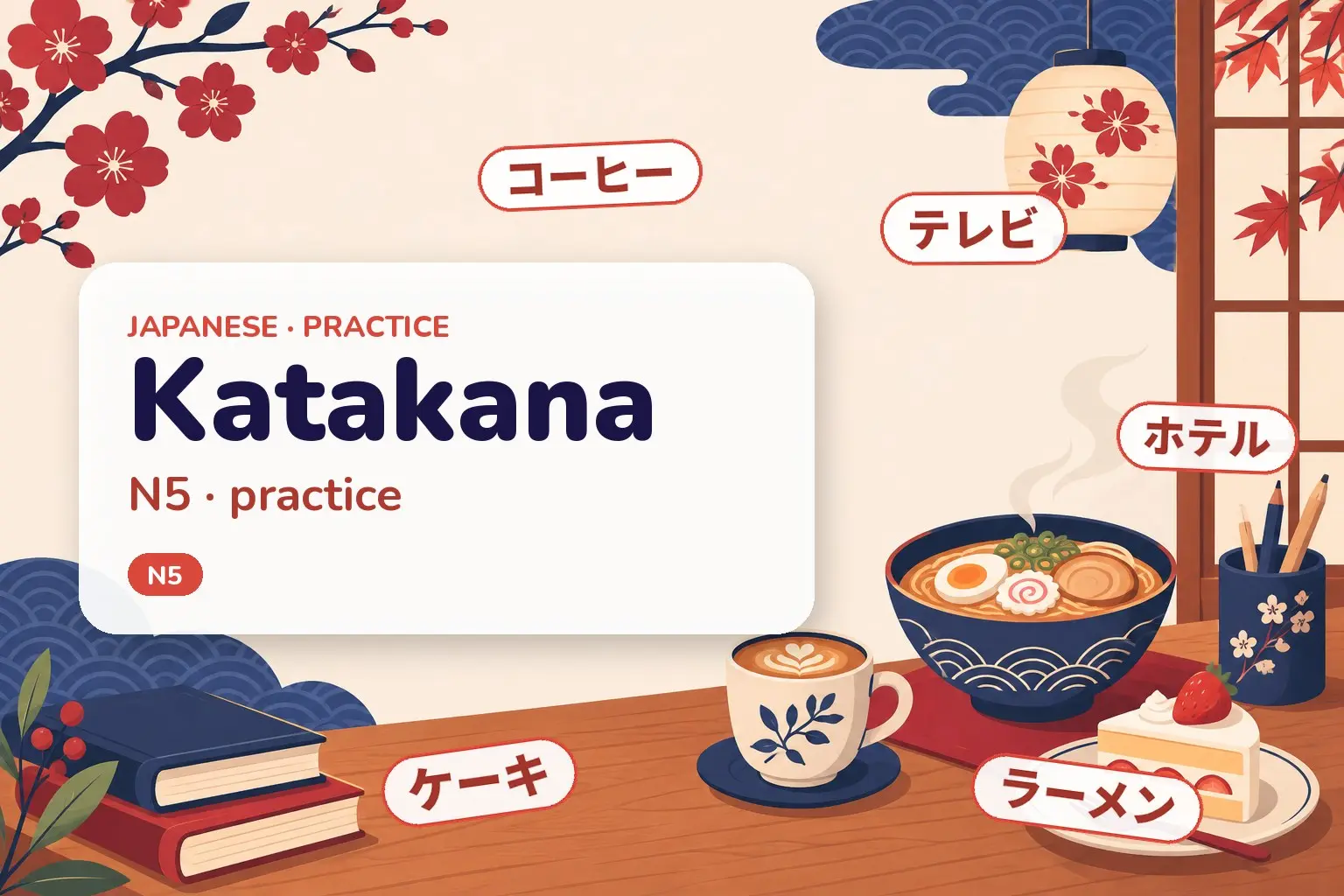
To make katakana automatic, read real loanwords at speed and write each kana from memory by stroke order. The two things beginners miss are the long-vowel mark ー, as in コーヒー (kōhī, coffee), and the lookalike pairs シ (shi) / ツ (tsu) and ソ (so) / ン (n).
Level: N5. You have met the katakana chart; now you make it automatic. Katakana is the script Japanese uses for words borrowed from other languages, so the fastest practice is reading real loanwords — most of them you can already half-recognise. This page is drills, not a new chart: loanword reading, the two marks beginners miss, the lookalike kana, and a quiz. Keep the complete katakana chart open if you are still learning the shapes.
By the end of this page you can…
…read common katakana loanwords at a glance, use the long-vowel mark ー (chōonpu) and the small ッ (tsu), tell the lookalike kana apart, and test yourself with the drills and quiz below.
Where katakana is used
Hiragana writes Japanese grammar and native words; katakana writes the rest. You will see it for:
- Loanwords (gairaigo): テレビ (terebi, “TV”), パン (pan, “bread”), コーヒー (kōhī, “coffee”).
- Foreign names and places: アメリカ (Amerika, “America”), ジョン (Jon, “John”).
- Onomatopoeia and emphasis: katakana can stand in for italics to make a word pop.
Because the words are borrowed, reading katakana is often a guessing game you can win: sound it out and the English word usually appears.
The two marks beginners miss
Two small marks change how a katakana word sounds, and skipping them is the most common reading error.
| Mark | Name | What it does | Example | Reading |
|---|---|---|---|---|
| ー | long-vowel mark (chōonpu) | stretches the vowel before it | コーヒー | kōhī |
| ッ | small tsu | doubles the next consonant | ベッド | beddo |
The long bar ー (chōonpu) only appears in katakana. It lengthens whatever vowel comes before it: ケーキ (kēki, “cake”) holds the first “e”. The small ッ (tsu) works just as it does in hiragana, doubling the following consonant: ベッド (beddo, “bed”).
The lookalike kana
A handful of katakana look almost identical. The trick is the direction of the strokes, not the overall shape.
- シ (shi) and ツ (tsu): シ (shi) has two short strokes that point sideways and a long stroke sweeping up from the bottom; ツ (tsu) has two short strokes on top and a stroke coming down.
- ソ (so) and ン (n): ソ (so) has a stroke coming down more vertically; ン (n) sweeps up from the bottom-left. Same split as shi/tsu — bottom-up means n or shi.
- ク (ku) and ケ (ke): ク (ku) is two strokes; ケ (ke) adds a third short stroke.
- ナ (na) and メ (me): ナ (na) is a cross shape; メ (me) is two crossing diagonals.
Read these loanwords aloud
Press play, then read each word back before you check the meaning. Mind the ー (chōonpu) and small ッ (tsu).
- コーヒーkōhīcoffeetwo long-vowel marks
- テレビterebitelevision
- ラーメンrāmenramenlong first vowel
- ホテルhoteruhotel
- タクシーtakushītaxilong final vowel
- ケーキkēkicake
- パンpanbreadfrom Portuguese pão
- カメラkameracamera
- バスbasubus
- ビールbīrubeer
- ベッドbeddobedsmall ッ doubles the d
- チョコレートchokorētochocolate
- アイスクリームaisukurīmuice cream
- スマホsumahosmartphoneclipped from sumātofon
- コンビニkonbiniconvenience store
- ピザpizapizza
A short daily routine
A routine you can keep beats a perfect plan you drop. One loop of about five minutes:
- Warm up (1 min): read one row of the chart aloud, e.g. カ キ ク ケ コ (ka ki ku ke ko).
- Reading sprint (1 min): read a 10-loanword list fast; mark any you stumbled on.
- Writing (2 min): cover the chart and write today’s row from memory, by stroke order.
- Lookalike drill (1 min): write シ (shi), ツ (tsu), ソ (so) and ン (n) side by side, saying each sound.
Practice
Katakana reading and writing practice
Try each one, then press Check. No sign-up, nothing is sent anywhere — it all runs in your browser.
Hint: you watch it
Show answer
television — テレビ (terebi) is 'television'.
4 Match each kana to its sound.
- シ (shi)
- ツ (tsu)
- ソ (so)
- ン (n)
Show answer
- シ (shi) → shi
- ツ (tsu) → tsu
- ソ (so) → so
- ン (n) → n
The lookalikes differ by stroke direction: up-from-bottom is シ (shi) or ン (n).
5 Put the katakana of 'ramen' in order.
Show answer
ラ (ra) ー (long mark) メ (me) ン (n) — ラーメン (rāmen): ラ (ra) + long mark + メ (me) + ン (n).
Hint: ベッド (beddo)
Show answer
doubles — The small ッ (tsu) doubles the following consonant: ベッド (beddo).
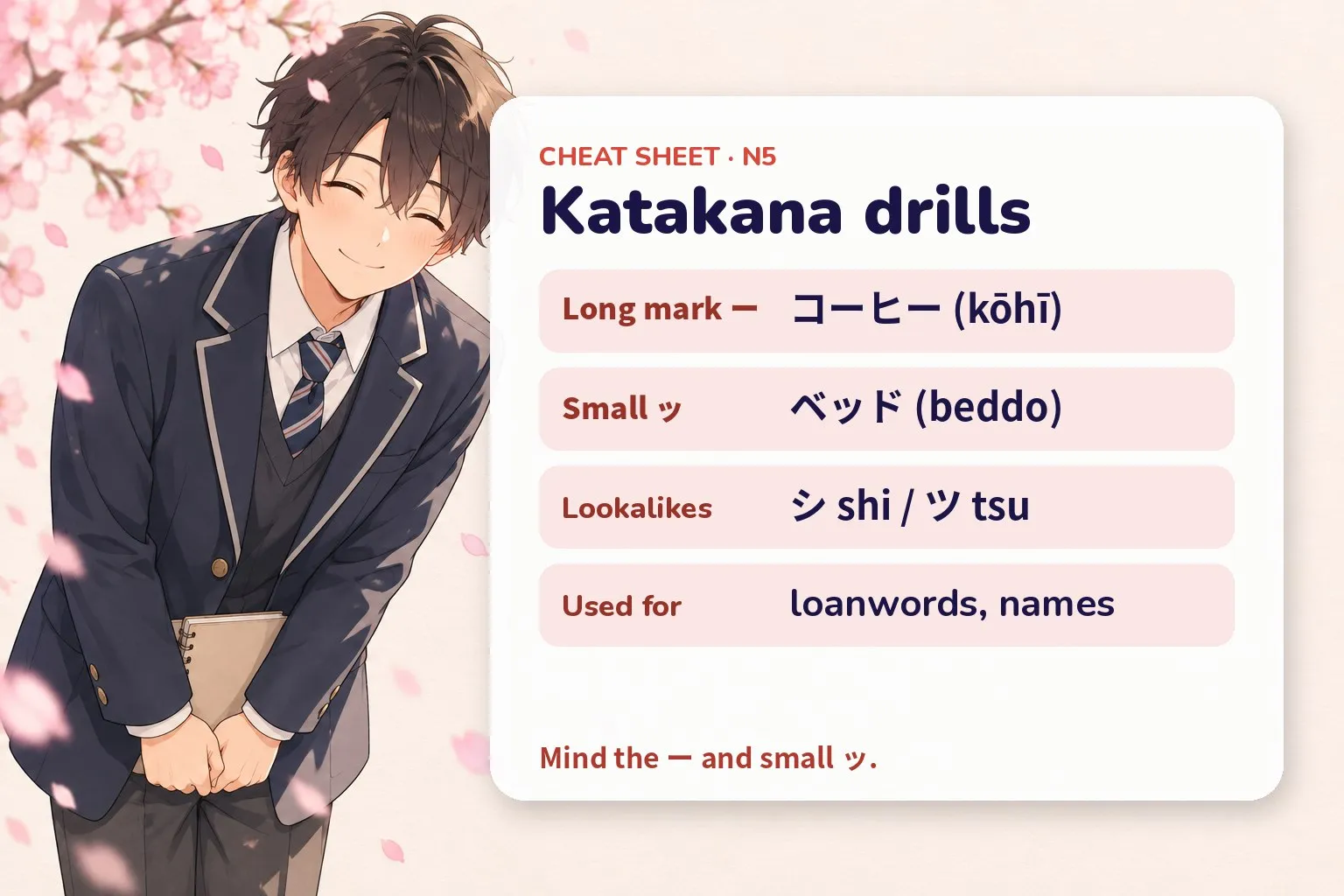
Quick recap before the quiz.
Quiz
Katakana practice quiz
8 questions · pick an answer and you'll see straight away if it's right.
-
Show answer
loanwords and foreign names — Katakana writes borrowed words, foreign names and emphasis.
-
Show answer
only in katakana — The ー (chōonpu) bar is a katakana mark.
-
Show answer
ケーキ (kēki) — ケーキ (kēki), with a long first vowel, is 'cake'.
-
Show answer
doubles the following consonant — The small ッ (tsu) doubles the next consonant: beddo.
-
Show answer
シ (shi) and ツ (tsu) — シ (shi) and ツ (tsu) differ by stroke direction.
-
Show answer
by the direction of the last stroke — Up-from-the-bottom is シ (shi); down-from-the-top is ツ (tsu).
-
Show answer
アイスクリーム (aisukurīmu) — アイスクリーム (aisukurīmu) is 'ice cream'.
-
Show answer
hotel — ホテル (hoteru) is 'hotel'.
Next
- Still learning the shapes? Use the complete katakana chart
- Drill the other syllabary with hiragana reading and writing practice
- Start your first sentences in the Japanese grammar section or at Start Learning Japanese Here
All Japanese practice topics
Vocabulary, pronunciation, phrases, practice and exam help, ordered by level. Pick a topic and go straight to it. New lessons go live every day, so topics marked Coming soon fill in over the next weeks.
Practice
N5 3 topics · 3 ready
- 01 Japanese Reading Practice: Beginner
- 02 Hiragana Reading & Writing Practice
- 03 Katakana Reading & Writing Practice You are here
N4 4 topics · 2 ready
- 04 How to Practise Japanese Listening
- 05 Japanese Reading Practice: Elementary
- 06 Japanese Particles Review Set Coming soon
- 07 Sentence-Ending Particles Practice Coming soon
N3 4 topics · 3 ready
- 08 Shadowing to Improve Japanese Speaking
- 09 Japanese Reading Practice: Intermediate
- 10 How to Practise Japanese Writing
- 11 Giving & Receiving (ageru/kureru/morau) Practice Coming soon
N2 2 topics · 1 ready
- 12 Japanese Reading Practice: Upper-Intermediate
- 13 Japanese Keigo Practice Set Coming soon