Hiragana Reading & Writing Practice
To lock in hiragana, split practice in two: read kana at speed until you no longer sound them out, and write each one by stroke order from memory. Short daily drills plus the quiz below beat one long session, and the tricky lookalikes need the most repetition.
Level: N5. You have met the hiragana chart; now you make the 46 kana automatic. This page is a practice routine, not a new lesson: fast reading drills, a stroke-order writing worksheet, memory tricks for the ones that trip everyone up, and a quiz. If you are still learning the shapes, keep the complete hiragana chart open beside you.
By the end of this page you can…
…read common hiragana words at a glance, write each kana from memory by stroke order, tell the lookalike kana apart, and test yourself with the drills and quiz below.
Two skills, two drills
Reading and writing feel like one thing but they are not. Reading is recognition: you see か (ka) and the sound comes. Writing is recall: you hear “ka” and must produce the shape. Recognition grows faster, so most learners can read a kana weeks before they can write it cleanly. Drill them separately.
- Reading drill: go through a row of kana or a short word list as fast as you can say each sound aloud. Repeat until there is no pause. Speed is the goal — if you are sounding out, keep going.
- Writing drill: cover the chart, then write each kana from memory in a grid, always by correct stroke order. Check against the chart, mark the ones you missed, and rewrite only those.
Stroke order matters
Every kana has a fixed stroke order — the sequence and direction of each pen stroke. The two rules that cover almost all kana are top to bottom and left to right. Writing in the right order is not fussiness: it makes your kana faster to write, easier to read, and far easier to remember, because the hand learns a single motion for each shape.
| Kana | Reading | Strokes | Watch out for |
|---|---|---|---|
| あ | a | 3 | the loop comes last |
| き | ki | 4 | two short top strokes, then the curve |
| さ | sa | 3 | one connected lower curve |
| す | su | 2 | the loop sits below the cross |
| な | na | 4 | the loop is the final stroke |
| ふ | fu | 4 | four separate small strokes |
Memory tricks for the shapes
Mnemonics turn an abstract shape into a picture. Use these, or invent your own — a trick you make yourself sticks best.
- き (ki) looks like a key — and it even sounds like “key”.
- さ (sa) — picture a person surfing a single wave (one connected curve).
- の (no) is a no-entry swirl: “no”.
- め (me) has a loop like an eye, and in Japanese 目 (me) means “eye”.
- ね (ne) has a loop like a cat’s tail curling.
Read these words aloud
Press play, then read each word back before you look at the meaning. These use only plain hiragana and are among the most common beginner words.
- あおaoblue
- いえiehouse
- うみumisea
- えきekistation
- おかねokanemoney
- かさkasaumbrellacontrast か (ka) and さ (sa)
- きってkittepostage stampsmall っ doubles the next sound
- くつkutsushoes
- ねこnekocatね (ne), not れ (re)
- はなhanaflower / nose
- ほしhoshistarほ (ho), not は (ha)
- みずmizuwater
- やまyamamountain
- ゆきyukisnow
- わたしwatashiI / meわ (wa), not ね (ne) or れ (re)
A five-minute daily routine
A routine you can keep beats a perfect plan you drop. One suggested loop:
- Warm up (1 min): read one row of the chart aloud, e.g. か き く け こ (ka ki ku ke ko).
- Reading sprint (1 min): read a 10-word list as fast as you can; note any you stumbled on.
- Writing (2 min): cover the chart and write today’s row from memory, by stroke order.
- Miss list (1 min): rewrite only the kana you got wrong, three times each, saying the sound aloud.
Practice
Hiragana reading and writing practice
Try each one, then press Check. No sign-up, nothing is sent anywhere — it all runs in your browser.
Hint: a common pet
Show answer
neko — ね (ne) + こ (ko) = neko, 'cat'.
4 Match each kana to its sound.
- は (ha)
- ほ (ho)
- ね (ne)
- わ (wa)
Show answer
- は (ha) → ha
- ほ (ho) → ho
- ね (ne) → ne
- わ (wa) → wa
ほ (ho) has an extra top bar は (ha) lacks; わ (wa) and ね (ne) differ in the final stroke.
5 Put the strokes of a kana in the usual direction.
Show answer
top middle bottom — The main rule is top to bottom (and left to right).
Hint: you climb it
Show answer
yama — や (ya) + ま (ma) = yama, 'mountain'.
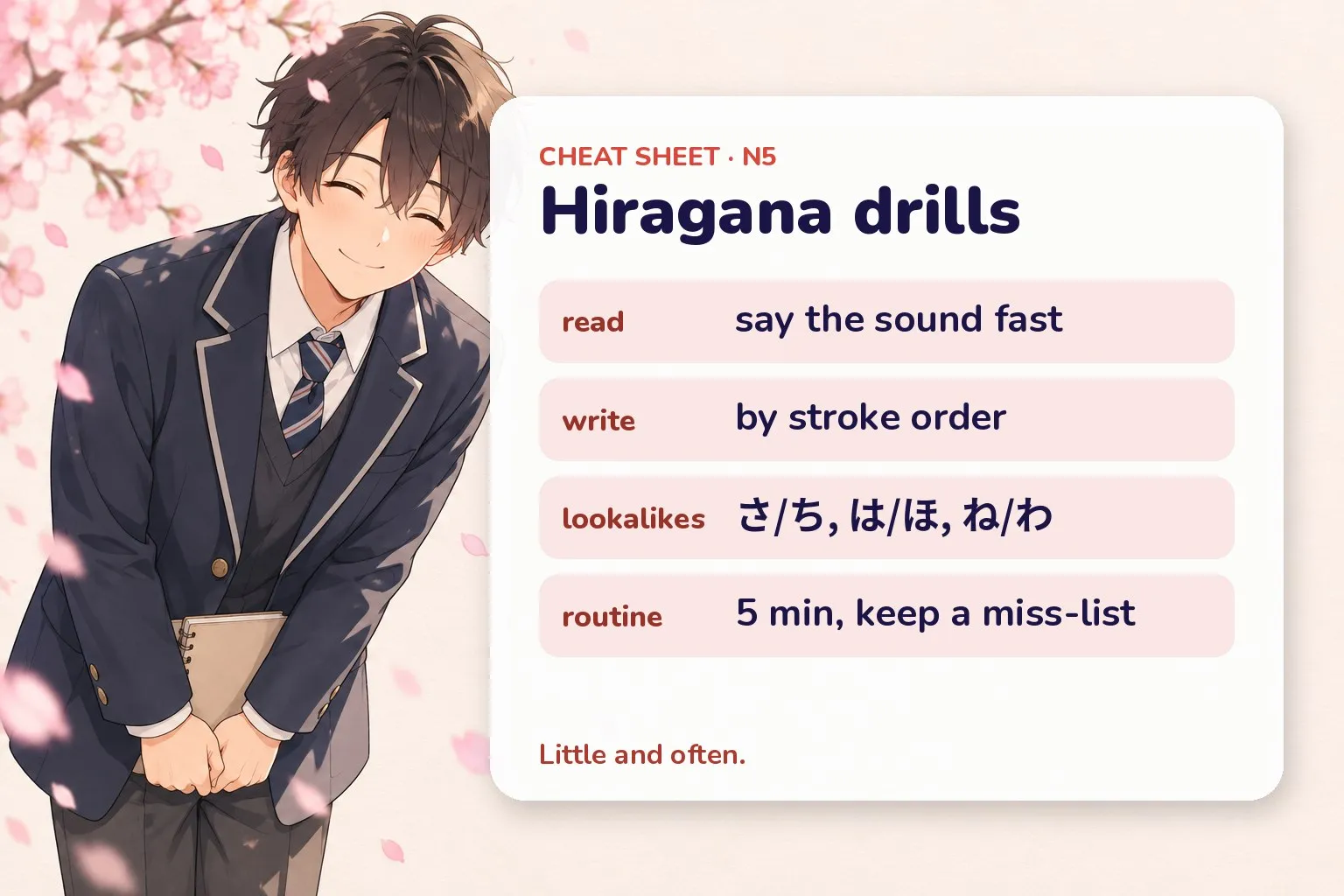
Quick recap before the quiz.
Quiz
Hiragana practice quiz
8 questions · pick an answer and you'll see straight away if it's right.
-
Show answer
two skills worth drilling separately — Reading is recognition; writing is recall. Drill both.
-
Show answer
top to bottom, left to right — Top to bottom and left to right cover almost every kana.
-
Show answer
さ (sa) — さ (sa); ち (chi) curves the other way.
-
Show answer
doubles the next consonant sound — The small っ (tsu) doubles the following sound: kitte.
-
Show answer
ねこ (neko) — ねこ (neko), with ね (ne), means 'cat'.
-
Show answer
it has an extra top bar — ほ (ho) has an extra top stroke that は (ha) does not.
-
Show answer
write from memory by stroke order, then check — Recall means producing the shape from memory, then checking against the chart.
-
Show answer
mizu — み (mi) + ず (zu) = mizu, 'water'.
Next
- Still learning the shapes? Use the complete hiragana chart
- Build longer writing with the guide to practising Japanese writing
- Start your first sentences in the Japanese grammar section or at Start Learning Japanese Here
All Japanese practice topics
Vocabulary, pronunciation, phrases, practice and exam help, ordered by level. Pick a topic and go straight to it. New lessons go live every day, so topics marked Coming soon fill in over the next weeks.
Practice
N5 3 topics · 3 ready
- 01 Japanese Reading Practice: Beginner
- 02 Hiragana Reading & Writing Practice You are here
- 03 Katakana Reading & Writing Practice
N4 4 topics · 2 ready
- 04 How to Practise Japanese Listening
- 05 Japanese Reading Practice: Elementary
- 06 Japanese Particles Review Set Coming soon
- 07 Sentence-Ending Particles Practice Coming soon
N3 4 topics · 3 ready
- 08 Shadowing to Improve Japanese Speaking
- 09 Japanese Reading Practice: Intermediate
- 10 How to Practise Japanese Writing
- 11 Giving & Receiving (ageru/kureru/morau) Practice Coming soon
N2 2 topics · 1 ready
- 12 Japanese Reading Practice: Upper-Intermediate
- 13 Japanese Keigo Practice Set Coming soon