How to Practise Japanese Writing
To practise Japanese writing, work up in steps: copy and adapt model sentences, then join them into short paragraphs, and after every piece run a feedback loop — compare your text with a correct model, mark the gaps, and rewrite. Little and often beats one long session.
Level: N3. Writing is the skill learners avoid longest, because it exposes every gap at once: grammar, kanji, word choice and word order. The cure is not talent but a routine — small, finished pieces that you correct and rewrite. This page gives you one.
By the end of this page you can…
…build Japanese writing up from sentences to paragraphs, run a feedback loop that actually fixes your mistakes, use model texts to sound more natural, and keep a routine you can sustain.
Writing is an output skill
Reading and listening are input; writing is output, and output shows you what you can actually produce, not just recognise. That is why it feels hard — and why it is the fastest way to find your real gaps. Every time you cannot write a word you thought you knew, you have found something worth studying.
Two kinds of writing practice help in different ways. Handwriting reinforces stroke order and helps kanji stick. Typing teaches the other half of modern Japanese: entering kana and choosing the right kanji from the IME candidate list — a skill in itself, because the wrong homophone is a classic error.
Build up in steps
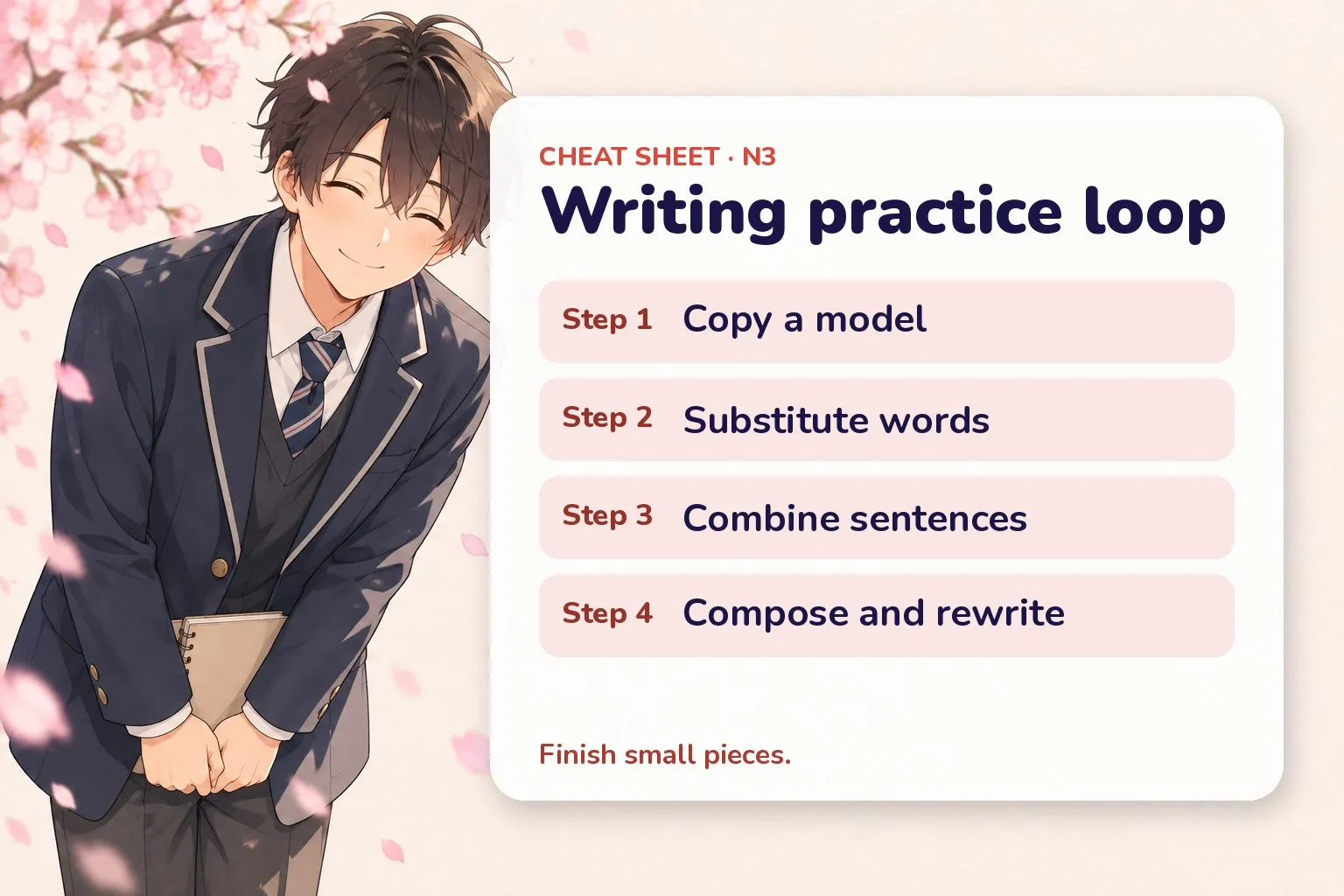
Do not jump straight to free writing. Climb a ladder:
- Copy a correct model sentence exactly, kana and kanji included.
- Substitute — swap one word for another you know: change the place, the time, the object.
- Combine two short sentences into one with a connector such as が (ga, “but”) or から (kara, “because”).
- Compose a short paragraph of four to six sentences on a familiar topic: your day, your town, your weekend.
Each rung reuses the grammar you are currently studying, so writing doubles as review.
The feedback loop
Writing without correction just drills your mistakes. After each piece:
- Write your short text.
- Compare it line by line with a correct model or a corrected version.
- Mark every difference — a wrong particle, a missing です (desu), an unnatural word order — not only outright errors.
- Rewrite the whole piece correctly. The rewrite is where the learning lands.
Learn from model answers
Imitation is not cheating — it is how you absorb natural phrasing. Keep a small bank of correct model texts at your level (a diary entry, a self-introduction, an email) and reuse their patterns with your own content. The example sentences below are model lines you can copy and adapt; each has a reading so you can say it as you write it.
- 今日は いい 天気です。Kyō wa ii tenki desu.Today the weather is nice.a simple opening line
- 朝 七時に 起きました。Asa shichi-ji ni okimashita.I got up at seven in the morning.
- 友達と 図書館で 勉強しました。Tomodachi to toshokan de benkyō shimashita.I studied at the library with a friend.
- お昼に ラーメンを 食べました。Ohiru ni rāmen o tabemashita.I ate ramen for lunch.
- 少し 疲れましたが、楽しかったです。Sukoshi tsukaremashita ga, tanoshikatta desu.I got a little tired, but it was fun.が (ga) joins two ideas
- 明日は 休みだから、ゆっくりします。Ashita wa yasumi dakara, yukkuri shimasu.Tomorrow is a day off, so I'll relax.から (kara) = because/so
- 私の 町は 小さいですが、静かです。Watashi no machi wa chiisai desu ga, shizuka desu.My town is small, but it's quiet.
- 週末に 映画を 見たいです。Shūmatsu ni eiga o mitai desu.I want to watch a film at the weekend.
- 最近 日本語を 勉強しています。Saikin nihongo o benkyō shite imasu.Lately I have been studying Japanese.
- 毎日 少しずつ 書く 練習を します。Mainichi sukoshi zutsu kaku renshū o shimasu.I practise writing a little every day.
A weekly writing routine
- Three short pieces a week, five to six sentences each, beat one long piece.
- Reuse this week’s grammar. If you are studying a particle or a verb form, build your sentences around it.
- Mine a frequency list. The high-frequency words (for example the FrequencyWords lists) tell you which vocabulary is worth drilling into your writing first.
- Keep a correction log. Write each mistake and its fix in one place; review it before the next piece so the same error does not return.
Common writing mistakes
- Dropping or confusing particles. は (wa), が (ga), を (o) and に (ni) carry the grammar; a missing or wrong particle changes the meaning. Check them on every sentence.
- Picking the wrong kanji from the IME. Homophones such as 聞く (kiku, “to listen”) and 効く (kiku, “to take effect”) look tempting in the candidate list — read each option before you confirm it.
- Mixing polite and plain styles. Keep one style within a piece: either です・ます (desu / masu) throughout, or the plain form throughout, not both.
- Over-using わたし (watashi). Japanese drops the subject when it is clear; starting every sentence with 私は (watashi wa) reads unnaturally.
Practice
Japanese writing-strategy practice
Try each one, then press Check. No sign-up, nothing is sent anywhere — it all runs in your browser.
2 Put the build-up ladder in order.
Show answer
copy a model sentence substitute a word combine two sentences compose a paragraph — Copy, substitute, combine, then compose.
Hint: the opposite of recognise
Show answer
produce — Writing is an output skill: it reveals what you can actively produce.
5 Match each writing habit to its benefit.
- handwriting
- feedback loop
- model texts
- correction log
Show answer
- handwriting → reinforces stroke order and kanji
- feedback loop → fixes mistakes instead of drilling them
- model texts → teach natural phrasing
- correction log → stops errors from returning
Each habit targets a different part of better writing.
Quick recap before you practise.
Quiz
Japanese writing quiz
8 questions · pick an answer and you'll see straight away if it's right.
-
Show answer
output skill — Writing is output: it shows what you can actively produce.
-
Show answer
copy a correct model sentence — Copying correct models teaches natural structure before you compose.
-
Show answer
write, compare, mark, rewrite — Compare your text with a model, mark the gaps, and rewrite.
-
Show answer
stroke order and kanji recall — Writing by hand reinforces stroke order and helps kanji stick.
-
Show answer
a finished five to six sentences — Short, finished, corrected pieces teach the most.
-
Show answer
reuse the grammar and vocabulary you are currently learning — Reusing current grammar and vocabulary turns writing into review.
-
Show answer
choosing the wrong kanji homophone — Homophones in the IME list are easy to pick wrongly — read each option.
-
Show answer
to review past mistakes so they do not return — Reviewing logged mistakes stops the same error coming back.
Next
- Pair it with input: how to practise Japanese reading
- Train your ear too: how to practise Japanese listening
- Sharpen output aloud with shadowing
- Build the grammar you will write with in the Japanese grammar section
- New here? Start with Start Learning Japanese Here
All Japanese practice topics
Vocabulary, pronunciation, phrases, practice and exam help, ordered by level. Pick a topic and go straight to it. New lessons go live every day, so topics marked Coming soon fill in over the next weeks.
Practice
N5 3 topics · 1 ready
- 01 Japanese Reading Practice: Beginner
- 02 Hiragana Reading & Writing Practice Coming soon
- 03 Katakana Reading & Writing Practice Coming soon
N4 4 topics · 2 ready
- 04 How to Practise Japanese Listening
- 05 Japanese Reading Practice: Elementary
- 06 Japanese Particles Review Set Coming soon
- 07 Sentence-Ending Particles Practice Coming soon
N3 4 topics · 3 ready
- 08 Shadowing to Improve Japanese Speaking
- 09 Japanese Reading Practice: Intermediate
- 10 How to Practise Japanese Writing You are here
- 11 Giving & Receiving (ageru/kureru/morau) Practice Coming soon
N2 2 topics · 1 ready
- 12 Japanese Reading Practice: Upper-Intermediate
- 13 Japanese Keigo Practice Set Coming soon