How to Practise Chinese Writing
Practise Chinese writing in layers: get the characters right with stroke order and radicals, write short subject-verb-object sentences, then link them with connectors like 然后 (ránhòu, then) and 因为 (yīnwèi, because), checking each piece against a model.
Level: HSK 3. Chinese writing has two layers English does not: the characters themselves, and the sentences you build from them. Treat them as separate skills. Drill characters so your hand and eye know them, then compose sentences and paragraphs with a small, reliable set of patterns. This page gives you a method you can repeat on any topic.
By the end of this page you can…
…run a short Chinese writing session: get your characters right, write clear subject-verb-object sentences, link them with connectors, and check your work against a model.
Get the characters right first
Before you compose, spend a few minutes on the characters you will need. Two habits pay off:
- Stroke order. Writing strokes in the standard order (top to bottom, left to right) makes characters come out balanced and legible, and it helps you remember them. 我 (wǒ, I) and 是 (shì, to be) are worth drilling early because you use them constantly.
- Radicals. Most characters contain a radical, a component that hints at meaning: 口 (kǒu, mouth) appears in 吃 (chī, to eat) and 喝 (hē, to drink). Spotting radicals turns a wall of characters into recognisable parts.
Write short sentences, then join them
Chinese sentences follow subject-verb-object order: 我 (wǒ) + 喝 (hē) + 咖啡 (kāfēi) gives 我喝咖啡 (wǒ hē kāfēi), I drink coffee. Start with short, true sentences in that order, then link them with connectors (guānlián cí):
- 然后 (ránhòu) — then / after that
- 因为 (yīnwèi) … 所以 (suǒyǐ) … — because … so …
- 但是 (dànshì) — but
- 而且 (érqiě) — and also / moreover
Build the model paragraph below one line at a time, reading each aloud with its pinyin.
Example sentences
- 我每天早上喝咖啡。Wǒ měitiān zǎoshang hē kāfēi.I drink coffee every morning.
- 然后我去上班。Ránhòu wǒ qù shàngbān.Then I go to work.然后 sequences the next action
- 因为我很忙,所以我没有时间。Yīnwèi wǒ hěn máng, suǒyǐ wǒ méiyǒu shíjiān.Because I'm busy, I don't have time.因为…所以 pairs cause and result
- 我想写字,但是我很累。Wǒ xiǎng xiězì, dànshì wǒ hěn lèi.I want to write, but I'm tired.但是 shows contrast
- 汉字很难,而且很多。Hànzì hěn nán, érqiě hěn duō.Characters are hard, and there are also many of them.而且 adds a second point
- 我每天写五个句子。Wǒ měitiān xiě wǔ gè jùzi.I write five sentences every day.
- 我先写,然后读一遍。Wǒ xiān xiě, ránhòu dú yí biàn.I write first, then read it once.
- 我的字很慢,但是很清楚。Wǒ de zì hěn màn, dànshì hěn qīngchu.My writing is slow, but it's clear.
Build a feedback loop
Characters you copy without checking just lock in errors. After each short piece, run a quick loop:
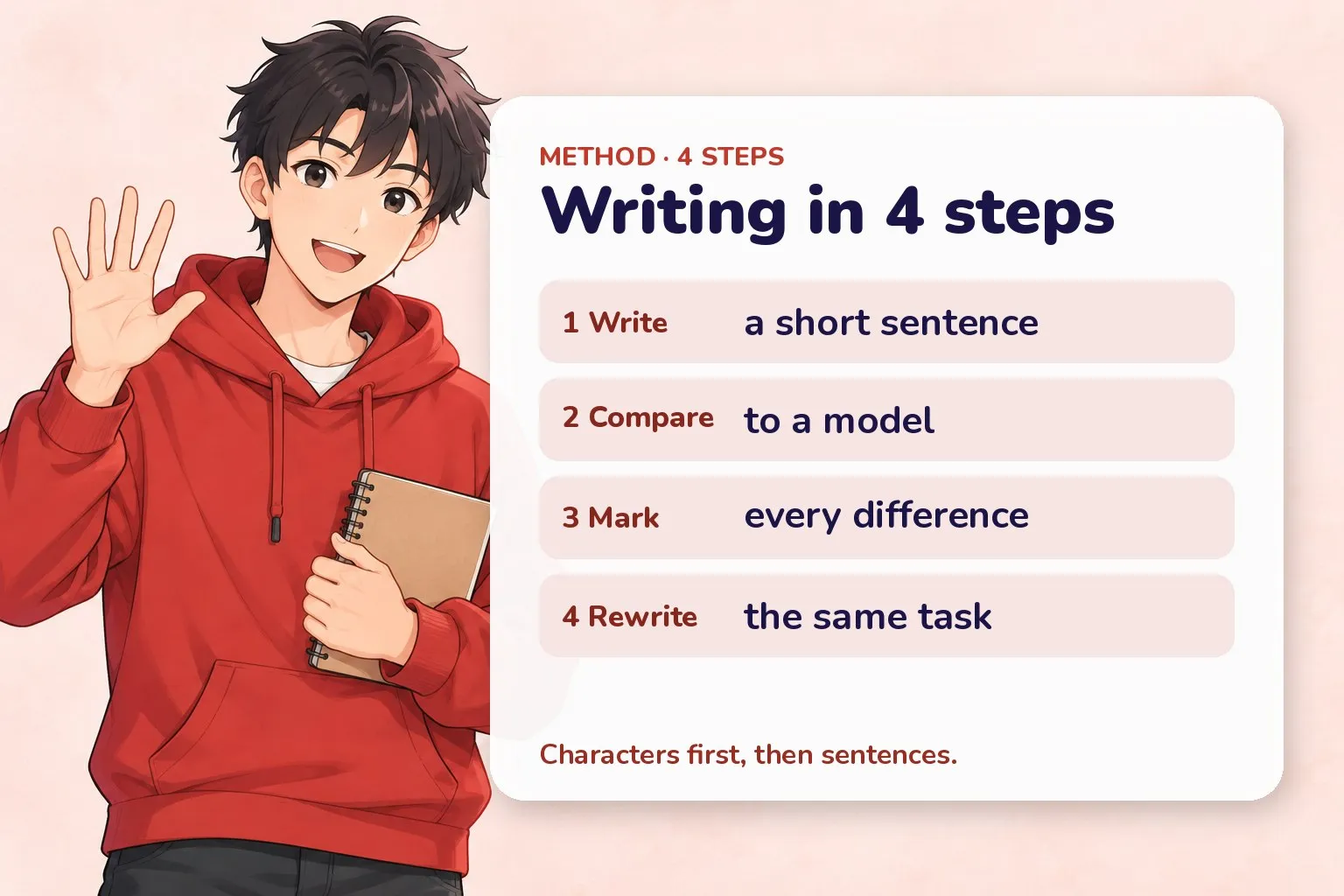
- Write the sentence or paragraph from the task.
- Compare it to a model — a lesson example, a graded reader, or a corrected version.
- Mark every difference: a wrong character, a missing connector, wrong word order.
- Rewrite the same task, fixing what you marked.
Write to model answers
A model answer is a short, correct text that does your task. Read it, cover it, write your own, then compare. Our reading practice passages and the sentences in each grammar lesson are good models because they are short and verified. Pair writing with shadowing so you can say the sentences you write.
Choose the words you reuse from a frequency list, so your practice builds the characters and words you will actually meet first.
Quick recap before you practise.
Practice
Chinese writing method practice
Try each one, then press Check. No sign-up, nothing is sent anywhere — it all runs in your browser.
Hint: it links one step to the next
Show answer
ránhòu — 然后 (ránhòu) means 'then / after that'.
4 Put the sentence in subject-verb-object order: 'I drink coffee.'
Show answer
我 (wǒ) 喝 (hē) 咖啡 (kāfēi) — Subject + verb + object: 我喝咖啡 (wǒ hē kāfēi).
5 Match each connector to its job.
- 然后 (ránhòu)
- 但是 (dànshì)
- 而且 (érqiě)
- 所以 (suǒyǐ)
Show answer
- 然后 (ránhòu) → then
- 但是 (dànshì) → but
- 而且 (érqiě) → and also
- 所以 (suǒyǐ) → so / therefore
然后 (ránhòu) then, 但是 (dànshì) but, 而且 (érqiě) and also, 所以 (suǒyǐ) so.
Quiz
Chinese writing practice quiz
8 questions · pick an answer and you'll see straight away if it's right.
-
Show answer
balanced, legible characters that are easier to remember — Standard stroke order makes characters balanced and memorable.
-
Show answer
a component that hints at meaning — Radicals like 口 (kǒu, mouth) hint at a character's meaning.
-
Show answer
subject-verb-object — Chinese is subject-verb-object: 我喝咖啡 (wǒ hē kāfēi).
-
Show answer
you must pick the right character from a pinyin list — Pinyin input shows a list; you must recognise the correct character.
-
Show answer
但是 (dànshì) — 但是 (dànshì) means 'but'.
-
Show answer
wrong characters vs wrong grammar — Character errors and grammar errors need different fixes.
-
Show answer
a short, correct text that does the same task — Short, correct, on-task models are easiest to learn from.
-
Show answer
a frequency list of common words — High-frequency words build the characters you meet first.
Next
- Read short model texts in Chinese reading practice
- Say what you write with shadowing practice
- New here? Start with Start Learning Chinese Here
All Chinese practice topics
Vocabulary, pronunciation, phrases, practice and exam help, ordered by level. Pick a topic and go straight to it. New lessons go live every day, so topics marked Coming soon fill in over the next weeks.
Practice
HSK 1 1 topics · 1 ready
HSK 2 4 topics · 2 ready
- 02 How to Practise Chinese Listening
- 03 Chinese Reading Practice: Elementary
- 04 Tone Pairs Practice Coming soon
- 05 The Particle 了 (le) Practice Coming soon
HSK 3 5 topics · 3 ready
- 06 Shadowing to Improve Chinese Speaking
- 07 Chinese Reading Practice: Intermediate
- 08 How to Practise Chinese Writing You are here
- 09 The 把 (bǎ) Construction Practice Coming soon
- 10 Resultative Complements Practice Coming soon