Chinese Reading Practice: Intermediate
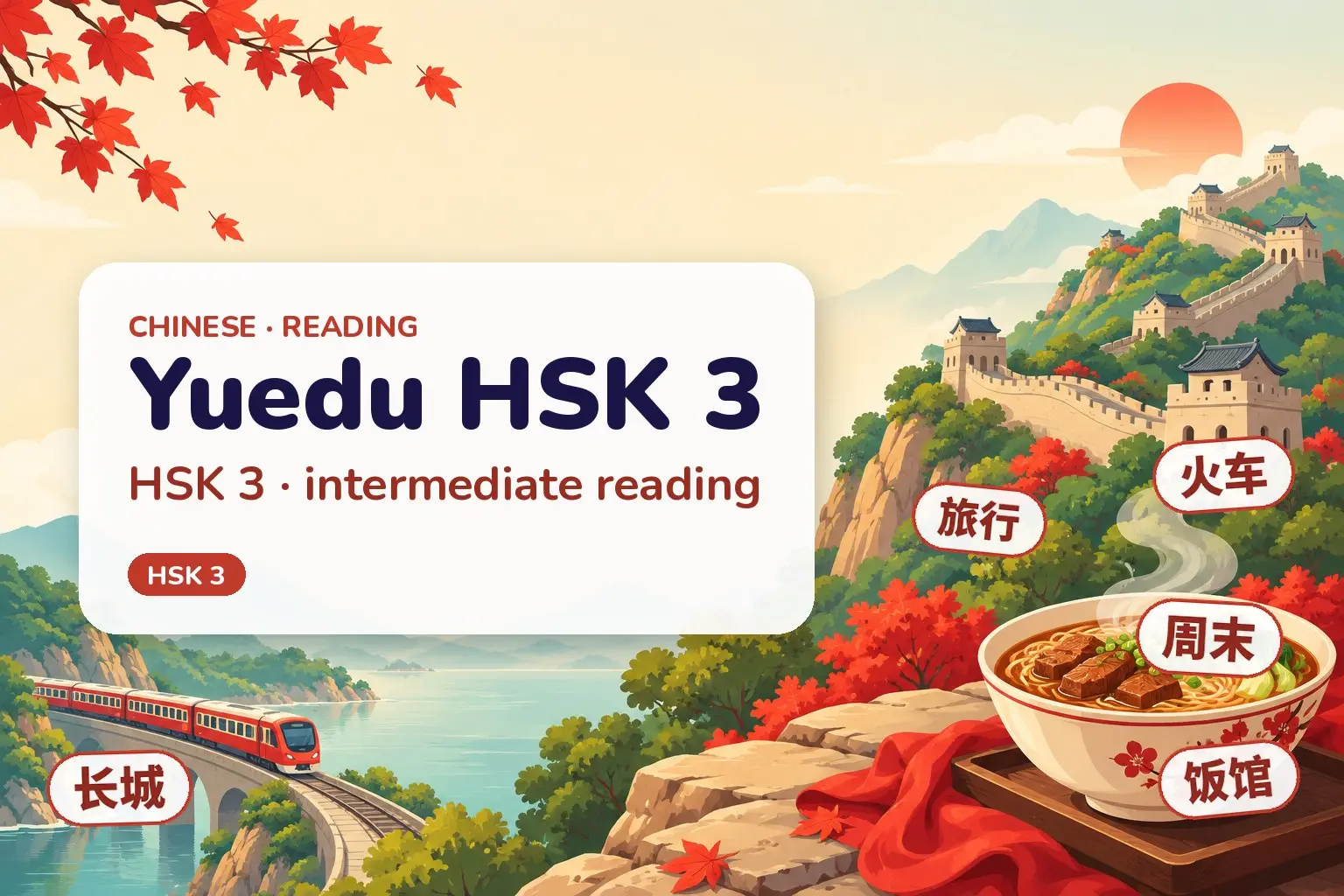
This intermediate (HSK 3) Chinese reading gives a short text about a weekend trip, with pinyin on every line. Read for the gist, track the time and sequence words, use the glossary last, then answer the comprehension and discussion questions.
Level: HSK 3 (intermediate). At HSK 3 a text starts to tell a real story: several sentences, a sequence of events, and an opinion at the end. This page gives one short HSK 3 text about a weekend trip, with pinyin on every line, and a clear method to work through it.
By the end of this page you can…
…read a short intermediate Chinese text about a trip, follow its order of events through sequence words, and answer comprehension and discussion questions about it.
How to read an intermediate Chinese text
Do not translate character by character. Work in passes, each with its own goal:
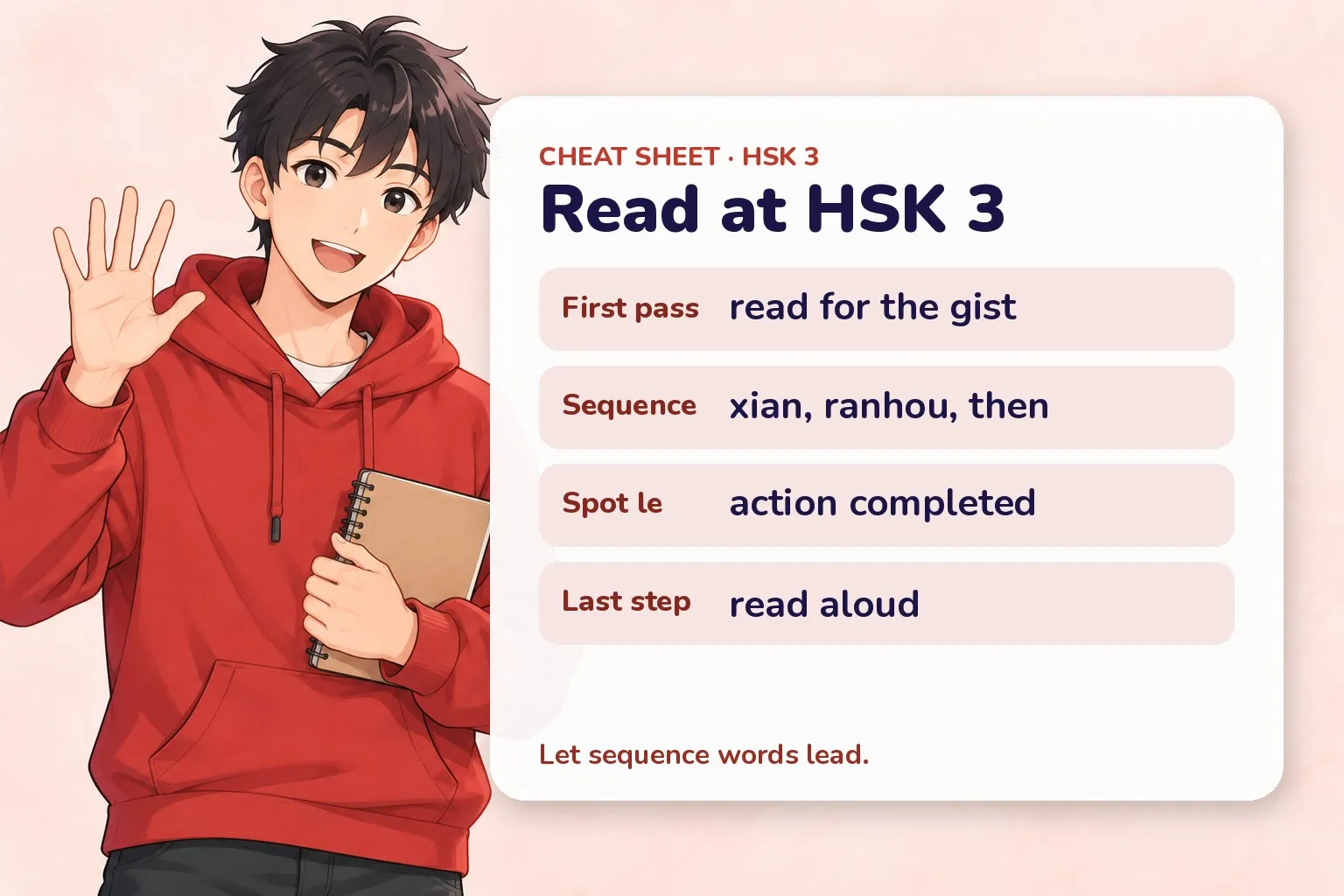
- First read — the gist. Read the whole text once, using the pinyin, without stopping. Who went where, and when?
- Second read — the order. Read again and mark the sequence words 先 (xiān, first), 然后 (ránhòu, then), 下午 (xiàwǔ, afternoon), 晚上 (wǎnshang, evening); they carry the timeline.
- Spot 了 (le). The particle 了 (le) signals a completed or changed situation — a quick clue that the action already happened.
- Word list, then answer. Only now check the glossed words below, then do the questions, returning to the text to confirm each answer.
The text: A weekend in Beijing
上个周末我和朋友去了北京。 (Shàng ge zhōumò wǒ hé péngyou qù le Běijīng.) — Last weekend, my friend and I went to Beijing. 我们先去了长城。 (Wǒmen xiān qù le Chángchéng.) — First we went to the Great Wall. 长城非常长也很高。 (Chángchéng fēicháng cháng yě hěn gāo.) — The Great Wall is very long and also very high. 下午我们在一家饭馆吃饭。 (Xiàwǔ wǒmen zài yì jiā fànguǎn chīfàn.) — In the afternoon we ate at a restaurant. 那家饭馆的菜很好吃也不贵。 (Nà jiā fànguǎn de cài hěn hǎochī yě bú guì.) — That restaurant’s food was tasty and not expensive. 晚上我们坐火车回家。 (Wǎnshang wǒmen zuò huǒchē huí jiā.) — In the evening we took the train home. 我觉得这次旅行很有意思。 (Wǒ juéde zhè cì lǚxíng hěn yǒuyìsi.) — I think this trip was very interesting. 下个月我想再去一次。 (Xià ge yuè wǒ xiǎng zài qù yí cì.) — Next month I want to go again.
New words
| Chinese | Pinyin | English |
|---|---|---|
| 周末 | zhōumò | weekend |
| 长城 | Chángchéng | the Great Wall |
| 非常 | fēicháng | very, extremely |
| 饭馆 | fànguǎn | restaurant |
| 菜 | cài | dish, food |
| 好吃 | hǎochī | tasty |
| 贵 | guì | expensive |
| 火车 | huǒchē | train |
| 旅行 | lǚxíng | trip, travel |
| 有意思 | yǒuyìsi | interesting |
Listen and repeat
Play each line, then say it aloud with the tones before you read on.
- 上个周末我去了北京。Shàng ge zhōumò wǒ qù le Běijīng.Last weekend I went to Beijing.
- 我们先去了长城。Wǒmen xiān qù le Chángchéng.First we went to the Great Wall.
- 长城非常长。Chángchéng fēicháng cháng.The Great Wall is very long.
- 下午我们吃饭。Xiàwǔ wǒmen chīfàn.In the afternoon we ate.
- 那家饭馆的菜很好吃。Nà jiā fànguǎn de cài hěn hǎochī.That restaurant's food was tasty.
- 菜也不贵。Cài yě bú guì.The food was not expensive either.
- 晚上我们坐火车回家。Wǎnshang wǒmen zuò huǒchē huí jiā.In the evening we took the train home.
- 这次旅行很有意思。Zhè cì lǚxíng hěn yǒuyìsi.This trip was very interesting.
- 下个月我想再去一次。Xià ge yuè wǒ xiǎng zài qù yí cì.Next month I want to go again.
- 你想去哪儿?Nǐ xiǎng qù nǎr?Where do you want to go?
Comprehension practice
Reading comprehension practice
Try each one, then press Check. No sign-up, nothing is sent anywhere — it all runs in your browser.
Hint: it marks the first action
Show answer
xiān — 先 (xiān) means 'first'.
4 Order the words: 'In the evening we took the train home.'
Show answer
晚上 (wǎnshang) 我们 (wǒmen) 坐火车 (zuò huǒchē) 回家 (huí jiā) — 晚上我们坐火车回家 (wǎnshang wǒmen zuò huǒchē huí jiā).
5 Match each word to its meaning.
- 周末 (zhōumò)
- 饭馆 (fànguǎn)
- 火车 (huǒchē)
- 有意思 (yǒuyìsi)
Show answer
- 周末 (zhōumò) → weekend
- 饭馆 (fànguǎn) → restaurant
- 火车 (huǒchē) → train
- 有意思 (yǒuyìsi) → interesting
周末 (zhōumò) weekend; 饭馆 (fànguǎn) restaurant; 火车 (huǒchē) train; 有意思 (yǒuyìsi) interesting.
Quick recap before you answer.
Quiz
Chinese reading comprehension quiz
8 questions · pick an answer and you'll see straight away if it's right.
-
Show answer
上个周末 (shàng ge zhōumò), last weekend — 上个周末 (shàng ge zhōumò) — last weekend.
-
Show answer
the writer and a friend, 我和朋友 (wǒ hé péngyou) — 我和朋友去了北京 (wǒ hé péngyou qù le Běijīng).
-
Show answer
very long and high, 非常长也很高 (fēicháng cháng yě hěn gāo) — 长城非常长也很高 (Chángchéng fēicháng cháng yě hěn gāo).
-
Show answer
tasty and not expensive, 很好吃也不贵 (hěn hǎochī yě bú guì) — 那家饭馆的菜很好吃也不贵 (cài hěn hǎochī yě bú guì).
-
Show answer
by train, 坐火车 (zuò huǒchē) — 晚上我们坐火车回家 (zuò huǒchē huí jiā).
-
Show answer
very interesting, 很有意思 (hěn yǒuyìsi) — 我觉得这次旅行很有意思 (hěn yǒuyìsi).
-
Show answer
completed — 了 (le) marks a completed or changed situation.
-
Show answer
read once for the gist — The first pass is for the gist — the overall meaning.
Discussion
Try answering in simple Chinese, reusing the text’s words: 你上个周末做了什么? (Nǐ shàng ge zhōumò zuò le shénme?) — What did you do last weekend? 你想去哪个城市旅行? (Nǐ xiǎng qù nǎ ge chéngshì lǚxíng?) — Which city would you like to travel to? There is no single right answer; borrow 周末 (zhōumò), 旅行 (lǚxíng) and 有意思 (yǒuyìsi) to build your own sentences.
Next
- Go back over the elementary text: Chinese Reading Practice: Elementary
- Build the grammar behind the text in the Chinese grammar section
- New here? Start with Start Learning Chinese Here
All Chinese practice topics
Vocabulary, pronunciation, phrases, practice and exam help, ordered by level. Pick a topic and go straight to it. New lessons go live every day, so topics marked Coming soon fill in over the next weeks.
Practice
HSK 1 1 topics · 1 ready
HSK 2 4 topics · 2 ready
- 02 How to Practise Chinese Listening
- 03 Chinese Reading Practice: Elementary
- 04 Tone Pairs Practice Coming soon
- 05 The Particle 了 (le) Practice Coming soon
HSK 3 5 topics · 2 ready
- 06 Shadowing to Improve Chinese Speaking
- 07 Chinese Reading Practice: Intermediate You are here
- 08 How to Practise Chinese Writing Coming soon
- 09 The 把 (bǎ) Construction Practice Coming soon
- 10 Resultative Complements Practice Coming soon