Shadowing to Improve Chinese Speaking

Shadowing means playing a short clip of spoken Mandarin and speaking along with it almost at the same time, copying the tones, sounds and rhythm without reading. Work in short daily bursts on clips you already understand, and record yourself to hear what to fix.
Level: HSK 3. Shadowing is one of the most efficient ways to make your spoken Mandarin clearer and more natural. You copy a speaker almost in real time, so your mouth learns the tones and rhythm of Chinese instead of the rhythm of your first language.
By the end of this page you can…
…run a short Chinese shadowing session on your own, avoid the common mistakes, and fit the practice into a daily routine.
What shadowing is
Shadowing means listening to a short piece of spoken Mandarin and speaking along with it at almost the same time — a beat behind the speaker — while you copy their tones, sounds and intonation. You are not translating and you are not reading aloud from a page. You are imitating a voice.
Because you speak with the audio rather than after it, you cannot stop to think about each tone. That pressure is the point: it trains your mouth to produce the natural pitch pattern of real Chinese instead of one careful syllable at a time.
How to shadow, step by step
- Choose a short clip, 10–30 seconds. A sentence or two of clear standard Mandarin is plenty — a slow dialogue, a simple story, or the audio on this site.
- Listen once or twice for meaning. Make sure you understand it before you try to speak.
- Shadow with your eyes closed, no text. Play the clip and speak along, a fraction behind the voice. Hold on to the melody — the rise and fall of the tones.
- Replay the same clip several times. Each pass, catch a little more: a tone you flattened, a neutral-tone syllable, a tone-change (like 不 (bù) → bú).
- Now open the transcript with pinyin. Read along while you shadow to find the exact syllables and tones you were blurring.
- Record yourself shadowing once more, then play your voice next to the original. The gaps you hear are your to-do list.
Common pitfalls
- Reading instead of listening. If your eyes are glued to the characters or pinyin from the start, you copy spelling, not sound. Ears first, text later.
- Flattening the tones. The most common Mandarin error is losing the pitch. Shadowing fixes this only if you actually copy the rise and fall — exaggerate it at first if you must.
- Chasing speed. Speaking fast but toneless is not fluency. Copy the rhythm, including the light neutral-tone syllables that native speech swallows.
- Practising silently. Shadowing only works out loud; mouthing the words gives your muscles no workout.
- One pass and move on. The improvement comes from repeating the same clip until the tones feel automatic.
Choose the right audio
Good shadowing audio is clear, not too fast, and comes with a transcript in characters and pinyin so you can check your tones. Standard Mandarin (pǔtōnghuà) is the most useful base. The spoken examples in these lessons each have an audio button, so you can shadow a single phrase, then a full sentence. Start with the short ones below.
Example sentences
Shadow each line below: play the audio, then speak along a beat behind. Start slow, repeat, and copy the tones.
- 你好,你好吗?Nǐ hǎo, nǐ hǎo ma?Hi, how are you?
- 我很好,谢谢。Wǒ hěn hǎo, xièxie.I'm fine, thank you.
- 你叫什么名字?Nǐ jiào shénme míngzi?What's your name?
- 我叫李明。Wǒ jiào Lǐ Míng.My name is Li Ming.
- 请给我一杯咖啡。Qǐng gěi wǒ yì bēi kāfēi.A coffee for me, please.
- 现在几点了?Xiànzài jǐ diǎn le?What time is it now?
- 多少钱?Duōshao qián?How much is it?
- 请再说一遍。Qǐng zài shuō yí biàn.Please say it again.
- 我听不懂。Wǒ tīng bu dǒng.I don't understand.
- 洗手间在哪里?Xǐshǒujiān zài nǎlǐ?Where is the toilet?
- 这个用中文怎么说?Zhège yòng Zhōngwén zěnme shuō?How do you say this in Chinese?
- 我等了大概十分钟。Wǒ děng le dàgài shí fēnzhōng.I waited about ten minutes.
- 很高兴认识你。Hěn gāoxìng rènshi nǐ.Nice to meet you.
- 非常感谢你的帮助。Fēicháng gǎnxiè nǐ de bāngzhù.Thank you very much for your help.
- 明天见。Míngtiān jiàn.See you tomorrow.
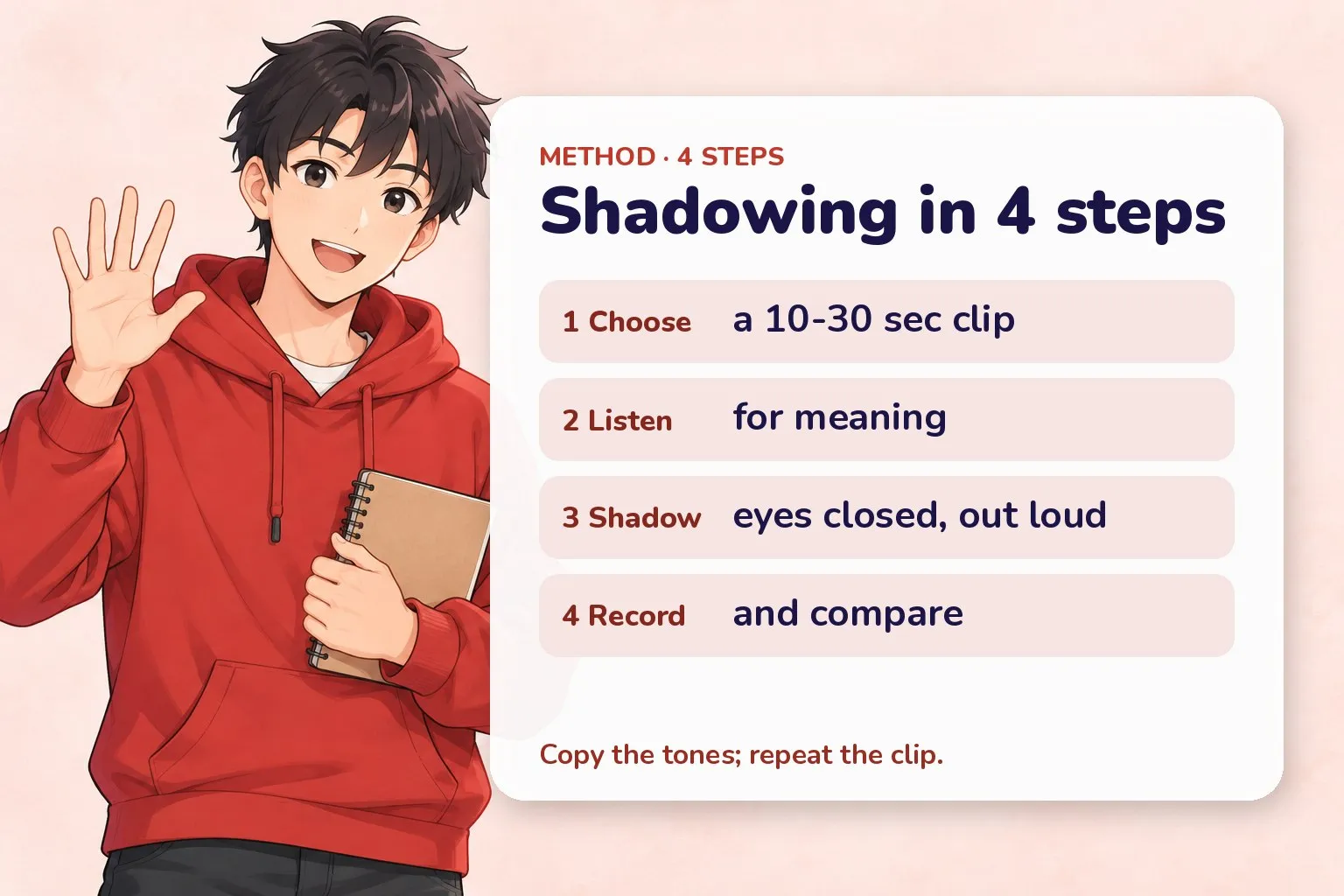
Quick recap before you practise.
Practice
Shadowing method practice
Try each one, then press Check. No sign-up, nothing is sent anywhere — it all runs in your browser.
Hint: the written version of the audio
Show answer
transcript — Ears first, then use the transcript to catch tones you blurred.
4 Put a shadowing session in order.
Show answer
choose a short clip listen for meaning shadow with no text record and compare — Choose, understand, shadow by ear, then record and compare.
5 Match each pitfall to its fix.
- reading from the start
- flattening the tones
- practising silently
- one pass only
Show answer
- reading from the start → listen first, text later
- flattening the tones → copy the rise and fall of the pitch
- practising silently → say it out loud
- one pass only → repeat the same clip
Each fix turns a common shadowing mistake into good practice.
Quiz
Shadowing quiz
8 questions · pick an answer and you'll see straight away if it's right.
-
Show answer
to copy the tones, sounds and rhythm of Mandarin — Shadowing reshapes how you sound by imitating a speaker closely.
-
Show answer
about 10–30 seconds — A short clip you can repeat beats a long one you cannot.
-
Show answer
so you copy the sound and tones, not the spelling — Starting by ear stops you copying pinyin spelling instead of real pitch.
-
Show answer
flattening or losing the tones — Copying the rise and fall of the tones is the whole point of shadowing Chinese.
-
Show answer
fluency is about tones and rhythm, not raw pace — Speaking fast but toneless is not fluent; copy the melody first.
-
Show answer
repeating the same clip until the tones feel automatic — Repetition of one clip is what builds the muscle memory.
-
Show answer
hear the gaps between your voice and the original — Comparing your recording to the original shows you exactly what to fix.
-
Show answer
whole phrases, following the melody — Tones sit in the music of a full phrase, so shadow phrases, not single syllables.
Next
- Build the tones it relies on in the Chinese grammar section
- New here? Start with Start Learning Chinese Here
All Chinese practice topics
Vocabulary, pronunciation, phrases, practice and exam help, ordered by level. Pick a topic and go straight to it. New lessons go live every day, so topics marked Coming soon fill in over the next weeks.
Practice
HSK 1 1 topics · 1 ready
HSK 2 4 topics · 2 ready
- 02 How to Practise Chinese Listening
- 03 Chinese Reading Practice: Elementary
- 04 Tone Pairs Practice Coming soon
- 05 The Particle 了 (le) Practice Coming soon
HSK 3 5 topics · 2 ready
- 06 Shadowing to Improve Chinese Speaking You are here
- 07 Chinese Reading Practice: Intermediate
- 08 How to Practise Chinese Writing Coming soon
- 09 The 把 (bǎ) Construction Practice Coming soon
- 10 Resultative Complements Practice Coming soon