Korean Romanization (Revised) and Its Limits

Revised Romanization (RR) is the official way to write Korean in Latin letters: 한글 (hangeul) becomes hangeul and 서울 (Seoul) becomes Seoul. It is useful for signs and names, but its letters follow Korean spelling rather than English sounds, so it cannot replace hangul.
Level: TOPIK 1. Romanization is a bridge, and like most bridges it is narrower than it looks. This page shows what Revised Romanization actually does with Korean letters, where it quietly changes the sound, and why the fastest route to Korean pronunciation is to stop reading the Latin letters as soon as you can.
What Revised Romanization is
Revised Romanization, usually shortened to RR, is the official system for writing Korean in Latin letters. It has been in use since 2000 and replaced an older system, McCune-Reischauer, whose spellings still survive in older books and in a few established names.
RR is a transcription: it writes how a word is pronounced, not how it is spelled letter by letter. That is why the city name 부산 (Busan) is written Busan and not something closer to its spelling, and why assimilated words come out with the change already applied.
The system has one job that it does well: putting Korean into Latin letters for people who cannot read hangul yet, on signs, maps, passports and dictionaries. It has a second job that it cannot do: teaching you how Korean sounds.
The letters, briefly
Korean has 14 basic consonant letters and 10 basic vowels, plus tense consonants and combined vowels. RR maps them one to one, with a handful of position rules.
| Hangul | RR | Rough English value | Reading example |
|---|---|---|---|
| ㄱ | g / k | g before a vowel, k elsewhere | 가방 (gabang, bag) |
| ㄷ | d / t | d before a vowel, t elsewhere | 도시 (dosi, city) |
| ㅂ | b / p | b before a vowel, p elsewhere | 밥 (bap, rice) |
| ㄹ | r / l | r before a vowel, l elsewhere | 라면 (ramyeon, noodles) |
| ㅅ | s | s, but a t-sound at the end | 옷 (ot, clothes) |
| ㅇ | - / ng | silent at the start, ng at the end | 강 (gang, river) |
| ㅈ | j | like the j in jam | 집 (jip, house) |
| ㅊ | ch | aspirated ch | 차 (cha, tea) |
| ㅋ | k | aspirated k | 커피 (keopi, coffee) |
| ㅌ | t | aspirated t | 토요일 (toyoil, Saturday) |
| ㅍ | p | aspirated p | 피자 (pija, pizza) |
| ㅎ | h | h | 하늘 (haneul, sky) |
| Vowel | RR | What it sounds like |
|---|---|---|
| ㅏ (a) | a | the a in father, short |
| ㅓ (eo) | eo | between the aw in saw and the u in cup |
| ㅗ (o) | o | a rounded o |
| ㅜ (u) | u | the oo in food, short |
| ㅡ (eu) | eu | no English match: say ee with lips relaxed |
| ㅣ (i) | i | the ee in see |
| ㅐ (ae) | ae | close to the e in bed |
| ㅔ (e) | e | close to the e in bed |
Those last two rows hide a real problem: ㅐ (ae) and ㅔ (e) are written differently but in fast speech often sound the same. RR keeps a written distinction that many speakers do not make, so the spelling is not a reliable guide to what you will hear.
Where RR changes the sound
Three rules explain most of what surprises learners.
Voicing by position. The letters ㄱ (g), ㄷ (d), ㅂ (b) and ㅈ (j) carry one Latin value before a vowel and a different one elsewhere: g turns into k, d into t, b into p, and j into t — ㅈ (j) is never written ch, which belongs to ㅊ (ch). So 국 (guk, soup) ends in k while 가방 (gabang, bag) keeps its g, 밥 (bap, rice) ends in p while 비빔밥 (bibimbap) holds both values in one word, and 낮 (nat, day) ends in t.
Assimilation is written in. Because RR follows pronunciation, consonant changes appear in the Latin spelling: 한국말 (hangungmal, Korean language) shows the ㄱ (g) becoming ng before ㄴ (n), and 독립 (dongnip, independence) shows the same shift.
Batchim is written by its neutralised sound, not the letter’s base value. A final consonant is romanised as it is pronounced: a final ㄱ (g) becomes k, the dental finals ㄷ (d), ㅅ (s), ㅆ (ss), ㅈ (j), ㅊ (ch), ㅌ (t) and ㅎ (h) all become t, and ㅂ (b) and ㅍ (p) become p, while ㄴ (n), ㅁ (m), ㅇ (ng) and ㄹ (r/l) keep their value. That is why 옷 (ot, clothes) ends in t although its letter is ㅅ (s), and 꽃 (kkot, flower) ends in t although its letter is ㅊ (ch); the official examples 월곶 (Wolgot), 벚꽃 (beotkkot) and 한밭 (Hanbat) follow the same pattern.
Where RR fails you
Romanization cannot carry vowel length, pitch or the difference between tense and plain consonants in a way an English reader will read correctly. 세 (se) and 쎄 (sse) look nearly identical in Latin and sound clearly different in Korean.
Names are the visible failure. Strict RR writes 김 (gim), 이 (i), 박 (bak) and 최 (choe), yet the same people appear as Kim, Lee, Park and Choi on passports, business cards and bylines. The older spellings were kept because they were already established, so a learner who trusts the Latin form will mispronounce a name that the owner says every day.
The last failure is grammar. Korean is agglutinative: verbs carry endings stacked on a stem, and the endings are where meaning lives. RR blurs the boundary between stem and ending because it writes sound, not structure. 읽다 (ikda, to read) loses its ㄹ (r/l) entirely in RR, and 좋아요 (joayo, it is good) hides the ㅎ (h) that the spelling shows.
Why read hangul instead
Hangul is not a hard script; it is a clever one. Each syllable is a block of two to four letters, so recognizing the block gives you the sound, and twenty-four basic letters cover the system.
Once you read hangul, three things change at once. You can look a word up in a dictionary, because dictionaries are alphabetised in hangul, not in RR. You can see the verb stem and its ending, which is where the grammar sits. And you stop depending on a transcription that was designed for signs, not for learners.
Example sentences
Everyday words where the romanization and the sound drift apart.
- 안녕하세요.annyeonghaseyoHello.The polite all-purpose greeting.
- 감사합니다.gamsahamnidaThank you.The ㅂ (b) of 합니다 sounds like m before ㄴ (n).
- 한국hangukKoreaFinal ㄱ is written k.
- 서울seoulSeoulㅓ is eo, ㅜ is u: one syllable each.
- 김치gimchikimchiThe familiar spelling kimchi is not RR.
- 비빔밥bibimbapbibimbap (mixed rice)Final ㅂ in 밥 is written p.
- 학생haksaengstudentㄱ before ㅅ is written k.
- 학교hakgyoschoolThe same ㄱ is k before ㄱ and g before ㅛ.
- 물mulwaterFinal ㄹ is l.
- 밥baprice, a mealThe p is unreleased.
- 라면ramyeoninstant noodlesㄹ before a vowel is r.
- 지하철jihacheolsubwayFinal ㄹ is l again.
- 여행yeohaengtravelㅕ is yeo, not yo.
- 좋아요joayoit is goodThe ㅎ disappears in pronunciation and in RR.
- 읽다ikdato readThe ㄹ is silent, so RR drops it.
- 꽃kkotflowerTense ㄲ is written kk.
Practice
Romanization practice
Try each one, then press Check. No sign-up, nothing is sent anywhere — it all runs in your browser.
1 Match each hangul word to its RR spelling.
- 서울 (seoul)
- 김치 (gimchi)
- 학교 (hakgyo)
- 물 (mul)
Show answer
- 서울 (seoul) → seoul
- 김치 (gimchi) → gimchi
- 학교 (hakgyo) → hakgyo
- 물 (mul) → mul
RR writes sound, so 서울 (seoul) keeps both vowels: se-oul.
Hint: b before the vowel, p at the end
Show answer
bap — 밥 (bap) is spelled bap: b for the initial ㅂ (b), p for the final one.
6 Build the greeting 'Hello.' from its parts.
Show answer
안녕 (annyeong) 하세요 (haseyo) — 안녕하세요 (annyeonghaseyo) is written as one word but built from 안녕 plus 하세요.
Quiz
Romanization quiz
9 questions · pick an answer and you'll see straight away if it's right.
-
Show answer
the pronunciation of standard Korean — RR follows how a word is pronounced, which is why assimilations show up in the Latin spelling.
-
Show answer
ㅓ (eo) — The letter ㅓ (eo) is written eo; ㅗ (o), ㅜ (u) and ㅡ (eu) are the other three.
-
Show answer
l — ㄹ is r before a vowel and l before a consonant or at the end, as in 물 (mul).
-
Show answer
한국말 (hangungmal) — The ㄱ (g) becomes ng before ㄴ (n), and RR writes the result.
-
Show answer
gim — Strict RR is gim; Kim is an older spelling kept by families and passports.
-
Show answer
the p is never released — A final ㅂ (b) closes the lips without releasing air.
-
Show answer
joayo — The ㅎ (h) is not pronounced before the vowel, so RR writes joayo.
-
Show answer
the verb stem and its endings — RR writes sound, so the boundary between stem and ending disappears.
-
Show answer
mul — The letters ㅁ (m), ㅜ (u) and ㄹ (r/l) give m-u-l.
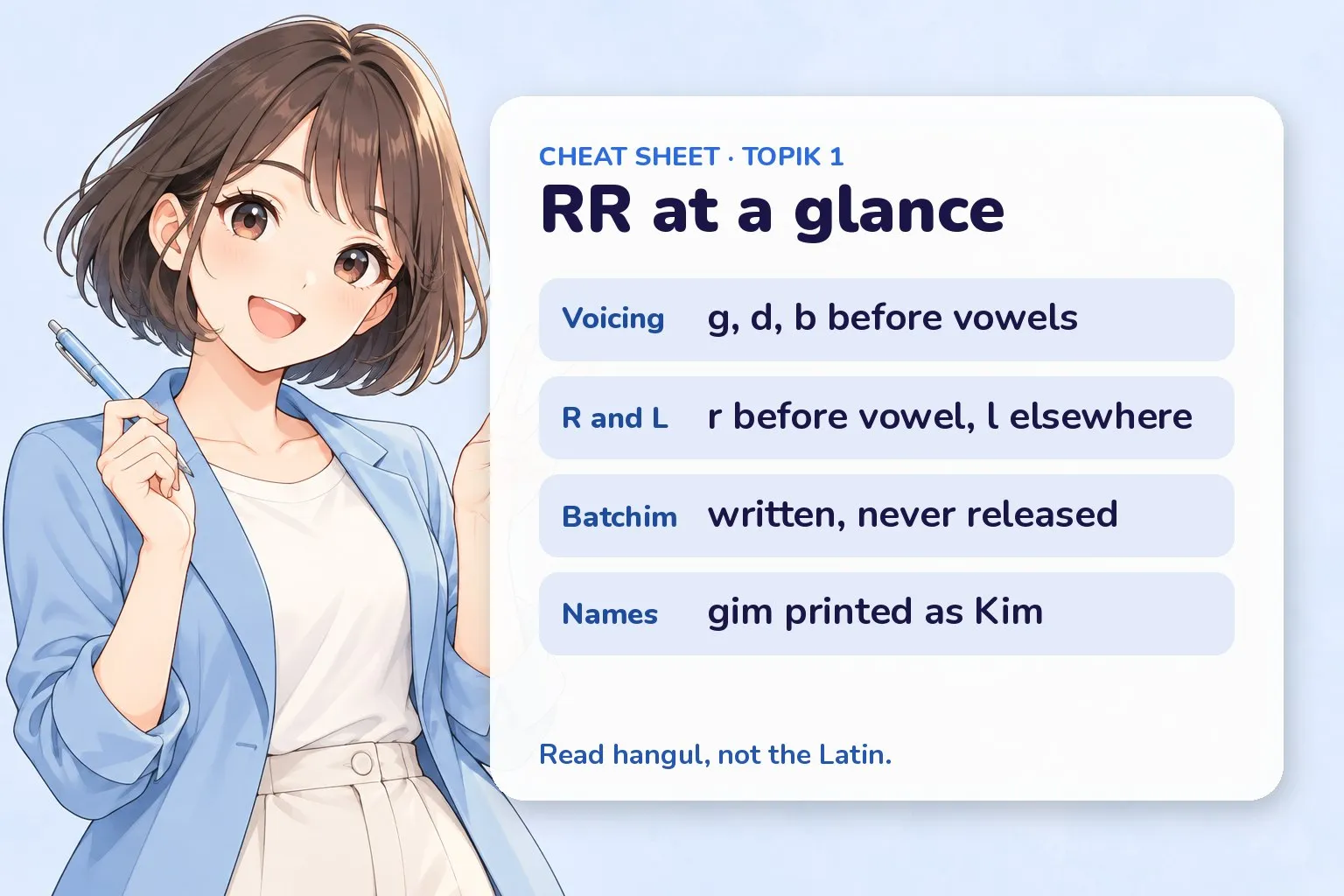
Quick recap before the quiz.
Recap cheat-sheet
| Point | What RR does | Example (reading) |
|---|---|---|
| Purpose (reading) | Writes standard pronunciation in Latin letters | 부산 (Busan) |
| Voicing | g, d, b, j before a vowel; k, t, p, t elsewhere | 학교 (hakgyo) |
| ㄹ | r before a vowel, l elsewhere | 라면 (ramyeon), 물 (mul) |
| Assimilation | Reflected in the spelling | 한국말 (hangungmal) |
| Batchim | Written by its neutralised sound, said unreleased | 밥 (bap) |
| Surnames | Often keep older spellings | 김 (gim) printed as Kim |
| Vowels | ㅓ eo, ㅡ eu, ㅐ ae, ㅔ e | 서울 (seoul) |
Next
- Build the letters from the start: Hangul consonants and Hangul vowels
- Why a syllable is a block: Hangul syllable blocks
- What RR cannot show: Korean sound change rules
- New here? Start with Start Learning Korean Here
All Korean pronunciation & writing topics
Vocabulary, pronunciation, phrases, practice and exam help, ordered by level. Pick a topic and go straight to it. New lessons go live every day, so topics marked Coming soon fill in over the next weeks.
Pronunciation & writing
TOPIK 1 9 topics · 8 ready
- 01 Korean Pronunciation Overview
- 02 Hangul Vowels
- 03 Hangul Consonants
- 04 Building Hangul Syllable Blocks
- 05 Batchim: Final Consonants
- 06 Tense (Double) Consonants
- 07 Complex Vowels & Diphthongs
- 08 Korean Romanization (Revised) & Its Limits You are here
- 09 How to Type Hangul (Keyboard Guide) Coming soon
TOPIK 3 2 topics · 2 ready
TOPIK 4 1 topics
- 12 Introduction to Hanja Coming soon