Korean Pronunciation Overview

Korean is written in Hangul, a phonetic alphabet whose letters group into syllable blocks and spell the sounds reliably. The hard parts for English speakers are the plain, aspirated and tense consonant triples, the vowels 어 (eo) and 으 (eu), and quiet final consonants.
On this page10 sections · tap to jump
Level: TOPIK 1. Korean is written in 한글 (han-geul), an alphabet designed to be learned fast and to match its sounds closely. Once you can read the blocks, most words say themselves. The few real hurdles are a couple of vowels, the three-way consonant sets, and how final consonants behave. This page shows you what to focus on first.
By the end of this page you can…
…read a 한글 (han-geul) syllable block, say the vowels and consonants English speakers struggle with, handle final consonants, and use the audio here to practise.
Hangul spells the sounds in blocks
한글 (han-geul) is not a picture system — it is an alphabet of simple letters. What makes it look different is that the letters stack into syllable blocks, one block per beat. The word 한글 (han-geul) is two blocks: 한 (han) + 글 (geul). Each block has a first consonant, a vowel, and sometimes a final consonant.
Because the spelling is regular, reading aloud is mostly reliable once you know the letters. A single distinct sound is a phoneme; Korean has about ten basic vowels and fourteen basic consonants, plus combinations.
The vowels to watch
Most vowels are straightforward; these three cause the most trouble for English speakers:
| Vowel | Sound | Example | Reading |
|---|---|---|---|
| 어 | “uh”, open and unrounded | 어머니 (mother) | eomeoni |
| 오 | “oh”, lips rounded | 오리 (duck) | ori |
| 으 | tight “eu”, lips spread, no English match | 음악 (music) | eumak |
The pair 어 (eo) and 오 (o) are different sounds: keep 어 (eo) open and unrounded, and round your lips for 오 (o). Also note 애 (ae) and 에 (e) now sound nearly the same for most speakers.
The consonant triples
Many Korean consonants come in a set of three that English does not distinguish. Getting these right changes the word:
| Plain | Aspirated (puff) | Tense (tight) | Reading |
|---|---|---|---|
| ㄱ | ㅋ | ㄲ | g/k · k · kk |
| ㄷ | ㅌ | ㄸ | d/t · t · tt |
| ㅂ | ㅍ | ㅃ | b/p · p · pp |
| ㅈ | ㅊ | ㅉ | j · ch · jj |
- Plain — ㄱ (g), ㄷ (d), ㅂ (b): soft, with little air — between the English voiced and voiceless sounds.
- Aspirated — ㅋ (k), ㅌ (t), ㅍ (p): a strong puff of air, like holding a tissue that flutters.
- Tense — ㄲ (kk), ㄸ (tt), ㅃ (pp): tight and hard, no puff, throat slightly squeezed.
For example 불 (bul, fire), 풀 (pul, grass) and 뿔 (ppul, horn) differ only by this three-way contrast.
Final consonants (batchim)
A consonant at the bottom of a block is called the batchim. Two rules matter:
- Only seven end-sounds exist. Many letters collapse to the same final sound, so 밖 (bak) and 박 (bak) are pronounced the same, and the final is cut short and unreleased — you stop the air rather than let it out.
- Liaison carries it over. When the next block starts with a vowel, the final consonant slides onto it: 음악 (eumak) sounds like “eu-mak”, and 한국어 (hangugeo) links across the blocks.
Sounds English speakers get wrong
- ㄹ (r/l) is both r and l. Between vowels it is a light tapped r, as in 라디오 (radio); at the end of a block it is an l, as in 물 (mul, water).
- 어 (eo) is not “oh”. Keep it open and unrounded; rounding it turns it into 오 (o).
- 으 (eu) has no English twin. Spread your lips as if smiling and make a tight “eu” with no rounding.
- No heavy stress. Korean is syllable-timed; give the blocks fairly even weight instead of punching one hard like English.
Listen and repeat with the audio
Press play on each word, then say it back. These contrast the features above.
- 한글han-geulHangul (the alphabet)two blocks: 한 (han) + 글 (geul)
- 안녕하세요annyeonghaseyohellofive even blocks
- 어머니eomeonimother어 (eo), open and unrounded
- 오리oriduck오 (o), lips rounded
- 음악eumakmusic으 (eu), then liaison: 'eu-mak'
- 불bulfireplain ㅂ (b)
- 풀pulgrassaspirated ㅍ (p), a puff of air
- 뿔ppulhorntense ㅃ (pp), tight and hard
- 달dalmoonplain ㄷ (d)
- 딸ttaldaughtertense ㄸ (tt)
- 라디오radioradioㄹ as a tapped r between vowels
- 물mulwaterㄹ as an l at the end
- 밥bapcooked rice / mealfinal ㅂ is cut off, unreleased
- 감사합니다gamsahamnidathank you
How to use the audio on this site
Every example and quiz word has a play button that uses your browser voice. Make it work for you:
- Say the blocks. Play a word and say one block per beat, keeping them even.
- Drill the triples. Repeat 불 (bul) / 풀 (pul) / 뿔 (ppul) until the plain, puff and tight sounds are clearly different.
- Stop the finals. Practise 밥 (bap) and 밖 (bak) ending with no release.
- Record and compare. Record yourself, then play the example again and listen for the gap.
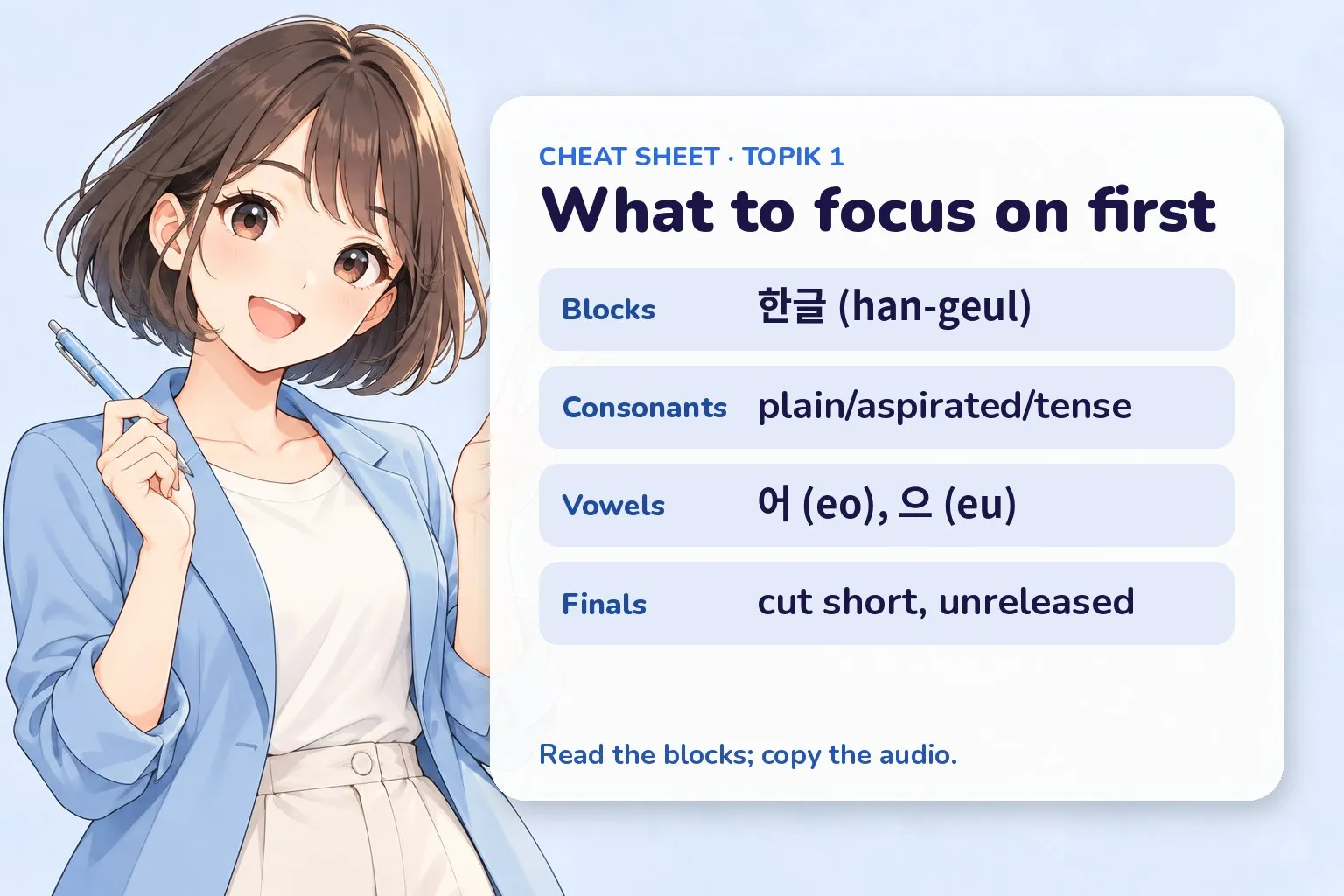
Quick recap before you practise.
Practice
Korean pronunciation practice
Try each one, then press Check. No sign-up, nothing is sent anywhere — it all runs in your browser.
Hint: spread your lips, no rounding
Show answer
eu — 으 (eu) is a tight, unrounded vowel: romanised eu.
4 Match each word to the feature it shows.
- 불 (bul)
- 풀 (pul)
- 뿔 (ppul)
- 물 (mul)
Show answer
- 불 (bul) → plain consonant
- 풀 (pul) → aspirated (puff)
- 뿔 (ppul) → tense (tight)
- 물 (mul) → final ㄹ (r/l) as l
불 (bul) plain, 풀 (pul) aspirated, 뿔 (ppul) tense; 물 (mul) ends in an l-sound.
Quiz
Korean pronunciation overview quiz
8 questions · pick an answer and you'll see straight away if it's right.
-
Show answer
a phonetic alphabet in syllable blocks — It is an alphabet; letters group into one block per beat.
-
Show answer
three: plain, aspirated, tense — Plain ㄱ (g), aspirated ㅋ (k), tense ㄲ (kk) is the pattern.
-
Show answer
a strong puff of air — Aspirated sounds release a noticeable puff of air.
-
Show answer
the plain / aspirated / tense contrast — Only the three-way consonant contrast differs; the words mean fire, grass and horn.
-
Show answer
open and unrounded — Keep 어 (eo) open and unrounded; rounding makes it 오 (o).
-
Show answer
cut short and unreleased — You stop the air; 밥 (bap) ends with no release.
-
Show answer
seven — Many letters collapse to the same final, leaving seven end-sounds — so 밖 and 박 (both bak) match.
-
Show answer
a tapped r between vowels and an l at the end — 라디오 (radio) has the tapped r; 물 (mul) ends in an l.
Next
- Build words into sentences with the 이다 (ida) copula
- Browse every topic in the Korean grammar section
- New here? Start with Start Learning Korean Here
All Korean pronunciation & writing topics
Vocabulary, pronunciation, phrases, practice and exam help, ordered by level. Pick a topic and go straight to it. New lessons go live every day, so topics marked Coming soon fill in over the next weeks.
Pronunciation & writing
TOPIK 1 9 topics · 1 ready
- 01 Korean Pronunciation Overview You are here
- 02 Hangul Vowels Coming soon
- 03 Hangul Consonants Coming soon
- 04 Building Hangul Syllable Blocks Coming soon
- 05 Batchim: Final Consonants Coming soon
- 06 Tense (Double) Consonants Coming soon
- 07 Complex Vowels & Diphthongs Coming soon
- 08 Korean Romanization (Revised) & Its Limits Coming soon
- 09 How to Type Hangul (Keyboard Guide) Coming soon
TOPIK 3 2 topics
- 10 Korean Sound-Change Rules Coming soon
- 11 Aspiration & Tensing in Context Coming soon
TOPIK 4 1 topics
- 12 Introduction to Hanja Coming soon