Hangul Consonants

Hangul has 19 consonant letters: 14 basic ones such as ㄱ (g/k), ㄴ (n) and ㅁ (m), plus 5 tensed doubles like ㄲ (kk). Each consonant pairs with a vowel inside a syllable block, and many change sound when they land at the end of a block.
Level: TOPIK 1. Consonants are the frame of every 한글 (han-geul) syllable block. There are 19 consonant letters in three families — basic, tensed and aspirated — and the main challenge is that several of them change sound depending on where they sit in the block. This page lays them out with readings and audio.
By the end of this page you can…
…name the 14 basic Korean consonants, recognise the 5 tensed doubles and the aspirated set, and predict how a consonant sounds at the start versus the end of a syllable block.
How consonants work in Hangul
한글 (han-geul) packs letters into syllable blocks, one block per beat. A block begins with a consonant in the top-left; if the syllable starts with a vowel sound, the silent ㅇ (ieung) fills that slot. A block may also end in a consonant, called the 받침 (batchim), the “support” at the bottom.
The same letter can sound different in those two places. At the start of a block a plain consonant is soft and voiced-sounding; as a batchim at the end it is “unreleased” — the mouth forms it but does not let the air out. That is why ㄱ (g/k) sounds like a light “g” in 가 (ga) but a clipped “k” in 악 (ak).
The 14 basic consonants
Each is shown with the vowel ㅏ (a) so you can see it inside a block.
| Letter | Name | Reading | With ㅏ | Sounds like |
|---|---|---|---|---|
| ㄱ | 기역 (giyeok) | g / k | 가 (ga) | soft “g”, “k” at block end |
| ㄴ | 니은 (nieun) | n | 나 (na) | “n” |
| ㄷ | 디귿 (digeut) | d / t | 다 (da) | soft “d”, “t” at block end |
| ㄹ | 리을 (rieul) | r / l | 라 (ra) | between “r” and “l” |
| ㅁ | 미음 (mieum) | m | 마 (ma) | “m” |
| ㅂ | 비읍 (bieup) | b / p | 바 (ba) | soft “b”, “p” at block end |
| ㅅ | 시옷 (siot) | s | 사 (sa) | “s” |
| ㅇ | 이응 (ieung) | silent / ng | 아 (a) | silent at start, “ng” at end |
| ㅈ | 지읒 (jieut) | j | 자 (ja) | “j” |
| ㅊ | 치읓 (chieut) | ch | 차 (cha) | aspirated “ch” |
| ㅋ | 키읔 (kieuk) | k | 카 (ka) | aspirated “k” |
| ㅌ | 티읕 (tieut) | t | 타 (ta) | aspirated “t” |
| ㅍ | 피읖 (pieup) | p | 파 (pa) | aspirated “p” |
| ㅎ | 히읗 (hieut) | h | 하 (ha) | “h” |
The aspirated consonants
Four letters are made with a strong puff of air. They are the plain letters with an extra stroke added, and in Revised Romanization they drop the “soft” spelling.
| Plain | Aspirated | Reading | Difference |
|---|---|---|---|
| ㄱ (g) | ㅋ | k | strong puff of air |
| ㄷ (d) | ㅌ | t | strong puff of air |
| ㅂ (b) | ㅍ | p | strong puff of air |
| ㅈ (j) | ㅊ | ch | strong puff of air |
Hold a sheet of paper in front of your mouth: an aspirated ㅋ (k) should make it flutter, while a plain ㄱ (g) barely moves it.
The five tensed consonants
Doubling a basic letter makes a tensed sound — tight, sharp and clipped, produced with a stiff mouth and throat, not just louder.
| Letter | Reading | From | Example |
|---|---|---|---|
| ㄲ | kk | ㄱ (g) doubled | 까 (kka) |
| ㄸ | tt | ㄷ (d) doubled | 따 (tta) |
| ㅃ | pp | ㅂ (b) doubled | 빠 (ppa) |
| ㅆ | ss | ㅅ (s) doubled | 싸 (ssa) |
| ㅉ | jj | ㅈ (j) doubled | 짜 (jja) |
Listen and read
Press play, then say each one back. These move from single syllables to short words.
- 가gathe syllable gaㄱ at the start is a soft g
- 나nathe syllable na
- 다dathe syllable da
- 라rathe syllable raㄹ between r and l
- 마mathe syllable ma
- 바bathe syllable ba
- 사sathe syllable sa
- 나무namutree
- 바다badasea
- 하늘haneulsky
- 강gangriverfinal ㅇ sounds like ng
- 악ak(a cry) ahfinal ㄱ is a clipped k
- 토끼tokkirabbittensed ㄲ (kk)
- 코konoseaspirated ㅋ (k)
- 짜다jjadato be saltytensed ㅉ (jj)
Practice
Hangul consonant practice
Try each one, then press Check. No sign-up, nothing is sent anywhere — it all runs in your browser.
Hint: like the end of 'sing'
Show answer
ng — Final ㅇ (ieung) is 'ng': 강 (gang).
4 Match each basic letter to its tensed double.
- ㄱ (g)
- ㄷ (d)
- ㅂ (b)
- ㅅ (s)
Show answer
- ㄱ (g) → ㄲ (kk)
- ㄷ (d) → ㄸ (tt)
- ㅂ (b) → ㅃ (pp)
- ㅅ (s) → ㅆ (ss)
Doubling a basic letter makes the tensed sound.
Hint: a body of water
Show answer
bada — ㅂ (b) + ㅏ (a) + ㄷ (d) + ㅏ (a) = bada, 'sea'.
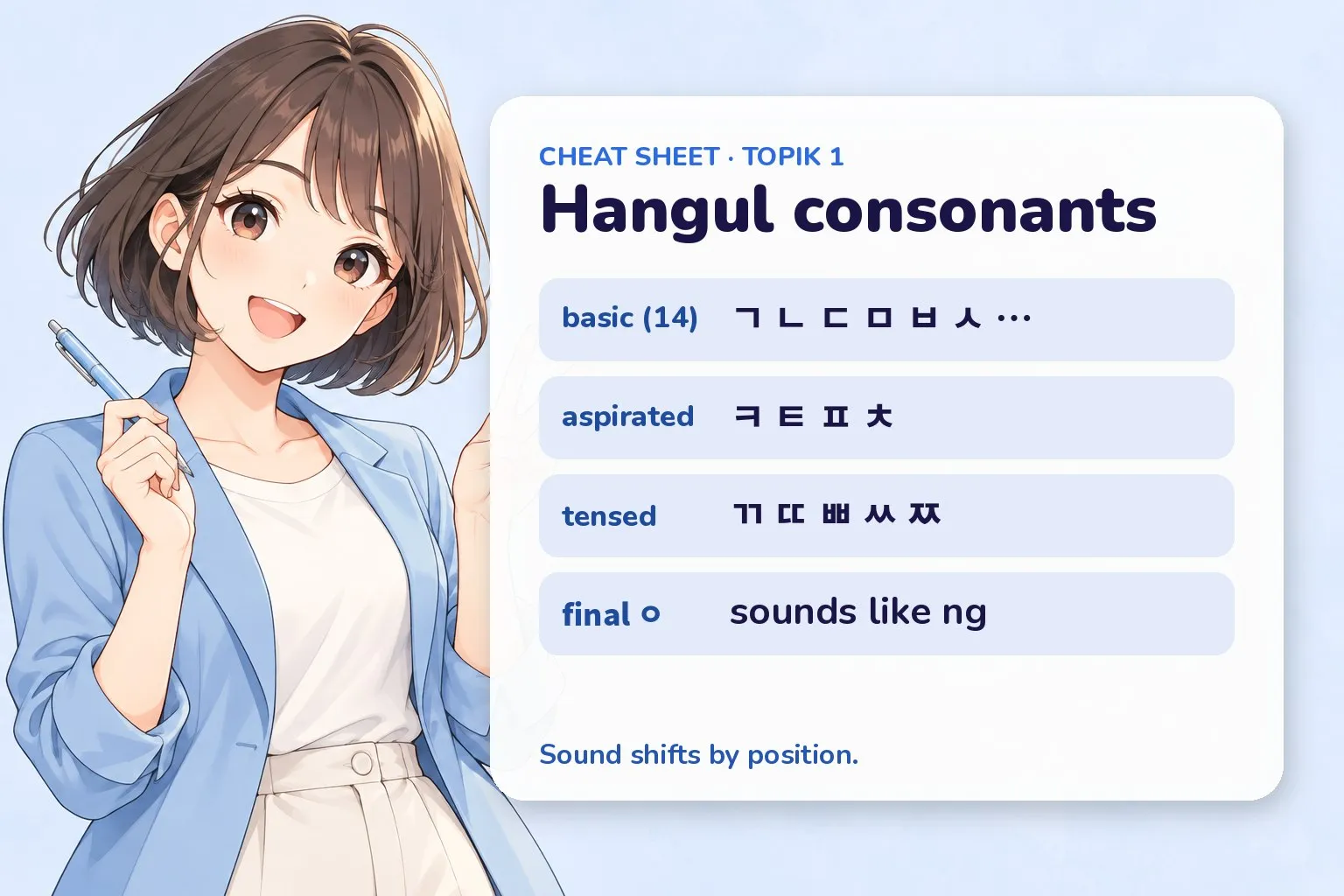
Quick recap before the quiz.
Quiz
Hangul consonants quiz
8 questions · pick an answer and you'll see straight away if it's right.
-
Show answer
19 — There are 19: 14 basic plus 5 tensed doubles.
-
Show answer
m — ㅁ (mieum) is 'm'.
-
Show answer
a strong puff of air — Aspirated letters release a strong puff of air.
-
Show answer
tight and sharp, made with a stiff mouth — Tensed letters are tight and clipped, not just louder.
-
Show answer
silent (a placeholder) — At the start ㅇ (ieung) is silent, holding the vowel's slot: 아 (a).
-
Show answer
a clipped k — As a batchim, ㄱ (g/k) is an unreleased 'k'.
-
Show answer
add a stroke — Adding a stroke gives the aspirated letter: ㄱ (g) → ㅋ (k).
-
Show answer
namu — ㄴ (n) + ㅏ (a) + ㅁ (m) + ㅜ (u) = namu, 'tree'.
Next
- Pair these with the vowels on Hangul vowels
- Hear whole syllable blocks in the Korean pronunciation overview
- Begin building sentences in the Korean grammar section or at Start Learning Korean Here
All Korean pronunciation & writing topics
Vocabulary, pronunciation, phrases, practice and exam help, ordered by level. Pick a topic and go straight to it. New lessons go live every day, so topics marked Coming soon fill in over the next weeks.
Pronunciation & writing
TOPIK 1 9 topics · 7 ready
- 01 Korean Pronunciation Overview
- 02 Hangul Vowels
- 03 Hangul Consonants You are here
- 04 Building Hangul Syllable Blocks
- 05 Batchim: Final Consonants
- 06 Tense (Double) Consonants
- 07 Complex Vowels & Diphthongs
- 08 Korean Romanization (Revised) & Its Limits Coming soon
- 09 How to Type Hangul (Keyboard Guide) Coming soon
TOPIK 3 2 topics · 2 ready
TOPIK 4 1 topics
- 12 Introduction to Hanja Coming soon