Batchim: Korean Final Consonants (7 Sounds)
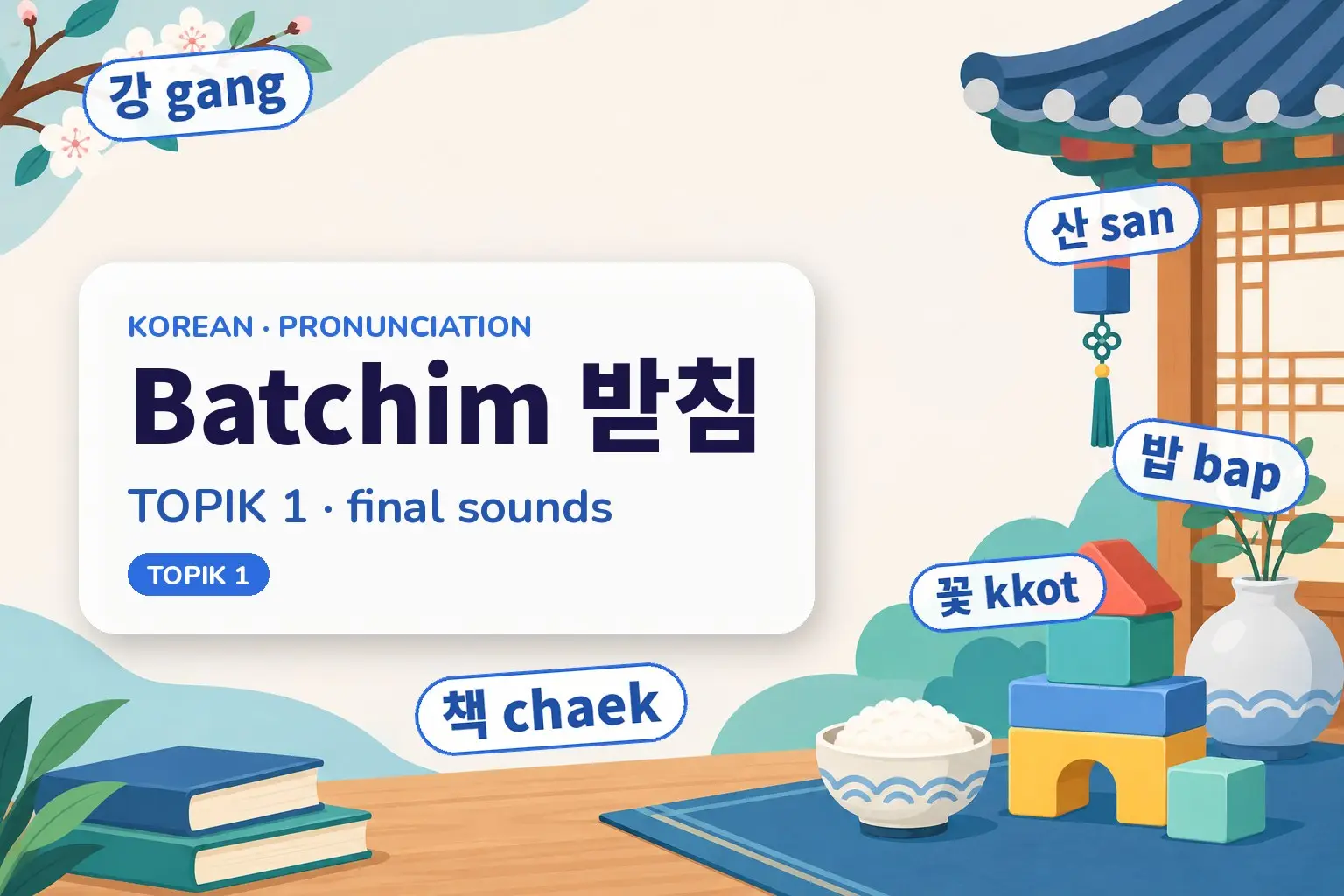
A batchim (받침, batchim) is the final consonant at the bottom of a Korean syllable block. Many letters can sit there, but in that position they collapse into just 7 sounds: ㄱ (k), ㄴ (n), ㄷ (t), ㄹ (l), ㅁ (m), ㅂ (p) and ㅇ (ng), each unreleased.
Level: TOPIK 1. You can already build a Hangul syllable block; now comes the sound that trips up most beginners — the consonant at the bottom of the block, the 받침 (batchim). Korean spelling allows many different letters down there, but in speech they shrink to only seven sounds. Learn those seven and your reading and listening both jump forward.
By the end of this page you can…
…name the seven representative final sounds, predict which batchim letter makes which sound, read a final consonant as unreleased, and carry a batchim across to the next vowel.
What a batchim is
A batchim, written 받침 (batchim), is the final consonant written at the bottom of a syllable block — the optional third slot after the initial consonant and the vowel. In 산 (san, “mountain”), the ㄴ (n) at the bottom is the batchim; in 밥 (bap, “rice / meal”), it is the ㅂ (p).
The key fact is that a final consonant is unreleased. In English we often let go of a final “p” or “t” with a little puff; in Korean the mouth simply closes on the sound and stops. 밥 (bap) ends with the lips pressed shut, no audible “puh” after it.
The seven representative sounds
However it is spelled, a batchim is pronounced as one of just seven sounds:
| Final sound | Letter(s) that make it | Example | Reading |
|---|---|---|---|
| ㄱ (k) | ㄱ, ㅋ, ㄲ | 책, 부엌, 밖 | chaek, bueok, bak |
| ㄴ (n) | ㄴ | 산 | san |
| ㄷ (t) | ㄷ, ㅅ, ㅆ, ㅈ, ㅊ, ㅌ, ㅎ | 옷, 꽃, 낮 | ot, kkot, nat |
| ㄹ (l) | ㄹ | 물 | mul |
| ㅁ (m) | ㅁ | 밤 | bam |
| ㅂ (p) | ㅂ, ㅍ | 밥, 앞 | bap, ap |
| ㅇ (ng) | ㅇ | 강 | gang |
The big group to remember is the ㄷ (t) sound: seven different letters — ㄷ (d), ㅅ (s), ㅆ (ss), ㅈ (j), ㅊ (ch), ㅌ (t) and ㅎ (h) — all land on the same unreleased “t” when they are the batchim. So 옷 (ot, “clothes”), 꽃 (kkot, “flower”) and 낮 (nat, “daytime”) all end the same way, even though they are written with ㅅ (s), ㅊ (ch) and ㅈ (j).
Liaison: the batchim moves to the next vowel
When the next syllable block begins with the silent ㅇ (ieung) — that is, with a vowel sound — the batchim slides over and is pronounced as the start of that syllable. This is why Korean particles seem to change the sound of a word:
- 밥 (bap) + 을 (eul) → read as 바블 (babeul), not “bap-eul”.
- 꽃 (kkot) + 이 (i) → read as 꼬치 (kkochi): the hidden ㅊ (ch) comes back.
- 옷 (ot) + 을 (eul) → read as 오슬 (oseul): the ㅅ (s) returns.
So the batchim shows its “true” letter only when a vowel pulls it across. On its own, at the end of a word or before another consonant, it stays one of the seven sounds.
Listen and read the batchim
Press play, then read each word aloud, closing firmly on the final sound.
- 밥baprice / mealㅂ = p, unreleased
- 책chaekbookㄱ = k
- 산sanmountainㄴ = n
- 물mulwaterㄹ = l
- 밤bamnight / chestnutㅁ = m
- 강gangriverㅇ = ng
- 옷otclothesㅅ sounds as ㄷ = t
- 꽃kkotflowerㅊ sounds as ㄷ = t
- 낮natdaytimeㅈ sounds as ㄷ = t
- 앞apfrontㅍ sounds as ㅂ = p
- 부엌bueokkitchenㅋ sounds as ㄱ = k
- 밖bakoutsideㄲ sounds as ㄱ = k
- 집jiphouseㅂ = p
- 빛bitlightㅊ sounds as ㄷ = t
- 꽃이kkochithe flower (subject)liaison: ㅊ moves to the vowel
- 밥을babeulrice (object)liaison: ㅂ moves over
Practice
Korean batchim practice
Try each one, then press Check. No sign-up, nothing is sent anywhere — it all runs in your browser.
Hint: the 'support' at the bottom
Show answer
batchim — The final consonant is the 받침 (batchim).
4 Match each word to its final sound.
- 밥 (bap)
- 책 (chaek)
- 산 (san)
- 강 (gang)
Show answer
- 밥 (bap) → ㅂ (p)
- 책 (chaek) → ㄱ (k)
- 산 (san) → ㄴ (n)
- 강 (gang) → ㅇ (ng)
Read each batchim as one of the seven representative sounds.
Hint: the hidden ㅊ (ch) comes back before the vowel
Show answer
kkochi — 꽃 (kkot) + 이 (i) joins as 꼬치 (kkochi).
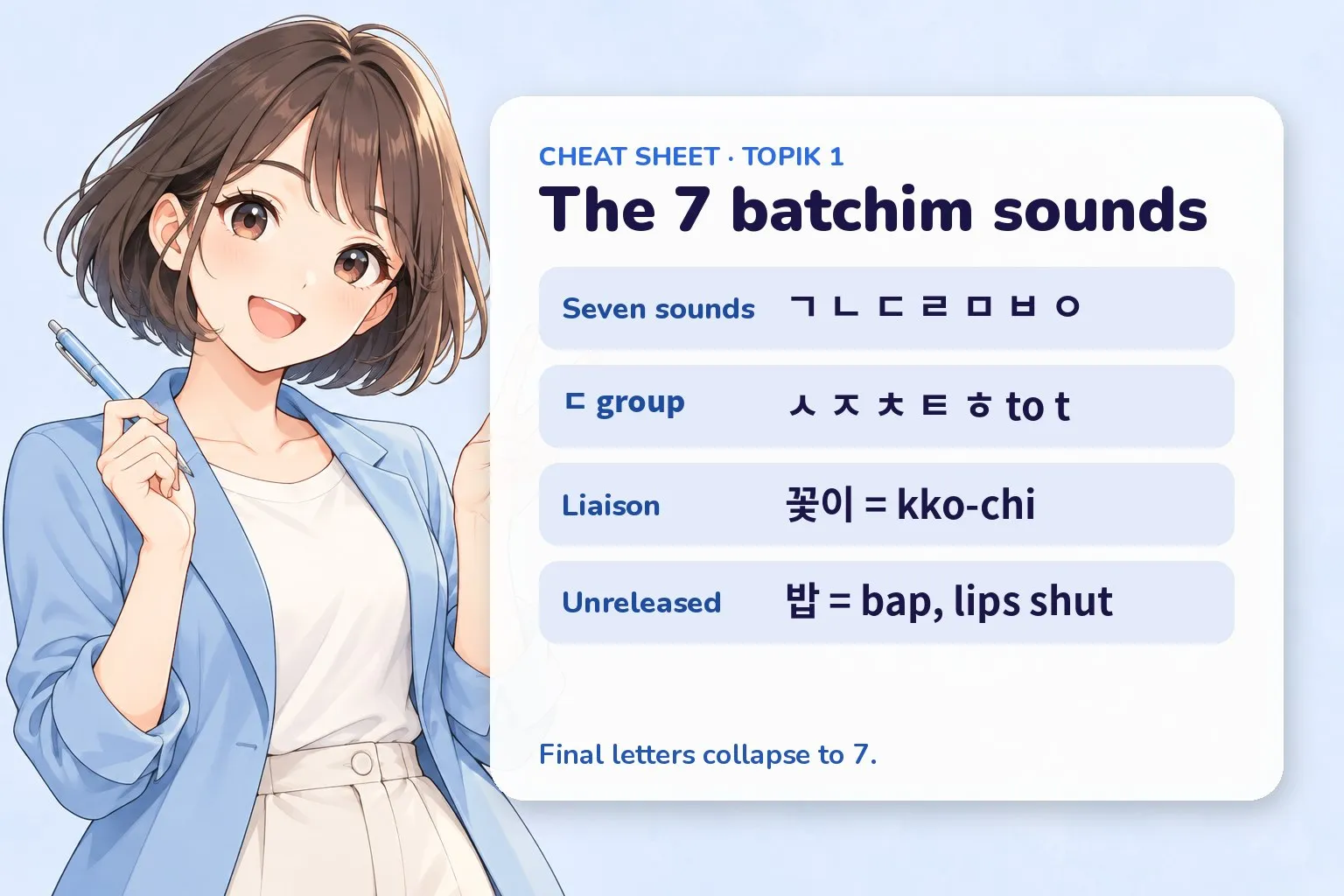
Quick recap before the quiz.
Quiz
Korean batchim quiz
8 questions · pick an answer and you'll see straight away if it's right.
-
Show answer
the final consonant at the bottom of a block — The batchim is the optional final consonant at the bottom of a syllable block.
-
Show answer
unreleased, the mouth closing on it — Finals are unreleased: 밥 (bap) ends with the lips shut, no puff.
-
Show answer
7 — Seven: ㄱ (k), ㄴ (n), ㄷ (t), ㄹ (l), ㅁ (m), ㅂ (p), ㅇ (ng).
-
Show answer
ㄱ (k) — Both collapse to the ㄱ (k) sound: 부엌 (bueok), 밖 (bak).
-
Show answer
ㅅ ㅈ ㅊ ㅌ ㅎ (t group) — ㄷ, ㅅ, ㅆ, ㅈ, ㅊ, ㅌ, ㅎ all become ㄷ (t) at the end.
-
Show answer
ng — ㅇ (ieung) as a batchim is 'ng': 강 (gang).
-
Show answer
kkochi — Liaison moves ㅊ to the vowel: 꼬치 (kkochi).
-
Show answer
ot — ㅅ as a batchim is ㄷ (t): 옷 (ot).
Next
- Revise how blocks are built in Hangul syllable blocks
- Hear the plain consonants in Hangul consonants
- Put words into sentences in the Korean grammar section or at Start Learning Korean Here
All Korean pronunciation & writing topics
Vocabulary, pronunciation, phrases, practice and exam help, ordered by level. Pick a topic and go straight to it. New lessons go live every day, so topics marked Coming soon fill in over the next weeks.
Pronunciation & writing
TOPIK 1 9 topics · 7 ready
- 01 Korean Pronunciation Overview
- 02 Hangul Vowels
- 03 Hangul Consonants
- 04 Building Hangul Syllable Blocks
- 05 Batchim: Final Consonants You are here
- 06 Tense (Double) Consonants
- 07 Complex Vowels & Diphthongs
- 08 Korean Romanization (Revised) & Its Limits Coming soon
- 09 How to Type Hangul (Keyboard Guide) Coming soon
TOPIK 3 2 topics · 2 ready
TOPIK 4 1 topics
- 12 Introduction to Hanja Coming soon