How to Practise Korean Writing
To practise Korean writing, climb in steps: copy and adapt correct model sentences, join them into short paragraphs, then run a feedback loop — compare your text with a model, mark the gaps (especially spacing and particles), and rewrite. Short, finished pieces beat long abandoned ones.
Level: TOPIK 3. Writing is the skill learners avoid longest, because it exposes every gap at once: grammar, spacing, particles and word choice. The cure is not talent but a routine — small, finished pieces you correct and rewrite. This page gives you one.
By the end of this page you can…
…build Korean writing up from sentences to paragraphs, run a feedback loop that fixes your real mistakes, handle spacing and particles, and keep a routine you can sustain.
Writing is an output skill
Reading and listening are input; writing is output, and output shows what you can actually produce, not just recognise. That is why it feels hard — and why it is the fastest way to find your real gaps. Each time you cannot write a word you thought you knew, you have found something worth studying.
Hangul is a strength here: it is a precise alphabet, so if you can say a word you can usually spell it. The traps are not the letters but spacing and particles, which carry the grammar.
Build up in steps
Do not jump straight to free writing. Climb a ladder:
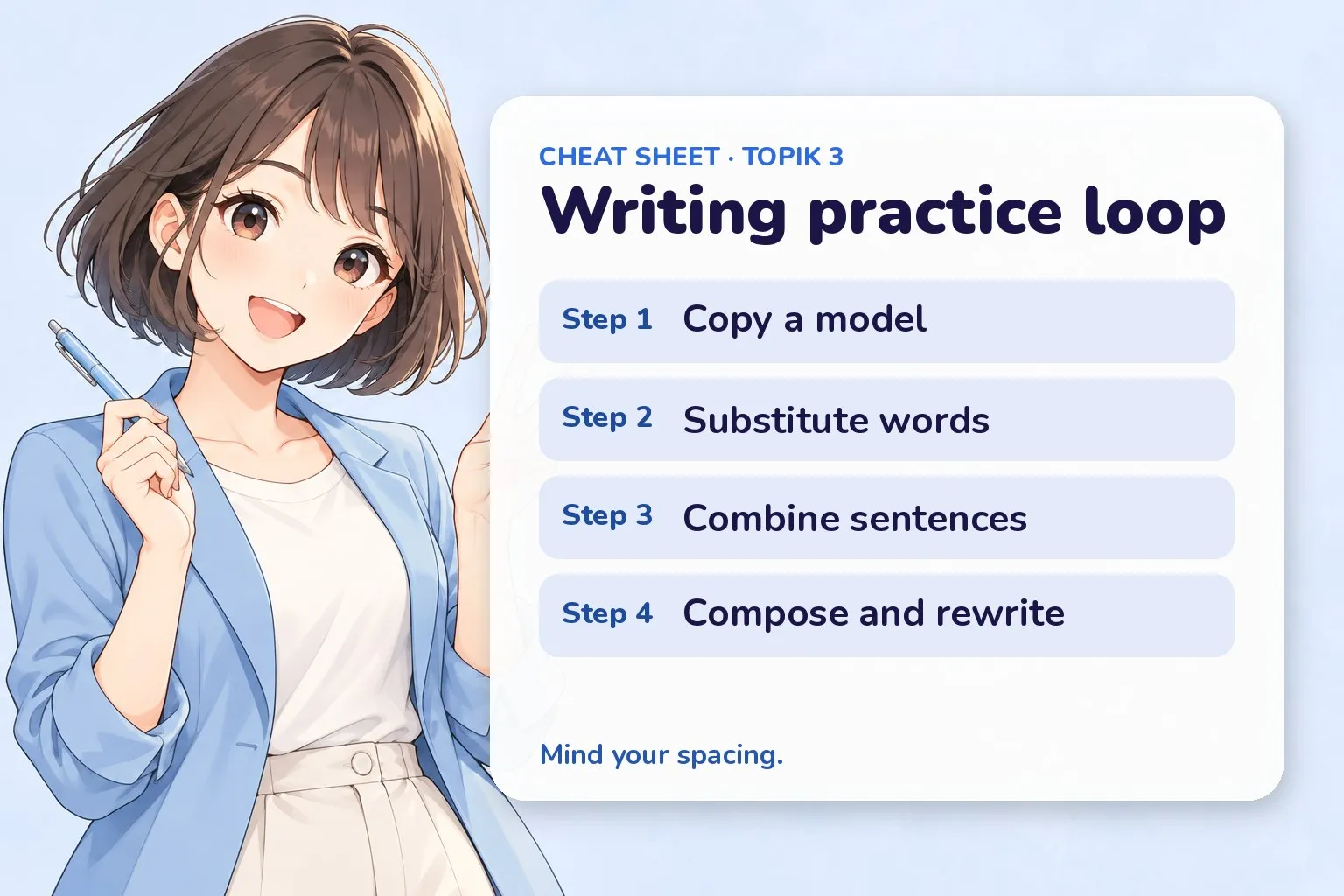
- Copy a correct model sentence exactly, spacing included.
- Substitute — swap one word for another you know: change the place, the time, the object.
- Combine two short sentences with a connector such as 그리고 (geurigo, “and”) or 그래서 (geuraeseo, “so”).
- Compose a short paragraph of four to six sentences on a familiar topic: your day, your town, your weekend.
Each rung reuses the grammar you are studying now, so writing doubles as review.
The feedback loop
Writing without correction just drills your mistakes. After each piece:
- Write your short text.
- Compare it line by line with a correct model or a corrected version.
- Mark every difference — a missing space, a wrong particle, an inconsistent ending — not only outright errors.
- Rewrite the whole piece correctly. The rewrite is where the learning lands.
Learn from model answers
Imitation is not cheating — it is how you absorb natural phrasing. Keep a small bank of correct model texts at your level (a diary entry, a self-introduction, a short message) and reuse their patterns with your own content. The example sentences below are model lines you can copy and adapt; each has its Revised Romanization so you can say it as you write it.
- 오늘 날씨가 좋아요.Oneul nalssiga joayo.The weather is nice today.a simple opening line
- 저는 아침 일곱 시에 일어났어요.Jeoneun achim ilgop sie ireonasseoyo.I got up at seven in the morning.
- 친구하고 도서관에서 공부했어요.Chinguhago doseogwaneseo gongbuhaesseoyo.I studied at the library with a friend.
- 점심에 김밥을 먹었어요.Jeomsime gimbabeul meogeosseoyo.I ate gimbap for lunch.
- 조금 피곤했지만 재미있었어요.Jogeum pigonhaetjiman jaemiisseosseoyo.I was a little tired, but it was fun.-지만 (-jiman) = but
- 내일은 쉬는 날이라서 푹 쉴 거예요.Naeireun swineun nariraseo puk swil geoyeyo.Tomorrow is a day off, so I'll rest well.-아서/어서 (-aseo/eoseo) = so
- 우리 동네는 작지만 조용해요.Uri dongneneun jakjiman joyonghaeyo.My neighbourhood is small, but it's quiet.
- 주말에 영화를 보고 싶어요.Jumare yeonghwareul bogo sipeoyo.I want to watch a film at the weekend.
- 요즘 한국어를 공부하고 있어요.Yojeum hangugeoreul gongbuhago isseoyo.Lately I have been studying Korean.
- 매일 조금씩 쓰기 연습을 해요.Maeil jogeumssik sseugi yeonseubeul haeyo.I practise writing a little every day.
A weekly writing routine
- Three short pieces a week, five to six sentences each, beat one long piece.
- Reuse this week’s grammar. If you are studying a verb ending or a particle, build your sentences around it.
- Mine a frequency list. The high-frequency words (for example the FrequencyWords lists) tell you which vocabulary to drill into your writing first.
- Keep a correction log. Write each mistake and its fix in one place and review it before the next piece, so the same error does not return.
Common writing mistakes
- Leaving out spacing — 띄어쓰기 (ttuieosseugi). Korean puts spaces between words; running them together is the top beginner error. Space after each noun-plus-particle chunk.
- Wrong particle choice. Pick 은/는 (eun/neun) and 이/가 (i/ga) by the final sound of the word: 은 (eun) and 이 (i) follow a final consonant, 는 (neun) and 가 (ga) follow a vowel.
- Mixing politeness levels. Keep one style within a piece — all 해요체 (haeyoche) or all 합니다체 (hamnidache) — not both.
- Spelling the final consonant by sound. A 받침 (batchim) may sound different from how it is written (final ㅅ (s), ㅈ (j), ㅌ (t) can all sound like a “t”); spell by the dictionary form, not by ear.
Practice
Korean writing-strategy practice
Try each one, then press Check. No sign-up, nothing is sent anywhere — it all runs in your browser.
2 Put the build-up ladder in order.
Show answer
copy a model sentence substitute a word combine two sentences compose a paragraph — Copy, substitute, combine, then compose.
Hint: 띄어쓰기 (ttuieosseugi)
Show answer
spacing — Korean requires spacing — 띄어쓰기 (ttuieosseugi) — between words.
5 Match each writing habit to its benefit.
- checking spacing
- feedback loop
- model texts
- correction log
Show answer
- checking spacing → fixes the top beginner error
- feedback loop → fixes mistakes instead of drilling them
- model texts → teach natural phrasing
- correction log → stops errors from returning
Each habit targets a different part of better writing.
Quick recap before you practise.
Quiz
Korean writing quiz
8 questions · pick an answer and you'll see straight away if it's right.
-
Show answer
output skill — Writing is output: it shows what you can actively produce.
-
Show answer
copy a correct model sentence — Copying correct models teaches natural structure before you compose.
-
Show answer
write, compare, mark, rewrite — Compare your text with a model, mark the gaps, and rewrite.
-
Show answer
missing spacing — 띄어쓰기 (ttuieosseugi) — Leaving out spaces between words is the top beginner mistake.
-
Show answer
이 (i) — A final consonant takes 이 (i); a final vowel takes 가 (ga).
-
Show answer
a finished five to six sentences — Short, finished, corrected pieces teach the most.
-
Show answer
keep one politeness style — Keep a single politeness level throughout a piece.
-
Show answer
to review past mistakes so they do not return — Reviewing logged mistakes stops the same error coming back.
Next
- Pair it with input: how to practise Korean reading
- Train your ear too: how to practise Korean listening
- Sharpen output aloud with shadowing
- Build the grammar you will write with in the Korean grammar section
- New here? Start with Start Learning Korean Here
All Korean practice topics
Vocabulary, pronunciation, phrases, practice and exam help, ordered by level. Pick a topic and go straight to it. New lessons go live every day, so topics marked Coming soon fill in over the next weeks.
Practice
TOPIK 1 3 topics · 1 ready
- 01 Korean Reading Practice: Beginner
- 02 Hangul Reading Fluency Practice Coming soon
- 03 Batchim Pronunciation Drills Coming soon
TOPIK 2 3 topics · 2 ready
- 04 How to Practise Korean Listening
- 05 Korean Reading Practice: Elementary
- 06 Korean Particles Review Set Coming soon
TOPIK 3 5 topics · 3 ready
- 07 Shadowing to Improve Korean Speaking
- 08 Korean Reading Practice: Intermediate
- 09 How to Practise Korean Writing You are here
- 10 Korean Honorifics Practice Set Coming soon
- 11 Korean Speech Levels Practice Coming soon