Korean Reading Practice: Intermediate
Intermediate Korean reading (TOPIK 3) means longer connected passages joined by endings like 아서/어서 (aseo/eoseo, 'because'), 지만 (jiman, 'but') and 면서 (myeonseo, 'while'). Read for the gist first, then reread to see how each clause links to the next.
Level: TOPIK 3. Intermediate reading is a real step up from beginner: the sentences are longer, and ideas join across clauses. The skill now is to follow how one clause relates to the next.
By the end of this page you can…
…read a short TOPIK 3 account of living alone in Seoul, follow the cause-and-contrast links between clauses, and answer questions about it.
How to read an intermediate text
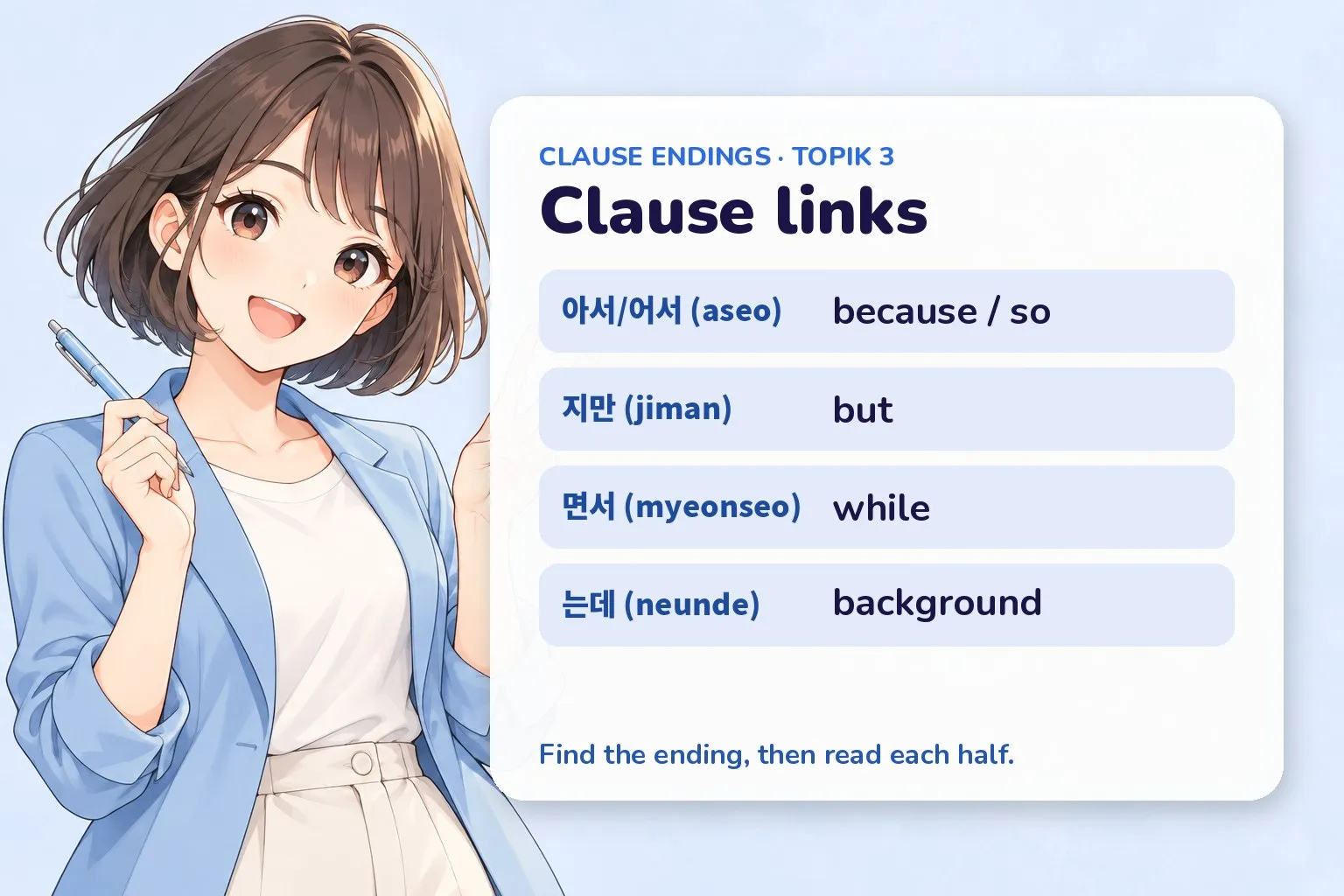
At this level, whole sentences hang together on clause endings. Learn to spot them and the long sentence falls into place: 아서/어서 (aseo/eoseo, “because/so”) gives a reason, 지만 (jiman, “but”) marks contrast, 는데 (neunde) gives background, and 면서 (myeonseo, “while”) shows two things at once. The verb at the end still carries the main action, so read to the end of the clause before deciding what it means.
The graded text
Read this short account one line at a time. Each line shows the Korean, its romanisation, and the English.
- 저는 작년부터 서울에서 혼자 살기 시작했어요.Jeoneun jangnyeon-buteo Seoul-eseo honja salgi sijakhaesseoyo.I started living alone in Seoul last year.살기 시작하다 = 'start living'
- 처음에는 아는 사람이 없어서 많이 외로웠어요.Cheoeumeneun aneun sarami eopseoseo mani oerowosseoyo.At first I had no acquaintances, so I was very lonely.없어서 (eopseoseo) = 'because there wasn't'
- 그래서 요리 수업을 들으려고 신청했어요.Geuraeseo yori sueobeul deureuryeogo sincheonghaesseoyo.So I signed up to take a cooking class.려고 (ryeogo) = 'intending to'
- 수업에서 여러 나라의 친구들을 만나게 되었어요.Sueobeseo yeoreo naraui chingudeureul mannage doeeosseoyo.In the class I came to meet friends from several countries.게 되다 = 'come to (happen)'
- 요리를 배우면서 한국어도 자연스럽게 늘었어요.Yorireul baeumyeonseo hangugeodo jayeonseureopge neureosseoyo.While learning to cook, my Korean also improved naturally.면서 (myeonseo) = 'while'
- 김치찌개는 조금 매웠지만 정말 맛있었어요.Kimchijjigaeneun jogeum maewotjiman jeongmal masisseosseoyo.The kimchi stew was a bit spicy but really delicious.지만 (jiman) = 'but'
- 수업이 끝난 후에 우리는 자주 같이 저녁을 먹었어요.Sueobi kkeunnan hue urineun jaju gachi jeonyeogeul meogeosseoyo.After class we often ate dinner together.ㄴ 후에 (hue) = 'after'
- 한국 생활이 쉽지는 않지만 점점 익숙해지고 있어요.Hanguk saenghwari swipjineun antjiman jeomjeom iksukhaejigo isseoyo.Life in Korea isn't easy, but I'm gradually getting used to it.지 않다 = negative; 지만 = 'but'
- 다음 달에는 친구들을 초대해서 직접 만든 음식을 대접하고 싶어요.Daeum darenaneun chingudeureul chodaehaeseo jikjeop mandeun eumsigeul daejeophago sipeoyo.Next month I want to invite my friends over and serve food I made myself.해서 (haeseo) = 'and so / by doing'
- 요리 수업 덕분에 서울 생활이 훨씬 즐거워졌어요.Yori sueop deokbune Seoul saenghwari hwolssin jeulgeowojyeosseoyo.Thanks to the cooking class, life in Seoul has become much more enjoyable.덕분에 (deokbune) = 'thanks to'
- 앞으로도 새로운 것을 계속 배우고 싶어요.Apeurodo saeroun geoseul gyesok baeugo sipeoyo.From now on too, I want to keep learning new things.
- 혼자 사는 것도 이제 괜찮아요.Honja saneun geotdo ije gwaenchanayo.Living alone is okay now, too.
Key vocabulary
These are some of the most useful intermediate words in the text.
| Word | Reading | English |
|---|---|---|
| 혼자 | honja | alone |
| 외롭다 | oeropda | to be lonely |
| 신청하다 | sincheonghada | to apply, sign up |
| 자연스럽게 | jayeonseureopge | naturally |
| 늘다 | neulda | to improve, increase |
| 익숙해지다 | iksukhaejida | to get used to |
| 초대하다 | chodaehada | to invite |
| 직접 | jikjeop | oneself, in person |
| 덕분에 | deokbune | thanks to |
| 훨씬 | hwolssin | much more |
Check you understood
- When and where did the writer start living alone? (In Seoul, last year.)
- Why did they feel lonely at first? (They had no acquaintances.)
- What did they sign up for, and why? (A cooking class, to meet people.)
- What improved while they were learning to cook? (Their Korean.)
- What does the writer want to do next month? (Invite friends over and serve food they made.)
Extension: read a little more every day
Once this passage feels easy, change the goal rather than the text at first: read it aloud for smooth rhythm, then cover the English and translate each line yourself, then retell the story from memory in your own words. When you are ready for new material, choose TOPIK 3 graded readers or simple blog-style diaries, and keep each session short. If you want to warm up on something gentler first, revisit the elementary reading passage.
Practice
Intermediate reading practice
Try each one, then press Check. No sign-up, nothing is sent anywhere — it all runs in your browser.
Hint: attaches to a verb stem
Show answer
jiman — 지만 (jiman) means 'but' and marks contrast.
3 Match each word with its meaning.
- 외롭다 (oeropda)
- 신청하다 (sincheonghada)
- 초대하다 (chodaehada)
- 덕분에 (deokbune)
Show answer
- 외롭다 (oeropda) → to be lonely
- 신청하다 (sincheonghada) → to apply
- 초대하다 (chodaehada) → to invite
- 덕분에 (deokbune) → thanks to
These are common TOPIK 3 words from the text.
Quick recap before you practise.
Quiz
Intermediate reading quiz
7 questions · pick an answer and you'll see straight away if it's right.
-
Show answer
reread a short passage with a new goal each pass — Reread a connected passage with a purpose each pass: gist, grammar, aloud.
-
Show answer
very lonely — 많이 외로웠어요 (mani oerowosseoyo) = 'I was very lonely'.
-
Show answer
because / so — 아서/어서 (aseo/eoseo) gives a reason: 'because / so'.
-
Show answer
friends from several countries — 여러 나라의 친구들을 만나게 되었어요 (yeoreo naraui chingudeureul mannage doeeosseoyo) = 'came to meet friends from several countries'.
-
Show answer
their Korean — 한국어도 자연스럽게 늘었어요 (hangugeodo jayeonseureopge neureosseoyo) = 'Korean also improved naturally'.
-
Show answer
but — 지만 (jiman) means 'but', marking contrast.
-
Show answer
they show how clauses relate (cause, contrast, 'while') — 아서/어서 (aseo/eoseo), 지만 (jiman) and 면서 (myeonseo) tell you how the halves of a long sentence relate.
Next
- Build the grammar behind the sentences in the Korean grammar section
- Warm up with the elementary text first: Korean Reading Practice: Elementary
- New here? Start with Start Learning Korean Here
All Korean practice topics
Vocabulary, pronunciation, phrases, practice and exam help, ordered by level. Pick a topic and go straight to it. New lessons go live every day, so topics marked Coming soon fill in over the next weeks.
Practice
TOPIK 1 3 topics · 1 ready
- 01 Korean Reading Practice: Beginner
- 02 Hangul Reading Fluency Practice Coming soon
- 03 Batchim Pronunciation Drills Coming soon
TOPIK 2 3 topics · 2 ready
- 04 How to Practise Korean Listening
- 05 Korean Reading Practice: Elementary
- 06 Korean Particles Review Set Coming soon
TOPIK 3 5 topics · 2 ready
- 07 Shadowing to Improve Korean Speaking
- 08 Korean Reading Practice: Intermediate You are here
- 09 How to Practise Korean Writing Coming soon
- 10 Korean Honorifics Practice Set Coming soon
- 11 Korean Speech Levels Practice Coming soon