Korean Reading Practice: Beginner
Beginner Korean reading means working through short, fully glossed texts built from the most common TOPIK 1 words. Read for the gist first, then reread for details, checking each word's romanisation and meaning before moving on.
Level: TOPIK 1. Reading at the beginner stage is not about speed or long texts. It is about short passages you can almost fully understand, read slowly and more than once, with every word’s romanisation in front of you. Hangul is phonetic, so once you can sound out the letters, reading practice is mostly about meeting the same common words again and again.
By the end of this page you can…
…read a short TOPIK 1 self-introduction, say each word, and answer simple questions about it.
How to read a beginner text
Three habits make beginner reading work. Keep the text short (a few sentences), reread it with a new purpose each time, and say the Hangul aloud so sound and meaning stick together.
The graded text
Read this short self-introduction one line at a time. Each line shows the Korean, its romanisation, and the English.
- 안녕하세요.Annyeonghaseyo.Hello.
- 저는 민수예요.Jeoneun Minsu-yeyo.I am Minsu.name
- 학생이에요.Haksaeng-ieyo.I am a student.role
- 서울에 살아요.Seoure sarayo.I live in Seoul.place
- 매일 학교에 가요.Maeil hakgyoe gayo.I go to school every day.
- 친구하고 점심을 먹어요.Chinguhago jeomsimeul meogeoyo.I eat lunch with a friend.
- 저녁에 집에서 책을 읽어요.Jeonyeoge jibeseo chaegeul ilgeoyo.In the evening I read a book at home.
- 만나서 반가워요.Mannaseo bangawoyo.Nice to meet you (closing).
Key vocabulary
These are some of the most common beginner words in the text.
| Word | Reading | English |
|---|---|---|
| 저 | jeo | I, me (polite) |
| 학생 | haksaeng | student |
| 서울 | Seoul | Seoul |
| 매일 | maeil | every day |
| 학교 | hakgyo | school |
| 친구 | chingu | friend |
| 점심 | jeomsim | lunch |
| 집 | jip | house, home |
| 책 | chaek | book |
| 읽어요 | ilgeoyo | read |
Check you understood
- Who is speaking, and what do they do? (A student named Minsu.)
- Where do they live? (Seoul.)
- How often do they go to school? (Every day.)
- What do they do in the evening? (Read a book at home.)
Extension: read a little more every day
Once this text feels easy, change the goal rather than the text at first: read it aloud for smooth rhythm, then cover the English and translate each line yourself. When you are ready for new material, choose graded readers or simple dialogues at the same level, and keep each session short.
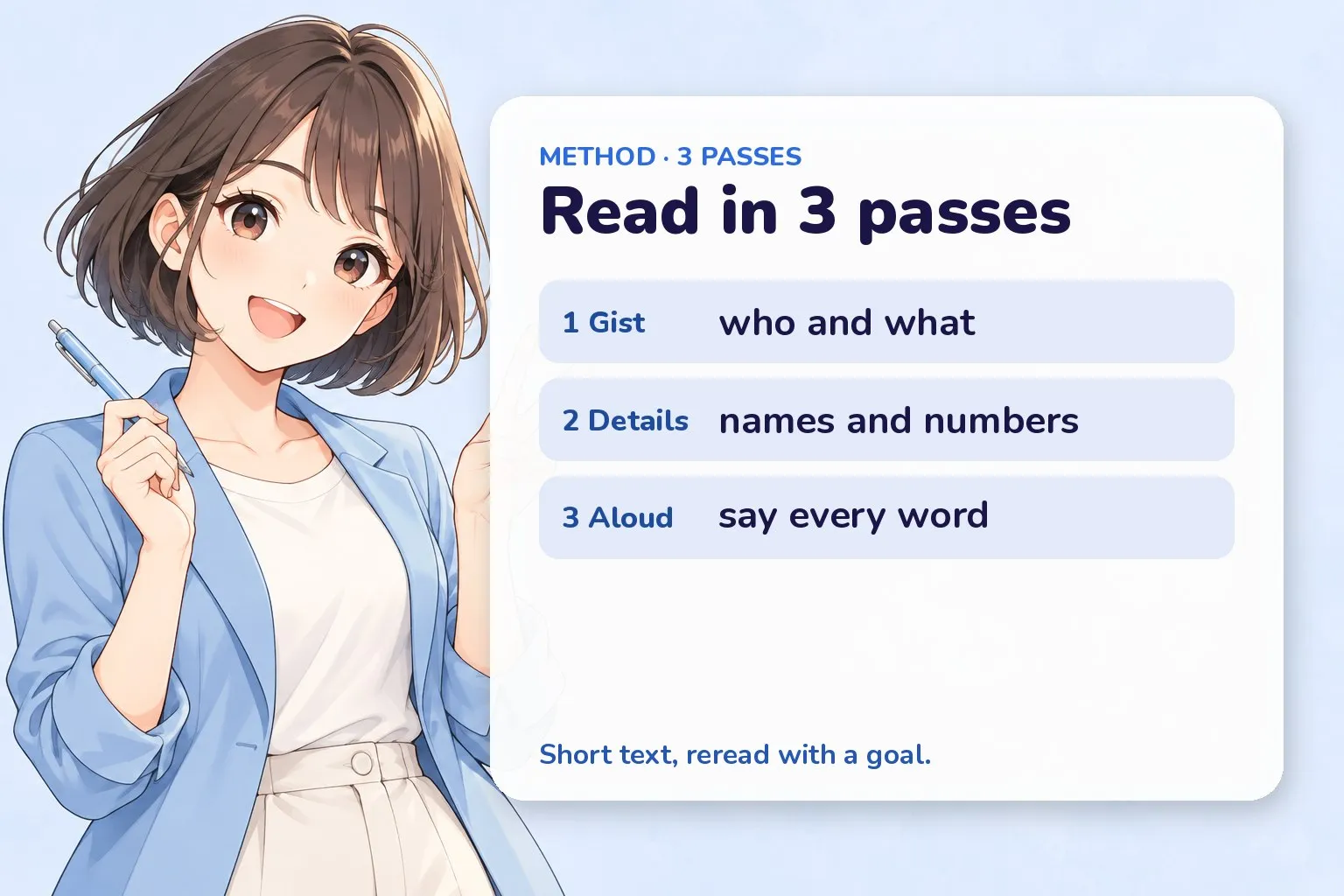
Quick recap before you practise.
Practice
Reading practice
Try each one, then press Check. No sign-up, nothing is sent anywhere — it all runs in your browser.
Hint: starts with h
Show answer
haksaeng — 학생 (haksaeng) means student.
3 Match each word with its meaning.
- 학교 (hakgyo)
- 친구 (chingu)
- 점심 (jeomsim)
- 책 (chaek)
Show answer
- 학교 (hakgyo) → school
- 친구 (chingu) → friend
- 점심 (jeomsim) → lunch
- 책 (chaek) → book
These are common TOPIK 1 words from the text.
Quiz
Beginner reading quiz
7 questions · pick an answer and you'll see straight away if it's right.
-
Show answer
reread a short text with a new goal each pass — Short texts, reread with a purpose, build beginner reading best.
-
Show answer
서울 (Seoul) — 서울에 살아요 (Seoure sarayo) = 'I live in Seoul.'
-
Show answer
student — 학생 (haksaeng) means student.
-
Show answer
a friend: 친구 (chingu) — 친구하고 점심을 먹어요 (Chinguhago jeomsimeul meogeoyo) = 'I eat lunch with a friend.'
-
Show answer
the gist — who and what — First pass for the gist, later passes for details and exact words.
-
Show answer
book — 책 (chaek) means book.
-
Show answer
the script is phonetic, so saying it fixes words faster — Hangul is phonetic, so reading aloud ties sound to meaning and speeds recall.
Next
- Build the grammar behind the sentences in the Korean grammar section
- Train your ear with How to Practise Korean Listening
- New here? Start with Start Learning Korean Here
All Korean practice topics
Vocabulary, pronunciation, phrases, practice and exam help, ordered by level. Pick a topic and go straight to it. New lessons go live every day, so topics marked Coming soon fill in over the next weeks.
Practice
TOPIK 1 3 topics · 1 ready
- 01 Korean Reading Practice: Beginner You are here
- 02 Hangul Reading Fluency Practice Coming soon
- 03 Batchim Pronunciation Drills Coming soon
TOPIK 2 3 topics · 2 ready
- 04 How to Practise Korean Listening
- 05 Korean Reading Practice: Elementary
- 06 Korean Particles Review Set Coming soon
TOPIK 3 5 topics · 2 ready
- 07 Shadowing to Improve Korean Speaking
- 08 Korean Reading Practice: Intermediate
- 09 How to Practise Korean Writing Coming soon
- 10 Korean Honorifics Practice Set Coming soon
- 11 Korean Speech Levels Practice Coming soon